

#Vermögensverwaltung #wealthmanagement | es twittert @chr_off | not investment advice
Zürich, Schweiz
Joined December 2017
- Tweets2K
- Following534
- Followers396
- Likes1.7K





great explainer 👇🏻
thanks for sharing

Okay, I think I understand the basics of datacenter economics and here's a thread to explain.
First, to build a data center, you need four things: compute (chips/GPU), land, water, and electricity. In other words, it's capital intensive and takes about 2 years to build. If you got land and water and no chips or no electricity, you got a problem.
Now, let's talk about scale and competitiveness. America is where it's happening. Why? The US got land (esp states like Texas etc), got natural resources like natural gas to power cheap electricity, and under Trump (before Blue Wave), got pretty willing investors and regulators, and finally, it got chips (Nvidia and also others). We'll talk about outside of America soon (Asia).
Okay, what is the scale we are talking about here?
32
Weissenstein & Partner retweeted

"I'm a portfolio manager at a $12 billion private credit fund.
I've been managing institutional capital for four years, and I'm proud to say we've never experienced a single default.
Disciplined underwriting. Rigorous covenant protections. Deep relationships with our private equity sponsors.
Also, we don't classify loans as defaulted if borrowers are still making interest payments.
And we're flexible about what constitutes an interest payment.
Let me give you an example. In 2021, we lent $180 million to a private equity-backed software company. Recurring revenue, mission-critical product. Beautiful business.
The sponsor paid 24 times adjusted EBITDA. We provided debt at eight turns.
Some people thought that was aggressive.
But we'd worked with the sponsor before. Very sophisticated people.
In 2023, EBITDA fell 35%. The company couldn't afford its interest payments anymore.
We agreed to let it pay us in kind.
For those unfamiliar with private credit, PIK means we add unpaid interest to the loan balance.
The company saves cash, and we earn more interest. Everybody wins.
Our loan grew to $197 million.
We marked it at 98 cents on the dollar.
The following year, EBITDA fell another 20%.
We provided a $35 million super-senior loan, extended the maturity by three years, and agreed to capitalize more interest.
The sponsor contributed $5 million in equity.
Strong alignment of interests.
Our discounted cash flow model assumed EBITDA would recover and the company would eventually sell for 18 times EBITDA.
We marked the loan at 96.
Conservative, in my opinion.
Last month, the company missed payroll.
We hired a restructuring adviser. $1,200 an hour. He concluded the company was insolvent.
I disagreed with his methodology.
We're now negotiating a debt-for-equity restructuring and considering transferring the loan to our affiliated opportunistic credit fund.
Our original fund can exit the investment. Our opportunistic fund gets exposure to a promising turnaround.
Everybody wins again.
People from traditional banking backgrounds sometimes struggle with private credit. Me? I love it.
Anyway, our fund just reported another quarter of positive returns.
Four years without a default.
I received my annual bonus last Friday. Cash, obviously.
I'm not an idiot."

Make sure your investors are not bolting while you attempt to keep going..
#OpenAI will keep investing in AI data centers despite election results, CFO tells CNBC
cnbc.com/2026/11/06/open-ai-…

1
95


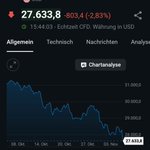
#NDX -11% in einem Monat.
Was ist eigentlich der aktuelle Stand beim geplanten #Anthropic IPO?

1
1
110
Obliterated, for once a word describing the facts properly

Trump’s American slapdown for the ages ft.trib.al/HYZSxM4

36
Wahrscheinlich eines dieser Statements aus der Kategorie "nicht gut gealtert" - wann, ist noch offen, aber eher nicht zu vermeiden.

1
43
says the owner of the house 🤡


Under @POTUS, the United States is showing the world what real economic growth looks like.
With just around 4% of the world’s population, we produce 26% of global nominal GDP. Our firms lead the G20 in productivity. And more than 60 of the world’s 100 most valuable companies are American.
Two hundred and fifty years after America’s founding, our best days are the ones we are still building.
38


Scott "The House" Bessent: "I have asymmetric Information"
🤡
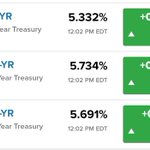
Interest rates on US 30-year mortgages topped 7% for the first time in almost two years. ft.trib.al/JaRKuPD

53
Eine kleine Marktbeobachtung: Der Dow Jones Transportation Average fällt seit Wochen deutlich zurück.
Früher wurde der Transport aufmerksam verfolgt. Die Logik war simpel: weniger Güter bewegt = schwächere Konjunktur. Zuerst sichtbar bei Eisenbahnen, Truckern, Paketdiensten und Airlines. In einer dienstleistungs- und technologiegeprägten Wirtschaft hat der Index aber einiges von seiner Bedeutung verloren.
Trotzdem lohnt sich vielleicht wieder ein Blick darauf. Hohe Dieselpreise belasten die Branche und erklären einen Teil der Schwäche. Gleichzeitig steigen aber die Zinsen, Finanzierungskosten nehmen zu und die Transporttitel stehen relativ breit unter Druck.
Ein verstaubter Konjunkturindikator, oder ein Frühwarnsignal, das man im Auge halten sollte?
#DJT #Transports #UPS #Airlines #Freight #Trucking

49
Weissenstein & Partner retweeted

You can say what you want about Iran but they're definitely pretty unique in their communication: never seen a country threaten another with a math equation before 😅
For those who didn't get it: there is a famous monetary policy formula used by the Fed called the "Taylor rule" that says a central bank's policy rate (i) should equal the neutral real rate (r*) plus target inflation (π*), plus 1.5 times the inflation gap and 0.5 times the output gap (the "i = r* + π* + 1.5(π−π*) + 0.5(y−y*)" part of Ghalibaf's formula).
Ghalibaf adds α(SOH−SOH*) and β(BEM−BEM*): SOH referring to the Strait Of Hormuz and BEM to Bab El-Mandeb. Both have positive coefficient, meaning the more those chokepoints are choked, the higher the rate the Fed would have to set to fight the resulting inflation.
In a nutshell this is Ghalibaf trolling the Fed, telling them that Iran is - in a very real way - setting American monetary policy.

Blasen entstehen nicht nur an der Börse - sie landen auch in Bilanzen linkedin.com/pulse/blasen-en… via @LinkedIn
24
Weissenstein & Partner retweeted

The accounting creativity Anthropic is employing to grease the IPO wheels is staggering. In the wake of releasing my new report on "The AI Trade" (sageroadresearch.com/product…), some clients and prospects have cited Anthropic's profitability as a counter point to my analysis of AI's inadequate enterprise adoption and unit economics. Yet, the claims Anthropic has had two profitable quarters in row is predicated on excluding stock-based comp, revenue sharing with distribution partners, and training costs. At SpaceX, training costs alone exceed revenue. To quote MarketWatch:
"A published report that pioneering artificial-intelligence lab Anthropic was profitable for the second quarter in a row includes a very important caveat...Adjusted operating income excludes stock-based compensation, which is not unusual for technology companies. However, the report also said the company’s gross margins — above 80% — exclude revenue shared with distribution partners, as well as the cost of training its models...Training costs can be massive. At SpaceX, which admittedly is behind OpenAI and Anthropic in attracting users, the AI segment’s research-and-development costs of $2.03 billion in the second quarter outpaced its $1.47 billion in revenue."
As for SBC, while its exclusion may be more typical, it's no less material. To quote my report: "Tech giants exclude stock-based-comp from their reported FCF, which is particularly concerning given the billions shelled out to AI engineers in recent years. That bill will eventually come due in the form of deferred taxes and buybacks to prevent dilution for shareholders. As The WSJ’s Jonathan Weil calculated earlier this year, Meta’s cash flow from operating activities in 2025 would have been 96% lower if SBC were considered in reported numbers."
Learn more about Sage Road Research here: sageroadresearch.com/. Interested in subscribing? Message me.
MarketWatch link: marketwatch.com/story/the-ve…

Weissenstein & Partner retweeted

Für die @SNB_BNS ist jetzt der perfekte Zeitpunkt gekommen, ihre Bilanz schrittweise zu verkürzen. Die deutlichen Kursgewinne auf US- und europäischen Aktien sowie die reale Aufwertung von USD und EUR gegenüber dem CHF verschaffen den Spielraum, Bilanzrisiken zu reduzieren.
agreed, uncomfortable observations regarding the US Treasury Secretary.

There is a nauseating mix of arrogance, hubris, denialism, refusal to face up to needed reforms, wrong belief systems (market is wrong), attempts at gaslighting & intimidation, basic misunderstanding of the bond markets mechanics. and ultimately incompetence and impotence
2/2
1
76
Weissenstein & Partner retweeted

Bessent thought he could use the USTreasury as a hedge fund, but if he can’t bring the market with him or increase leverage beyond $40 trillion, the strategies aren’t going to work.
The president had 6 bankruptcies.
The Treasury Secretary had 2 losing hedge funds.
Markets are rightly wary.


Weissenstein & Partner retweeted

"Once the market understands the fundamentals, I'm sure it will agree with us" -- Bessent
In my years working/investing on/in Argentina, it was always a sell signal when the Economy Minister would tell investors who didn't want to buy his bonds bc of the policy mix "No, es que el mundo nos tiene que entender". Pretty much every Argentine econ minister said this.
Bottom line: When you're trying to sell your bonds to the market, it's you who has to understand the market, not the market that has to understand you.
SpaceX IPO, Aschenbrenner, $500'000'000'000 Private Market Deal - the top of this epic bubble is closing in.
Anthropic, OpenAI on the way..
💣

If this $500 billion in Nvidia deal goes through, it may be the largest private-market financing on record. It would match the expected total bond sales from tech-related firms for the entirety of 2026. The race for capital is still accelerating. ft.com/content/98a8fd17-15b6…

2
150