

Wiktor Soral retweeted

📢 Just published! In the chapter "The Political Psychology of Vaccination" @mariababinska, @WiktorSoral and @Michal_Bilewicz explore how political ideology, feelings of control, and conspiracy beliefs shape attitudes toward vaccines and public health. doi.org/10.1007/978-3-032-18…

Excited to finally share results of one of my most important research projects: The emotional drivers of hate speech: Unpacking the central role of contempt in derogatory communication tandfonline.com/doi/full/10.…

Also, if you are attending #ISPP2025 consider joining our Friday session on hate speech.

Wiktor Soral retweeted
O tym, jak emocje są wykorzystywane podczas kampanii i czy trudno jest uniknąć głosowania pod wpływem emocjii, w Podcaście @DemagogPL opowiada dr @WiktorSoral. demagog.org.pl/podcast/chaos…

Wiktor Soral retweeted
Uczucia Demokratów wobec Republikanów są dziś bardziej
negatywne niż uczucia Republikanów wobec Demokratów. Nowy raport @paulina__gorska, Anny Czerwińskiej, Martyny Pałys, Macieja Górskiego i Wojciecha Podsiadłowskiego już na stronach @CenterUw.
cbu.psychologia.pl/wp-conten…

Wiktor Soral retweeted
Control threat makes moral reasoning more utilitarian only under conditions promoting more careful processing of dilemmas. New research from @Sindhuja121, @WiktorSoral, Karol Lewczuk and Mirek Kofta in #BJSP!
bpspsychub.onlinelibrary.wil…

Wiktor Soral retweeted
New article from @WiktorSoral, Maciej Bieńkowski and @Michal_Bilewicz in #SocialPsychology shows that hate speech most often targets groups that are perceived as inferior and disrespected, and thus – potentially – more dehumanized and less empathized with.
econtent.hogrefe.com/doi/ful…

Wiktor Soral retweeted

#Podcast #NewsalboFakeNews z @RadiowaTrojka, tym razem o teoriach spiskowych, m. in. o... teorii płaskiej Ziemi. Rozmowa z @andrzejkozl (@NASK_pl), dr @WiktorSoral (@UniWarszawski) oraz dr @chemicznykrakus #podcasty #fakenews @CYFRA_GOV_PL
podcasty.polskieradio.pl/tra…
Wiktor Soral retweeted
Co się dzieje, gdy ludzie tracą pracę i przez dłuższy czas nie są w stanie znaleźć nowej? O tym w nowym artykule @WiktorSoral i wspolpracownikow na łamach Journal of Personality. 🧵👇
doi.org/10.1111/jopy.12967

Wiktor Soral retweeted

.@eyeslasho once again demonstrating his stupidity. The PCA plots shown here do not support the idea for a "biological basis for race". On the contrary, they nicely illustrate how human genetic variation is clinal and doesn't cluster into non-continuous groups.


Wiktor Soral retweeted

If 2 out of 3 studies are significant, is this convincing?
Researchers 1) underestimate how common mixed results are in a set of studies, and 2) underestimate the strength of evidence in favor of H1.
2 out of 3 is common, and strong evidence for H1!
lakens.github.io/statistical…

Wiktor Soral retweeted
New article shows Bayes factors are massively misused: journals.sagepub.com/doi/10.… Recommends updating teaching material - which I already have done in my free textbook lakens.github.io/statistical… But, from next year, I will also stop teaching Bayes factors.

Wiktor Soral retweeted

Incredibly, the placebo effect is (mostly) not real.
It is a result of statistical confusion. Whenever you have a group with extreme values, they tend to exhibit regression to the mean. Eg. on average, sick people tend to become more healthy over time.
Thus if you give one group medicine, and one group placebo, the placebo group will also tend to get better over time, because of regression to the mean.
People have then misinterpreted this to think that it is the placebo pill that actively does this.
If you want to demonstrate a placebo effect, you have to construct a study where there are three groups:
• A. treatment
• B. placebo
• C. no treatment, no placebo
If B and C get different outcomes, that would demonstrate a placebo effect.
When this has been tried, mainly there has been no provable placebo effect. See the paper in the screenshot. (There is some evidence for an effect for pain, but this get's into a slightly different debate.)
The fact that the placebo effect is mainly not real, fortunately frees us from having to come up with convoluted explanations, as to why the placebo effect would work even when we tell the patient that it is a placebo, as in the quoted tweet.


Wiktor Soral retweeted

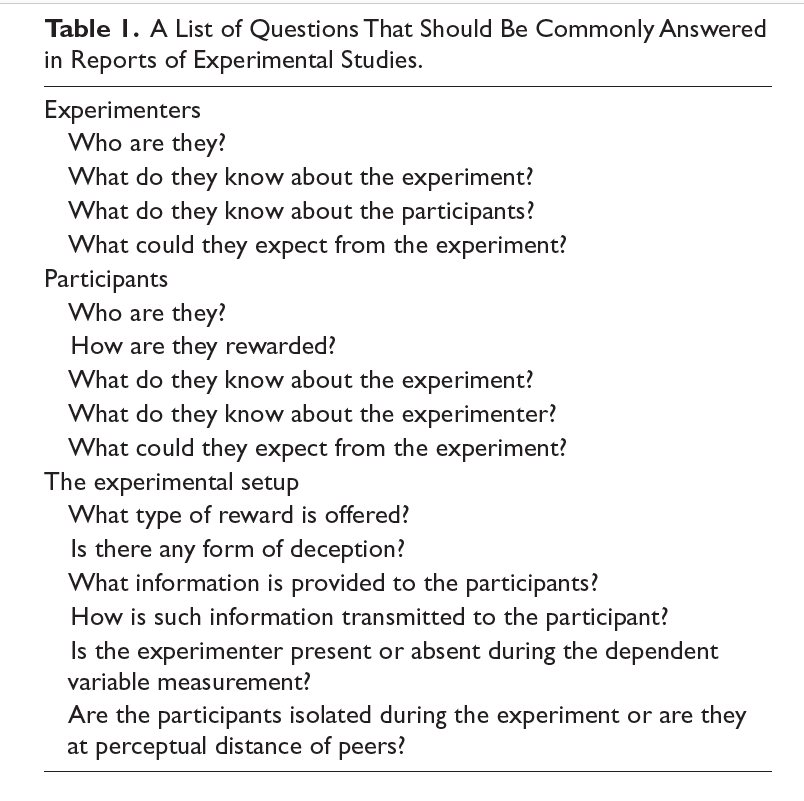
Some questions to ask when conducting or reviewing psychology studies, from Klein et al. (2012): doi.org/10.1177/174569161246…
Wiktor Soral retweeted

If you are still at the #easp2023krk on Tuesday evening, and not completely bored with research on conspiracy beliefs, come to listen about the relations between secondary traumatic stress and conspiracy theories (a talk co-authored with @WiktorSoral, Main Auditorium, 17:50).

Wiktor Soral retweeted
"The role of right-wing authoritarianism in support for populist leaders". A new chapter from @MIKK_WINIEWSKI and Maciej Bieńkowski in @routledgebooks volume "The Psychology of Politically Unstable Societies” (eds. Anna Kende and @barbaralastic).
routledge.com/The-Psychology…

Wiktor Soral retweeted

Quarto offers a myriad of features, some of which are especially useful for academics! In this 20-minute video, @minebocek walks you through some of these features that she uses almost daily for writing papers and teaching #rstats.
quarto.org/docs/blog/posts/2…
To całkiem miły prezent, choć success rate trochę jednak przeraża.

Wyniki #OPUS 24 i #SONATA 18 ‼️
Laureatki i laureaci reprezentujący wszystkie dziedziny nauki otrzymają niemal 520 mln zł na realizację 363 projektów badawczych z zakresu badań podstawowych.
Gratulujemy 🥳
Szczegóły ➡️ ncn.gov.pl/aktualnosci/2023-…

ALT Zdjęcie przedstawia ulotki konkursów OPUS i SONATA, utrzymane w kolorach czerwieni i szarości.
Wiktor Soral retweeted

Should I stay or should I go?
@dbulska with a few words about doing research abroad.
bps.org.uk/psychologist/shou…

Wiktor Soral retweeted
Two articles by @CenterUw researchers and collaborators in the new #PAC special issue dedicated to Emile Bruneau. Both report real-life interventions reducing antisemitism and anti-immigrant attitudes.

📢 New Research Available 📢
We are delighted to announce that new #PAC Journal research is now available to read from:
"Putting science to work for peace: A special issue in honor of Emile Bruneau"
Check it out:
psycnet.apa.org/PsycARTICLES…
(1/3)


