







Adam retweeted

LlamaRisk team is attending @chainlink’s LINK:NYC this week.
If you’re an asset issuer, protocol team, institution, or just want to talk risk management, dm our CEO @WormholeOracle or COO @simonb_defi to book time.


Adam retweeted
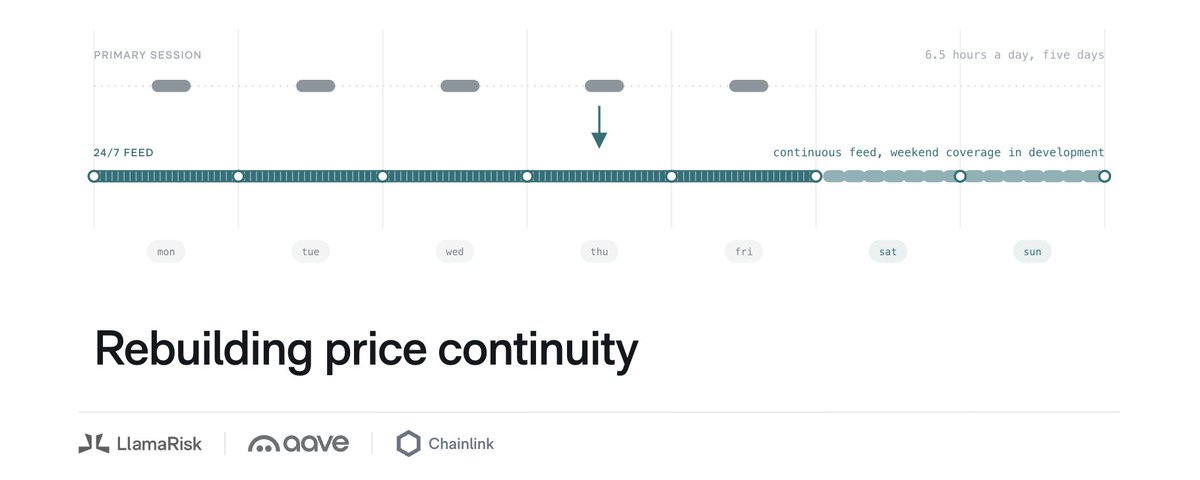
A price that exists is not a price you can lend against.
Weekend markets now price major US stocks, but off-hours books are often thin. Before a weekend price secures credit, it has to resist manipulation and come from venues with real depth behind the quote.


Adam retweeted
Today the SEC issued a five-year conditional exemption letting tokenized NMS stock trade onchain in the US: temporary relief from the exchange and dealer definitions, plus a request for comment. Effectively a sandbox, and a well-designed one. With important conditions:
🟩 A qualifying venue must halt a token concurrently with any halt in the underlying stock on its primary listing exchange.
🟩 Contracts must be public, auditable, and deployed on permissionless ledgers.
🟩 Venues must verify tokens carry the same rights and privileges as the share. Synthetics don't qualify.
🟩 Venues must publish prices, trade sizes, timestamps, pool addresses and daily volumes.
That reads like a spec for session-aware, transparent market structure. It's the spec we've been engineering to for tokenized equities on @aave, built with @chainlink, whose feeds already tell a protocol not just the price but the market state it was formed in.
For onchain credit, this builds the missing layer. SEC-permissioned venues making markets in full-rights tokenized blue chips means growing onchain depth to price against and exit into. Those are the two things a lending market needs from its venue layer.
Regulation and risk architecture are converging on the same design. Tokenized equities are getting real market structure. Aave is where it becomes a credit market.


Adam retweeted
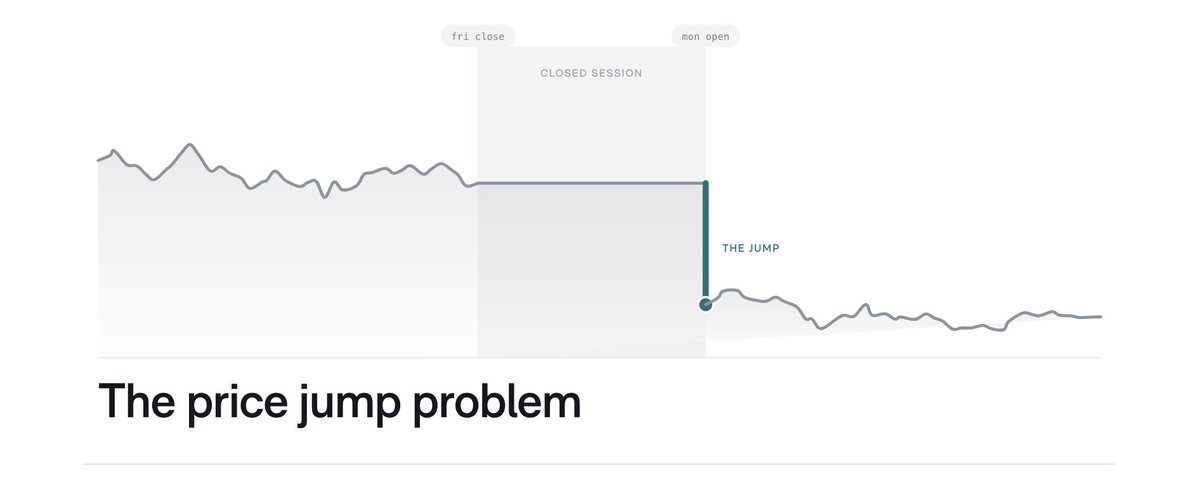
Equities have 32.5 regular trading hours a week. Onchain lending runs 168.
Price data doesn't stop outside those hours; 24/5 feeds exist and overnight venues trade. But regular hours carry the vast majority of volume, depth thins sharply once they end, and the primary markets sit closed all weekend. Information keeps arriving; reliable prices get harder to come by.
That gap tends to clear at Monday's open in one large step, and large single steps are what liquidation engines struggle with.
The price jump problem, in full:
Adam retweeted
Tokenized credit is being proposed as collateral on @aave Horizon. Our review of HINC, Neuberger Berman’s high-income credit fund tokenized by @securitize, covers its legal structure, redemption path, technical controls, risk parameters, and listing conditions.
Full review: governance.aave.com/t/arfc-o…

Adam retweeted

Better @pendle_fi PT risk management can become a massive growth lever for @Aave and Aave DAO's revenue.
By June 2025, roughly $1.6B of PT-sUSDe-31JUL2025 had been deposited on Aave, representing around 3/4 of the token's entire supply.
But PTs create a difficult tradeoff for lending protocols:
> Price them too aggressively and the protocol takes additional liquidation risk
> Price them too conservatively and users get less borrowing power, making Aave a less attractive venue for PT leverage
LlamaGuard PT improves that equation.
Instead of using the same conservative assumptions throughout the PT's lifecycle, its valuation and liquidation parameters can dynamically adjust as its risk changes approaching maturity.
This means Aave can give the same collateral more borrowing power while keeping risk parameters aligned with what liquidators could actually recover.
That's important because better risk infrastructure doesn't only protect Aave's users, but it also allows Aave to support more complex collateral, make that collateral more capital efficient, and potentially attract more borrowing activity as a result. Ultimately, generating more revenue for Aave DAO.
As the types of financial assets coming onchain expand, risk management increasingly becomes part of Aave's competitive advantage. Especially given how flexible V4 is.
I really like the direction that @StaniKulechov and team are pursuing, and the current synchrony among key service providers such as Aave Labs, @LlamaRisk, @Token_Logic and @chainlink.

This is a very interesting upgrade to @Aave's risk infrastructure.
@LlamaRisk just launched LlamaGuard PT on Aave, a new risk oracle for Pendle PTs built on @Chainlink CRE.
PT-srUSDe is the first market to use it.
Pendle PTs have a predictable lifecycle: they trade at a discount and converge toward par as they approach maturity, while their risk profile changes along the way.
Using a fixed pricing model means accounting for the riskiest point throughout the PT's entire life, which can leave borrowing capacity on the table.
LlamaGuard is tackling the above problem by using time to maturity and the PT's live price path to dynamically determine its oracle valuation and adjust parameters including borrowing power, liquidation thresholds, and liquidation bonuses.
This gives the same collateral having more borrowing power while keeping liquidation parameters aligned with its changing risk profile.
LlamaGuard PT:
> Is built by LlamaRisk
> Is owned by Aave Governance
> Runs through Chainlink CRE
Aave owns the contracts and can independently verify the workflows and every change made by the system, creating a path to support increasingly complex collateral with more granular risk management and better capital efficiency.
It also expands the role of oracles beyond simply answering "what is this asset worth?", now allowing protocols to determine how an asset should be treated based on liquidity, volatility, maturity, and other real-time risk signals.
This is extremely convenient as DeFi starts supporting more complex financial products and new financial primitives come along.
Adam retweeted
This is a very interesting upgrade to @Aave's risk infrastructure.
@LlamaRisk just launched LlamaGuard PT on Aave, a new risk oracle for Pendle PTs built on @Chainlink CRE.
PT-srUSDe is the first market to use it.
Pendle PTs have a predictable lifecycle: they trade at a discount and converge toward par as they approach maturity, while their risk profile changes along the way.
Using a fixed pricing model means accounting for the riskiest point throughout the PT's entire life, which can leave borrowing capacity on the table.
LlamaGuard is tackling the above problem by using time to maturity and the PT's live price path to dynamically determine its oracle valuation and adjust parameters including borrowing power, liquidation thresholds, and liquidation bonuses.
This gives the same collateral having more borrowing power while keeping liquidation parameters aligned with its changing risk profile.
LlamaGuard PT:
> Is built by LlamaRisk
> Is owned by Aave Governance
> Runs through Chainlink CRE
Aave owns the contracts and can independently verify the workflows and every change made by the system, creating a path to support increasingly complex collateral with more granular risk management and better capital efficiency.
It also expands the role of oracles beyond simply answering "what is this asset worth?", now allowing protocols to determine how an asset should be treated based on liquidity, volatility, maturity, and other real-time risk signals.
This is extremely convenient as DeFi starts supporting more complex financial products and new financial primitives come along.
The first protocol-owned risk oracle is live on @aave.
Built by LlamaRisk.
Powered by the @chainlink Runtime Environment (CRE).
Owned by Aave.
It dynamically manages Pendle PT collateral risk. First on Aave v3 Ethereum. Coming soon to all Aave PT markets.
Let's gho 👻
Adam retweeted
The AIP to activate LlamaGuard PT is live for voting on @aave governance.
What a yes vote brings:
→ PT collateral parameters recomputed continuously, every move bounded by on-chain limits
→ Designed for predictable, gradual re-rates. No cliffs
→ A liquidation threshold that rises as the asset de-risks toward maturity
→ A workflow Aave owns, can verify, and can revoke at any time
This is the vote that turns risk management into protocol infrastructure.
Read and vote: app.aave.com/governance/v3/p…
Adam retweeted
Congratulations to the Tydro team on v2, with fixed-rate borrowing, isolated markets, and Kraken custody, built for institutions.
We work with Tydro on their risk perimeter: parameters, asset DD, monitoring, incident response, with the same standards we hold across the Aave ecosystem.
Good day for onchain credit.

Adam retweeted
Before a PT listing reaches the forum, a lot has to already be in place.
For PT-AUSD on Monad and PT-USDG on X Layer, that meant:
✅ Pendle deployed on the chain
✅ Yield rebated into the wrapper (neither AUSD nor USDG pays holders by default)
✅ Pool seeded deep enough to trade
✅ Underlying already live as an Aave reserve
✅ Chain and issuer incentives pointed at the same asset
✅ PT looping has market viability with a liquid supply of borrowable assets
No single team controls all of that, but someone has to coordinate it. @Token_Logic did, twice in four weeks, streamlining quality PT markets to Aave.
Then it comes to us: supply caps, E-Mode thresholds, discount rate bounds, and dynamic risk operations by LlamaGuard PT, tuned continuously throughout the asset's lifecycle. All market operations through bounds set by the DAO.
Professional risk coverage of the full market lifecycle is why the largest PT markets in DeFi are on @aave.
Adam retweeted
This morning a Pendle PT lending market was manipulated. A push of less than 3% in the pool price liquidated twelve borrowers holding roughly $36M in positions.
LlamaGuard PT, which we're bringing to Aave, prevents this attack vector.
Borrowers in the PT-reUSD lost about $1.35M between them. Every one of those positions was healthy minutes before. The tightest buffer was half a percent, the widest about two. The design accepts a tradeoff, lenders are insulated while borrowers bear the risk.
The affected markets price PT collateral from a short TWAP of the Pendle pool, taking the lower of that TWAP and a fixed linear discount. But it also connects borrower health factors directly to pool conditions. Whoever can move the pool for a single TWAP window moves the oracle, and in a PT looping market the whole book stacks near the LTV ceiling by design. That's why a sub-3% move made essentially every leveraged position liquidatable at the same moment. It's a defensive market, and the defense is paid for in user experience: holding a position safely means keeping a wide buffer and watching the pool around the clock.
The Aave market, powered by LlamaGuard, is defensive. The quoted price is deliberately conservative. The difference is in how the oracle is allowed to move. It never quotes the pool directly. It quotes a linear discount that re-rates toward a smoothed, multi-day average of the market rate, and only when the drift crosses a published 0.30% gate, no more often than a minimum delay allows, in steps bounded by limits that live in contracts Aave Governance owns. A borrower's health factor moves gradually and predictably.
Run today's attack against LlamaGuard's design. A fifteen-minute pool push barely dents a multi-day smoothed rate. Even a sustained displacement buys the attacker one bounded step per delay window, each with limited price impact. Walking the oracle down far enough to force a cascade means holding the Pendle pool displaced for days, in public, while every step prints on-chain and the risk stewards and guardian watch it happen. The attack doesn't become impossible. It becomes slow, expensive, and visible, with the payoff throttled to a trickle. Manipulation is an economics game, and the economics invert.
A second layer compounds this. On the Aave market the liquidation threshold is dynamic: it rises toward its cap as the PT approaches maturity while the liquidation penalty falls toward its floor. Open a position near the line and, all else equal, your health tends to improve with time, both because the PT pulls to par and because the threshold walks up beneath you. Under a static configuration, a tight position only ever decays.
Put together: the protocol is protected by the dynamic liquidation threshold, borrowers are protected by capped and predictable oracle steps, and the market's stability doesn't hang on a pool that can turn illiquid or volatile without warning.
That's what a risk layer is for. The full argument, and the architecture behind it, is in the piece below. 👇
Adam retweeted
Tokenized stocks have unique properties that pose challenges for collateral integration in DeFi. We're delivering sophisticated risk methodologies to make @aave the preferred venue for products like Coinbase Tokenized Stocks.

Adam retweeted
1/ Here's Adam @wormholeoracle, founder and CEO of LlamaRisk, on the missing layer of the oracle stack, and what we're building with @chainlink to bridge the gap. 🧵
Adam retweeted

Tydro v2 adds a new risk service provider: @LlamaRisk.
LlamaRisk serves as the risk manager to the @Aave DAO, whose codebase powers Tydro's lending engine.
LlamaRisk will provide:
• Due diligence extending the Aave risk framework's standards to assets on Tydro, starting with kBTC
• Parameter changes co-signed by both teams before execution.
• A risk monitoring overlay and participation in incident response through a dedicated 24/7 escalation channel

Adam retweeted
We're standing for re-election to the @ethena_labs Foundation Risk Committee.
Term 4 coincided with Ethena's biggest strategic shift yet: USDe backing moving into RWAs and diversified yield strategies. Our diligence cleared the path for $380M in institutional lending and $500M in RWAs, now 23% of the backing portfolio.

Adam retweeted
Aave is deprecating ~96 asset reserves and winding down six entire deployments - Sonic, Scroll, zkSync, Metis, Soneium and Aptos. $98.1M of supply, $15.6M of debt, retired in one coordinated action.
Why it matters:
Operational load doesn't scale with size. Cutting that surface hardens Aave, making its risk exposure more focused and intentional. We will be uniformly applying the Aave Risk Framework to enforce and maintain the highest standards in the industry. This will be done in accordance with our continuous risk assessment for all assets across all deployments.
Furthermore, this move helps create a launchpad for V4. The hub-and-spoke model is a structural shift in risk isolation: exposure is contained at the spoke rather than pooled across the protocol, so a listing no longer imposes its risk on everything beside it. That changes what Aave can underwrite: more issuers, more asset categories, RWAs and tokenized equities among them, without expanding the shared risk surface.
Adam retweeted
LlamaRisk is hiring a Senior Quantitative Researcher.
The mandate: Lead the R&D team in making risk parameter management on Aave automatable. Turn analyst judgment into methodologies a system can execute at scale, across markets holding billions in deposits.
The surface you'd own:
• Dynamic risk management models (e.g., caps, IR curve, liquidation optimization)
• Stress scenario construction
• Bad debt formation models sitting under all of them
• Aave v4 market design: Hubs, Spokes, Caps, Liquidation Engine
• RWA collateral: tokenized equities, commodities, and the hedging structures that make them workable
• Set the technical bar for R&D output and peer-review it before it ships
• Work with engineering on production-readiness (e.g., data that can actually be surfaced, models cheap enough to run continuously)
Apply if this is you:
Built risk models deployed against real exposure. Deep in probability, stochastic processes, optimization, statistics. Understand lending mechanics and how assets behave under stress. Python and the standard research stack. Have led a small research team. Control theory or reinforcement learning is a real plus.
Remote-first, salary in USD stablecoin, real latitude over the research agenda.