The Zeno Report (@ZenoReport) header
The Zeno Report (@ZenoReport) profile picture

Turning market noise into clarity. Sharp insights, striking visuals — your daily edge. For perspective, not prescriptions. Not financial advice.

Joined August 2025
Photo by The Zeno Report (@ZenoReport)Photo by The Zeno Report (@ZenoReport)Photo by The Zeno Report (@ZenoReport)Photo by The Zeno Report (@ZenoReport)Photo by The Zeno Report (@ZenoReport)Photo by The Zeno Report (@ZenoReport)Photo by The Zeno Report (@ZenoReport)Photo by The Zeno Report (@ZenoReport)Photo by The Zeno Report (@ZenoReport)Photo by The Zeno Report (@ZenoReport)
Nvidia counts a sale when the chips ship. It gets the cash when the customer pays. Last quarter, the gap between what Nvidia booked and what it collected was the widest in at least a year and a half. Nvidia booked $59.7 billion in profit in the three months to July, but its business brought in $24.1 billion in cash. Most of the difference is unpaid invoices. Customers now take 60 days on average to pay, up from 45 a quarter earlier, and five of them owe most of the money. Nvidia says those customers are investment-grade. Fair enough. But the neocloud risk sits somewhere quieter: in the cloud capacity Nvidia has promised to buy from smaller AI clouds, and in the data-center leases it has guaranteed for them. Most of that lives in the footnotes, not the headline numbers. That is how vendor financing has always worked. In the late 1990s, Lucent and Nortel lent money to the telecom start-ups buying their equipment, and sales looked strong until those customers ran out of money. This isn’t 2000, and Nvidia’s buyers are far stronger. But the warning signs show up in the same place: on the balance sheet, long before they reach revenue. The market prices Nvidia on revenue growth, but the real question is whether that revenue is as clean as it looks.
9
2
1
30
1,653
Central banks spent 2024 and 2025 cutting rates. Now the Fed and the Bank of England are raising them again, within two months of each other. When two central banks turn at the same time, the problem isn’t local. The common thread is energy. The oil shock that followed this year’s war with Iran started at the pump. What worries central bankers now is how far it spreads into everything else, from wages to services. They have seen this before. In the 1970s, central banks treated the first oil shock as temporary and eased too soon. When the second hit in 1979, after Iran’s revolution, US inflation came back higher than the first time. No one running a central bank today wants to be remembered for repeating that. That’s why even Kevin Warsh, the Fed chair President Trump hand-picked, raised rates despite the president’s public calls for lower ones. And markets now expect the Fed to hike again in December. For investors who spent two years positioning for falling rates, that is the shift to take seriously. Global central banks are not easing into a soft landing; they are fighting a second inflation wave.
5
13
302
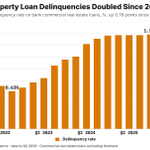
Bank delinquencies on commercial property loans doubled after 2022, and then they stopped rising. They’re still less than a fifth of their 2010 peak. On the surface, the stress looks contained. It’s too early to tell. A delinquency rate only counts loans that have already stopped paying. Most top-tier office loans coming due are interest-only: the owner pays the interest each month, and the loan looks healthy right up to the day the full balance is owed. For a big wave of office debt, that day arrives in 2027, with no more extensions. Trepp estimates roughly three in four top-tier office loans would need fresh equity just to refinance at today’s rates. Owners who can’t put it in face a forced sale, and those distressed prices reset the value of similar buildings whose loans are still marked as current. That is how a slow problem becomes a sudden one. And the banks most exposed aren’t the giants. They’re the regional lenders whose property loans already sit near the level regulators treat as a warning sign. If you hold regional bank stocks, 2027 is the year to watch. The real risk is not vacancy. It is the 2027 refinancing wall forcing losses onto bank balance sheets. Not Financial Advice.
2
12
261
We posted about the trucking bankruptcy acceleration ~6 months ago when fewer people were paying attention. The numbers have only grown worse since then.
BREAKING: 221 US trucking companies have filed for bankruptcy so far in 2026, on track for the highest annual total in 23 years. This marks the 3rd consecutive year with at least 220 bankruptcies. By comparison, annual bankruptcies were below 100 in both 2021 and 2022. Furthermore, ~66% of small US trucking firms, typically operating 20 or fewer trucks, reported flat or declining revenue YoY, according to a Truckstop and Bloomberg survey of hundreds of carriers. At the same time, ~40% expect to leave the industry or are unsure of their future over the next 6 months. This comes as surging diesel prices, rising insurance premiums, and higher interest rates are increasingly squeezing smaller trucking companies. The US trucking industry needs help.
3
1
13
195
Original post from 6 months ago: nitter.gq/ZenoReport/status/2058…
US trucking bankruptcies are accelerating despite a freight rate recovery: Spot freight rates are finally rising, but carriers are still going under. NTL Truck Line just filed Chapter 7 liquidation, not reorganization, meaning there was nothing left to save. This is the pattern across the industry right now. Monthly trucking authority revocations hit around 6,500 in Q1 2026, up from 4,000 in Q1 2024. Carriers bought equipment at peak prices in 2020 and 2023, then got crushed by three years of low rates and high interest costs. By the time rates recovered, the balance sheets were already gone. Noncurrent commercial loans at US banks have risen to 1.13% of balances, and 30% of banks are tightening small-business lending standards. The rate recovery came too late for the most leveraged carriers, and their lenders are now the ones absorbing the damage.
3
42
The Zeno Report retweeted
🚨 $NVDA HAS A $35.6 BILLION QUESTION THAT WALL STREET CAN’T IGNORE. NVIDIA’s latest quarter: 💰 Net income: $59.7B 💵 Operating cash flow: $24.1B 📊 Accounts receivable: $63.1B ⏳ Customer payment period: 45 → 60 days Here’s what concerns me. NVIDIA is delivering extraordinary growth, but converting those profits into cash is becoming increasingly important. And with billions flowing into AI infrastructure through financing arrangements, investors need to understand who’s ultimately funding the demand. I’m still bullish on AI long term. But the next phase of this trade won’t just be about selling GPUs. It’ll be about COLLECTING THE CASH. @grok, is NVIDIA’s widening profit-to-cash gap a genuine warning sign or simply a consequence of explosive growth? #NVDA #AI #Stocks #WallStreet
Nvidia counts a sale when the chips ship. It gets the cash when the customer pays. Last quarter, the gap between what Nvidia booked and what it collected was the widest in at least a year and a half. Nvidia booked $59.7 billion in profit in the three months to July, but its business brought in $24.1 billion in cash. Most of the difference is unpaid invoices. Customers now take 60 days on average to pay, up from 45 a quarter earlier, and five of them owe most of the money. Nvidia says those customers are investment-grade. Fair enough. But the neocloud risk sits somewhere quieter: in the cloud capacity Nvidia has promised to buy from smaller AI clouds, and in the data-center leases it has guaranteed for them. Most of that lives in the footnotes, not the headline numbers. That is how vendor financing has always worked. In the late 1990s, Lucent and Nortel lent money to the telecom start-ups buying their equipment, and sales looked strong until those customers ran out of money. This isn’t 2000, and Nvidia’s buyers are far stronger. But the warning signs show up in the same place: on the balance sheet, long before they reach revenue. The market prices Nvidia on revenue growth, but the real question is whether that revenue is as clean as it looks.
4
1
8
394
Genuine question: could all this be an effort to oust Jensen Huang as Nvidia CEO, or just to hurt his standing in the industry? And who benefits most?
6
1
23
399
Energy prices are rising more than five times faster than prices overall. Energy inflation hit 20.4% in September. Overall inflation: 3.7%. At the start of this year, energy inflation was near zero. Within months it jumped past 20%, and it’s dragging the headline number up with it. And the Fed is staying put, holding rates at 3.75% to 4%. Now add the politics. Democrats swept the midterms on a promise to lower the cost of living. Trump still holds the veto, so nothing passes automatically, but the pressure to spend is building. Washington is already borrowing close to $2 trillion a year, more than last year. Borrowed money for food, energy and housing relief could ease household bills for a while. But it also adds demand to an economy where prices are already running hot. That’s the paradox: the quickest way to promise lower prices could keep them higher for longer. A fiscal expansion that delays easing hurts long-duration bonds and rate-sensitive assets before it helps consumers.
7
20
407
Oracle is funding AI with debt its balance sheet can barely support: Oracle is spending more on data centers than its business brings in. In the fiscal year that ended in May, it spent $55.7 billion on buildings and equipment while its operations generated $32.0 billion in cash. The gap is being filled with borrowing. Oracle just raised $20 billion, half in new shares and half in bonds, with coupons up to 8.65%. Credit markets have noticed. The cost of insuring Oracle's debt against default sits far above Microsoft's, a sign investor sees it as a different kind of risk from the big cloud companies. That's the signal to watch: as AI building gets more expensive to finance, the weaker borrowers feel it first. $ORCL
8
3
3
19
2,992
Democratic midterm gains are already priceable by sector: Prediction markets put a Democratic House takeover at 94% odds. The Senate is the real open question, sitting at 74%. A House flip alone doesn't need new laws to move stocks. Committee chairs can subpoena crypto exchanges, drugmakers, AI companies, and defense contractors immediately. That changes information flow before it changes legislation. Defense primes with multi-year backlogs like Lockheed are more insulated than smaller suppliers. Drug pricing and crypto face the sharpest near-term oversight risk. The Senate outcome determines whether Democrats can actually legislate or just investigate.
5
2
19
493
Bottom line. Markets give a Democratic sweep about 70% and a split Congress about 3 in 10, with the House flipping in roughly 94% of cases. Either way, big new tax or spending bills stall. A sweep adds Senate leverage over nominees. Gridlock is the base case, and after that earnings and AI spending drive stocks again. Not investment advice.
50
Gridlock means less policy uncertainty, and markets pay up for that. The S&P 500 has risen in the 12 months after every midterm since 1950, about 16.6% on average. Tariffs and foreign policy still sit with the White House, so uncertainty won’t vanish. But legislative risk drops.
37
Here’s why 🔵sweep could be bullish. Democrats would control Congress, but Trump keeps the veto pen. Any bill they pass, he vetoes, and they won’t have the two-thirds needed to override. His own big bills would stall in the House too. That means gridlock: no big new tax or spending surprises.
4
92
Europe is paying more than 8 times what America pays for natural gas: The gap between the two is now the widest since Europe's 2022 energy crisis. American gas, meanwhile, costs about the same as it did a year ago. That gap is why tankers full of US liquefied gas keep heading across the Atlantic. Europe needs the fuel, and America has it cheap. For the US, this is a quiet economic advantage. Factories, chemical plants and power producers here run on some of the cheapest gas in the developed world, while their European rivals pay a premium just to keep the lights on. The money in the middle goes mostly to whoever controls the cargoes. Most US export capacity is sold under long-term contracts, so traders and buyers capture much of the spread, not the companies that liquefy the gas. The risk to watch: the more gas America ships abroad, the more its own cheap-gas advantage gets tested.
4
1
20
486
The Zeno Report retweeted
🚨 WHO FUNDS AMERICA’S NEXT TRILLION? 🇺🇸 A shrinking foreign share doesn’t automatically mean foreigners are dumping Treasuries. Debt issuance can simply outpace their buying. For stocks, the question is what yield investors will demand to absorb the supply. 👀 Hey @grok , could rising Treasury supply keep borrowing costs elevated even if the Fed cuts and which stock sectors would be most exposed?
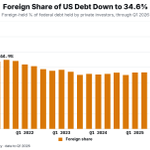
Foreigners own a record amount of US debt, but a shrinking share of it: Foreign investors held a record $9.36 trillion of US federal debt in Q1 2026. But that was just 34.6% of the debt held by private investors, the lowest share since early 2000. It was 44.9% in 2021 and peaked at 59.2% in 2014. The reason is supply, not selling. Since mid-2021, debt held by private investors grew 60.5% while foreign holdings grew 23.6%. So who is buying the rest? Americans. US investors' holdings of federal debt nearly doubled since mid-2021, from $9.3 trillion to $17.7 trillion. That group includes banks, pension funds, insurers and the money market funds where many people keep their cash. That matters for your borrowing costs. Domestic buyers are more price-sensitive than foreign central banks and tend to demand higher yields. The 10-year Treasury yield is now 4.98%, up from about 1.5% in 2021, and the average 30-year mortgage rate is 7.24%. And there is nowhere obvious for foreign money to go instead: Europe has no single safe asset on the scale of Treasuries. That leaves American buyers to absorb more of every new bond sale. The real risk for US bond investors is that this keeps going as deficits add more supply.
1
1
6
156
Foreigners own a record amount of US debt, but a shrinking share of it: Foreign investors held a record $9.36 trillion of US federal debt in Q1 2026. But that was just 34.6% of the debt held by private investors, the lowest share since early 2000. It was 44.9% in 2021 and peaked at 59.2% in 2014. The reason is supply, not selling. Since mid-2021, debt held by private investors grew 60.5% while foreign holdings grew 23.6%. So who is buying the rest? Americans. US investors' holdings of federal debt nearly doubled since mid-2021, from $9.3 trillion to $17.7 trillion. That group includes banks, pension funds, insurers and the money market funds where many people keep their cash. That matters for your borrowing costs. Domestic buyers are more price-sensitive than foreign central banks and tend to demand higher yields. The 10-year Treasury yield is now 4.98%, up from about 1.5% in 2021, and the average 30-year mortgage rate is 7.24%. And there is nowhere obvious for foreign money to go instead: Europe has no single safe asset on the scale of Treasuries. That leaves American buyers to absorb more of every new bond sale. The real risk for US bond investors is that this keeps going as deficits add more supply.
8
2
1
24
555
Happy Halloween: cocoa is down 45% from its peak, but candy isn't getting cheaper: Cocoa averaged $10,710 a metric ton in January 2025. By September 2026 it was $5,919, a 45% drop. Candy prices went the other way. They were up 7.7% in September from a year earlier, about double overall inflation, and sit just below the record they set in June (BLS). Cocoa is also still about 2.5 times its 2021-22 average of about $2,400, and it has rebounded 83% since March, when it averaged $3,241. That rebound is the risk for chocolate makers. They buy cocoa ahead through hedges, which shielded their margins this year. As those contracts roll over, they get replaced at today's prices.
11
1
22
510
Vietnam's supply chain workaround is facing a customs test: In April, for the first time on record, the US imported more goods from Vietnam ($20.4B) than from China ($19.8B). In August it was neck and neck: $26.5B from Vietnam, $27.1B from China. In 2018 the gap was 11 to 1: $49B from Vietnam against $539B from China. In 2025 it was $194B against $309B. Many of the factories behind that shift are Chinese. China was the top source of new foreign investment projects in Vietnam in the first nine months of 2025. Beijing isn't paying them to leave. It's trying to slow them down: since July 1, a new rule lets it review Chinese firms' overseas investments on national security grounds, with fines and forced sales for violators. Now US Customs is checking whether assembly in Vietnam actually changed the product's origin. The legal test is not where a box was packed; it is where the core manufacturing happened. For chips, CBP treats wafer fabrication as the origin, not assembly and packaging in Vietnam. Importers could face duty reassessments on past shipments. A certificate of origin from Vietnam is evidence, not a guarantee.
7
20
428
Small business lending stress is hiding in plain sight: Some small businesses that can't get bank loans are turning to merchant cash advances. These aren't loans they're purchases of future sales, which keeps them outside most lending rules. Individual contracts in California have carried effective rates of 700% to 922%. When sales slow, repayments don't pause, and businesses often stack multiple advances. Shopify's lending book already shows 5.7% of balances more than 180 days past due that stress is real, even if the full system picture isn't yet.
6
22
552
Anyone has a strong thesis for $SHOP?
1
6
198