

✞ Evangelical/Baptist ✍ 20-Year Research Blogger of Augustinian & Reformed Works on God’s Love, Will, Grace, & the Free Offer 🧐 Editor 📚 Book Collector
Joined October 2009
- Tweets16.2K
- Following753
- Followers1K
- Likes12.9K
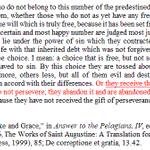




Here we can see a kind of common grace in Augustine, where “those who do not belong to the number of the predestined whom whom the grace of God is leading to the kingdom,” yet “receive the grace of God” for a time.

Since talk of Dr. Jim Parker III is in the news and his handout in classes showing his lineage as a student going back to Calvin, a wrong impression 𝘮𝘢𝘺 be left. When I spoke with him in the late 90’s, he was, at most, a so-called 4-pointer, but more like a 3-pointer. He definitely rejected LA, and IG was troublesome to him as well. At the time I was a staunch 5-pointer, and an avid listener to MacArthur, Sproul, and especially an admirer of S. Lewis Johnson Jr. on the subject.
In 1690, these, among other ideas of the Jansenists, were condemned by Pope Alexander VIII (1610–1691):
“4. Christ gave Himself for us as an oblation to God, not for the elect only, but for all the faithful only.”
Pope Alexander VIII, “Error of the Jansenists (Condemned in a Decr. of the Holy Office, Dec. 7, 1690),” in Henry Denzinger and Karl Rahner, eds., 𝘛𝘩𝘦 𝘚𝘰𝘶𝘳𝘤𝘦𝘴 𝘰𝘧 𝘊𝘢𝘵𝘩𝘰𝘭𝘪𝘤 𝘋𝘰𝘨𝘮𝘢, trans. Roy J. Deferrari (B. Herder Book Co., 1954), 339.
“30. When anyone finds a doctrine clearly established in Augustine, he can absolutely hold and teach it, disregarding any bull of the pope.”
Pope Alexander VIII, “Error of the Jansenists (Condemned in a Decr. of the Holy Office, Dec. 7, 1690),” in 𝘛𝘩𝘦 𝘚𝘰𝘶𝘳𝘤𝘦𝘴 𝘰𝘧 𝘊𝘢𝘵𝘩𝘰𝘭𝘪𝘤 𝘋𝘰𝘨𝘮𝘢, 340.
This is funny. I also noticed the same after reading Peter Sammons’s review of Curt Daniel’s “History and Theology of Calvinism.” About that review, Daniel says, “he [Sammons] misunderstands the historic Reformed view and my exposition of it. The negative review has multiple factual errors, e̲v̲e̲n̲ t̲h̲e̲ b̲o̲o̲k̲’̲s̲ p̲r̲i̲c̲e̲.”
Curt Daniel, 𝘏𝘺𝘱𝘦𝘳-𝘊𝘢𝘭𝘷𝘪𝘯𝘪𝘴𝘮: 𝘐𝘵𝘴 𝘏𝘪𝘴𝘵𝘰𝘳𝘺 𝘢𝘯𝘥 𝘛𝘩𝘦𝘰𝘭𝘰𝘨𝘺 (Founders Press, 2026), 239n132.
The über, ultra, mega, super duper Calvinists on 𝕏: “God does not ‘try’ to do anything.”
Meanwhile Calvin:


This is a good tribute. Dr. Parker was also servant-hearted, and generous. He let me stay at his condo in Dallas in the late 90’s and early 2000’s so that I could get schooling at Criswell College. He was gregarious (or extroverted, unlike me) and so impacted a lot of people, even in little ways, through personal interaction, not by way of books and academic writing. A few years ago, he gave @WesleyLHuff his entire library.
I have funny memories of him sometimes acting like a stereotypical fundamentalist, even though he was far from that, and an intellectual. But as David Closson says below, Jim never wore his academic credentials on his sleeve. That taught me, long ago, that the truly educated never do that. Jim sometimes dressed as Gandalf, and to his abundance of friends, Parker modeled that virtuous wizard’s qualities.
Hat Tip to @DrDavidLAllen for telling me this news.
I like this distinction and think this manner of talking about “freedom” best accords with NT usage, but I’d like to find a way to improve on the language regarding “free will.” We are stuck with it more or less, I know, or with “free agency” or “free choice,” but perhaps there is better terminology?

This is a good tribute. Dr. Parker was also servant-hearted, and generous. He let me stay at his condo in Dallas in the late 90’s and early 2000’s so that I could get schooling at Criswell College. He was gregarious (or extroverted, unlike me) and so impacted a lot of people, even in little ways, through personal interaction, not by way of books and academic writing. A few years ago, he gave @WesleyLHuff his entire library.
I have funny memories of him sometimes acting like a stereotypical fundamentalist, even though he was far from that, and an intellectual. But as David Closson says below, Jim never wore his academic credentials on his sleeve. That taught me, long ago, that the truly educated never do that. Jim sometimes dressed as Gandalf, and to his abundance of friends, Parker modeled that virtuous wizard’s qualities.
Hat Tip to @DrDavidLAllen for telling me this news.

I am saddened to learn that my former @SBTS professor, Dr. James Parker, passed away last night. Dr. Parker had an extraordinary academic pedigree. He studied at Baylor, Trinity, Princeton, Basel, and Johns Hopkins, and he delighted in pointing out that he could trace his academic lineage through generations of teachers all the way back to John Calvin.
What made this even more endearing was how lightly he wore all of it. While many of his colleagues built substantial publishing careers, Dr. Parker often joked that one of his great contributions to scholarship was a 2001 Baptist Press article about Santa Claus. He could trace his academic lineage to Calvin, but he was far more likely to tell you a funny story than to remind you of his credentials.
During my years as a student at Southern Seminary, Dr. Parker became a regular part of my life. I joined his shepherding group as an M.Div. student—admittedly, in part because I had heard he took his students to a very nice Brazilian steakhouse at the end of the semester. Later, during my doctoral studies, I worked in the School of Theology, and it was almost guaranteed that Dr. Parker would stop by for an hour or more to talk and tell stories. He seemed to know nearly every significant evangelical figure of the twentieth century, and his stories about them were endlessly entertaining.
Dr. Parker also somehow convinced the dean to let professors eat in the seminary dining hall for half price, which meant that over my five years as an on-campus student, I shared literally hundreds of meals with him. He taught one of my doctoral colloquium, but some of the most important things I learned from him came outside the classroom. Dr. Parker taught me, among other things, not to take myself too seriously.
For several years I lived at the Duck and Goose, a house long associated with men preparing for ministry at Southern. Dr. Parker told me that years earlier the men there had hosted professors for dinner, and he encouraged my roommates and me to revive the tradition—with the understanding, of course, that he would be the first professor invited. We gladly obliged and hosted him several times.
I am grateful for the classes, the meals, the long conversations, the stories, and the friendship. Southern Seminary has lost one of its great characters, and I will miss him.


My copy has arrived. Interesting quotes coming soon.
Quick first impressions: Good quality paper; clean appearance; massive bibliography; good scripture and subject indexes; 782 total pages. The hardback cover without the dust jacket looks dull and boring.

As I continue to dig into the historical dispute over Augustine’s view of God’s universal salvific will, my introductory section keeps expanding. Eventually the other sections will continue to get filled out as well. Do 𝘯𝘰𝘵 trust AI on the subject.
theologicalmeditations.blogs…
“Even the popular apologist James White sounds Hyper-Calvinist in casting doubt on the idea of ‘a desire on God’s part that every single person come to repentance,’ alluding to 2 Peter 3:9 [in White, 𝘛𝘩𝘦 𝘗𝘰𝘵𝘵𝘦𝘳’𝘴 𝘍𝘳𝘦𝘦𝘥𝘰𝘮, 147–148].”
Curt Daniel, 𝘏𝘺𝘱𝘦𝘳-𝘊𝘢𝘭𝘷𝘪𝘯𝘪𝘴𝘮: 𝘐𝘵𝘴 𝘏𝘪𝘴𝘵𝘰𝘳𝘺 𝘢𝘯𝘥 𝘛𝘩𝘦𝘰𝘭𝘰𝘨𝘺 (Founders Press, 2026), 234.
Hint: It’s more than a mere sound. 😉
“The free offer is inseparably related to the universal saving will or desire of God in the gospel. As John Murray has cogently observed, this is the state of the question. Hyper-Calvinists reject both.” Curt Daniel, Hyper-Calvinism (Founders Press, 2026), 229.
🎯
Minor adjustment: Hypers reject both, but 𝘮𝘢𝘺 redefine the offer to mean a bare presentation.
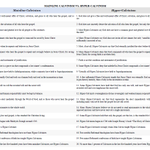
This is an AI reproduction of Curt Daniel’s new chart (on pp. xxvii–xxviii) comparing Mainline Calvinism with Hyper-Calvinism. Sorry about the size. Too much information is pushed into a tight space.

Take a look at this, @David651975. Dr. Daniel mentions our websites. Cool. I did not know he was going to do that. We’re famous. 😎🤓
I look forward to finally meeting him sometime around Easter next year.
