






Pinned Tweet
Most LLMs learn to think only after pretraining—via SFT or RL. But what if they could learn to think during it? 🤔
Introducing RLP: Reinforcement Learning Pre-training—a verifier-free objective that teaches models to “think before predicting.”
🔥 Result: Massive reasoning boosts & gains that COMPOUND after post-training!
📝 Blog: research.nvidia.com/labs/adl…
🔗Paper: github.com/NVlabs/RLP/blob/m…
🧵↓

Excited to present Nemotron-CrossThink @eaclmeeting 🇲🇦🚀
We extend RL beyond math while achieving accurate answers with significantly fewer tokens!
📍 Salle Le Riad 🗓 26 March | ⏰ 9:00–10:30 AM (Moroccan Time)
Session: Reasoning and Self-Learning in LLMs

RL boosts LLM reasoning—but why stop at math & code? 🤔
Meet Nemotron-CrossThink—a method to scale RL-based self-learning across law, physics, social science & more.
🔥Resulting in a model that reasons broadly, adapts dynamically, & uses 28% fewer tokens for correct answers!
🧵↓

6
336
Intelligent and Super Efficient!

Announcing NVIDIA Nemotron 3 Super!
💚120B-12A Hybrid SSM Latent MoE, designed for Blackwell
💚36 on AAIndex v4
💚up to 2.2X faster than GPT-OSS-120B in FP4
💚Open data, open recipe, open weights
Models, Tech report, etc. here:
research.nvidia.com/labs/nem…
And yes, Ultra is coming!

4
381
2/2 at ICLR 2026! 🎊
So happy to share that both of our papers have made it to @iclr_conf!
1️⃣RLP: Reinforcement as a Pretraining Objective
(arxiv.org/abs/2510.01265)
2️⃣Front-Loading Reasoning: The Synergy between Pretraining and Post-Training Data (arxiv.org/pdf/2510.03264)

So grateful to all the collaborators who made these works possible 🙏
1️⃣ RLP: @ahatamiz1, @shrimai_, @jankautz, @MostofaPatwary, @MohammadShoeybi, @ctnzr, @YejinChoinka
2️⃣Front-Loading Reasoning: @shrimai_, Eric Nyberg, @MostofaPatwary, @MohammadShoeybi, @YejinChoinka, @ctnzr
4
170
RLP is ready for ICLR 2026! 🥳 We have added extensive ablations and new experimental results (thanks to the reviewers). Excited to share the final story soon!

I am happy to announce that RLP has been accepted to ICLR 2026 ! 🎉
RLP re-imagines the foundations of LLM training by bringing reinforcement learning directly into the pretraining stage.
This was a true team effort, and it would not have been possible without the invaluable contributions of our amazing team:
@shrimai_ @__SyedaAkter @jankautz @MostofaPatwary @MohammadShoeybi @ctnzr @YejinChoinka
Paper: arxiv.org/abs/2510.01265
Code: github.com/NVlabs/RLP

Thank you @rohanpaul_ai for sharing our work!
In "Front-Loading Reasoning", we show that injecting reasoning data into pretraining builds models that reach the frontier.
On average, +22% (pretraining) → +91% (SFT) → +49% (RL) relative gains. 🚀
🔗Paper: arxiv.org/pdf/2510.03264
📝 Blog: research.nvidia.com/labs/adl…

New @nvidia paper shows that teaching reasoning early during pretraining builds abilities that later fine-tuning cannot recover.
Doing this early gives a 19% average boost on tough tasks after all post-training.
Pretraining is the long first stage where the model learns to predict the next word from lots of text.
Supervised fine-tuning is a later stage where it studies step by step answers from labeled examples.
Reinforcement learning then rewards better answers so the model improves further.
Diversity matters most in pretraining, while high quality matters most in supervised fine-tuning, roughly 11% vs 15% gains.
Even doubling supervised fine-tuning on a base that skipped early reasoning could not catch up.
Adding lots of mixed-quality supervised fine-tuning data even cut math by about 5%.
High quality reasoning added in pretraining looked small at first, then showed up strongly after supervised fine-tuning.
Teams should load diverse reasoning into pretraining, use a small high quality set for supervised fine-tuning, then stabilize with rewards.
----
Paper – arxiv. org/abs/2510.03264
Paper Title: "Front-Loading Reasoning: The Synergy between Pretraining and Post-Training Data"

13
1,089
When should an LLM learn to reason? 🤔 Early in pretraining or late in fine-tuning?
Our new work, "Front-Loading Reasoning", challenges the "save it for later" approach. We show that injecting reasoning data into pretraining is critical for building models that reach the frontier.
📝 Blog: research.nvidia.com/labs/adl…
🔗Paper: tinyurl.com/3tzkemtp
🧵↓
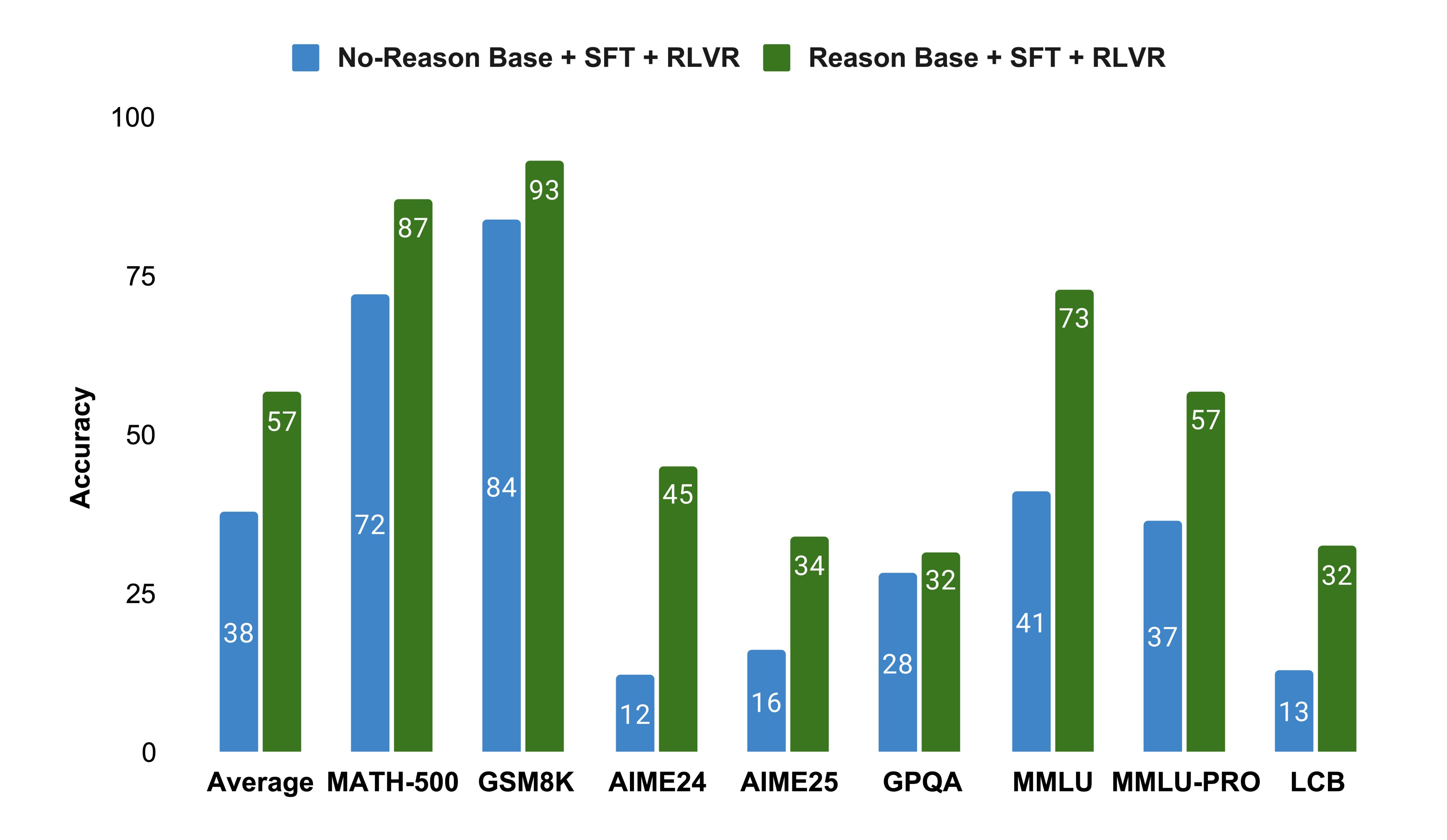
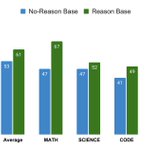
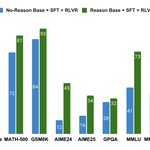
We find that "front-loading" reasoning data into pretraining creates a durable, compounding advantage.
📈 Stage 1 (Pretraining): +16% avg. gain out of the gate.
📈 Stage 2 (SFT): Advantage grows to +9.3% after fine-tuning.
📈 Stage 3 (RL): Finishes with a massive +19% lead on expert benchmarks.
SFT & RL amplify a strong foundation; they can't create one.


Nemotron-CrossThink is now trending on @huggingface!
Thanks to everyone who has checked out the dataset! We're excited to see the interest in scaling RL to diverse reasoning domains.
🤗 Dataset: huggingface.co/datasets/nvid…


RL boosts LLM reasoning—but why stop at math & code? 🤔
Meet Nemotron-CrossThink—a method to scale RL-based self-learning across law, physics, social science & more.
🔥Resulting in a model that reasons broadly, adapts dynamically, & uses 28% fewer tokens for correct answers!
🧵↓
MIND is at ICLR 2025 🎉 and we’re releasing the pretraining dataset of 138B tokens + blog as the conference kicks off!
📄 Poster #258: Aug 25, 10AM–12:30PM
📍Hall 3 + Hall 2B
🤗 Dataset: tinyurl.com/bd38d62n
🧠 Blog: tinyurl.com/4ndhte8x
🔗 Paper: arxiv.org/abs/2410.12881

Super proud to be part of Nemotron-H — efficient LLMs with up to 3× faster inference and competitive accuracy!
Trained along with high-quality synthetic data, Nemotron-H shines on long-thought reasoning tasks while being significantly faster!
Paper: bit.ly/3E0GBw6

MIND has been accepted to #ICLR2025 🥳🙌🎉
Huge thanks to my amazing co-authors! Excited to share more about our research soon—stay tuned! 🚀📄
Paper: openreview.net/pdf?id=TuOTSA…
Synthetic data can boost LLM’s reasoning—how?
Introducing MIND—a method to boost LLM’s math reasoning by generating dialogues with knowledge gaps between participants.
❌Don’t just dump data into LLM—✅rephrase dialectically with MIND to make the most use of your tokens!
🧵↓

Attending #ACL2024 to present our work 'VisReas' in Thailand!
Looking forward to an exciting discussion on reasoning ability of Multimodal LLM and VLMs.
Feel free to drop by and say 'Hi'
@ Findings In-Person Poster Session 2
⏲️August 12 17:45 - August 12 18:45
VLMs excel at spatial reasoning. How well do they detect unanswerable questions derived from minor perturbations?
In our #ACL2024 paper, we propose a new compositional VQA dataset addressing unanswerability and find that SOTA VLMs fail to detect these inconsistencies!
🧵↓


This is a war I don’t want to see. As I came here, I saw people being brought in rikshas, with bullet wounds, ambulances coming in one after another with corpses. I just stood and watched. They are not related to me but my heart is breaking. #StepDownHasina #Bangladesh #murderer
170
VLMs excel at spatial reasoning. How well do they detect unanswerable questions derived from minor perturbations?
In our #ACL2024 paper, we propose a new compositional VQA dataset addressing unanswerability and find that SOTA VLMs fail to detect these inconsistencies!
🧵↓

I will be working as a research intern at @NVIDIA this summer. Looking forward to contributing towards better generative AI!
Bright minds from multiple departments with different perspectives have come together for this exciting compilation.Time to redefine 'social agents' in a proper manner! 🚀🚀🚀

When solving a difficult problem, we often draw a diagram to help us visualize. What if VLMs could do the same?
Introducing Self-Imagine – a method that enhances the reasoning abilities of VLMs on text-only tasks through visualization.
Paper: arxiv.org/abs/2401.08025
🧵↓
