
MTS @theworldlabs. Prev: @UMichCSE, @GoogleAI, @MetaAI, @GeorgiaTech. I am interested in computer vision, machine learning, and cognitive science. 🇪🇬
- Tweets229
- Following827
- Followers1K
- Likes1.6K


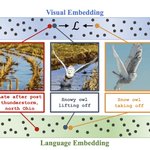




ALT A figure showing 3 images: left to right, the first image is of a creek, the second is of an owl flying in a creek, and the third is of an owl flying across a clear sky. The captions are "late after post. thunderstorm, north Ohio", "Snowy Owl lifting off", "Snow owl taking off". The figure depicts that the right two images lie close to each other in language embedding space, while the left two are close to each other in visual embedding space. There is a loss term that is bringing the visual embeddings of the two owl pictures close to each other.

ALT A figure depicting image pairs from 3 different datasets: CC3M, CC12M, and RedCaps. All the pairs have similar captions with the images capturing the same object, but the object appears in a different pose, lighting, or background or in a different image style. For example, the first pair has two images of dogs jumping, one is jumping from a grassy plain onto a lake, while the second just shows the dog with a sea background. both captions are: "animal jumps into the water". Other image pairs have different captions. For example, two images of grilled chickens, the first is on a grill, while the other is served on a plate with asparagus. The first captions is "spatchcock chicken on the Weber E-310. Happy Sunday!" and the second caption is "Spatchcock chicken with asparagus on the Weber 22 Performer".


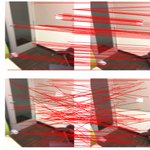
ALT The top shows a video reel of an indoor scene. Two frames are highlighted from the reel with arrows showing those frames in a larger resolution with the heading Input RGB-D images. In the center, the scene depicted by the two images is shown with the camera icons depicting the camera locations for each of the images. On the right, the two frames are shown with the heading Rendered RGB-D. A two-headed arrow connects both images and is overlaid with the text "consistency losses"

ALT A figure of the presented model. The caption reads: Our end-to-end approach. Our model takes as input two RGB-D images of a scene. First, we encode the images into a feature map and project them into a 3D point cloud. Second, we extract correspondences between the two feature point clouds. Third, we use the 3D correspondences to estimate rotation and translation from the first to the second view; a 6-DOF transformation that aligns the two point clouds. Finally, we use differentiable rendering to render the points from both point clouds and apply consistency losses.

