

Palo Alto, CA
Joined July 2025
- Tweets57
- Following595
- Followers712
- Likes306




Very hard challenge. I actually made use of some of the algorithms I developed while working on distributed space systems.

We just beat Nvidia at multi-robot coordination.
Announcing Blitz, our internal GPU-accelerated planner for multi-cell, multi-arm robotic assembly.
We cut planning time by 76% and planned execution time by 57% versus SOTA baselines including cuARMS and cuRobo V1/V2, through successive optimization on matched benchmark inputs.
The Nvidia cuARMS code isn’t yet public. We independently implemented and extended the method for our frontier manufacturing stack.
How we developed Blitz:
- A native C++/CUDA core combines graph search with batched GPU kernels for collision checking and trajectory timing
- A*-style continuation uses cost-to-go heuristics to explore parallel plans
- Collision computation draws on GPU-resident geometry, context-aware caches and compact contact masks
- We optimize executable makespan through synchronized multi-arm shortcutting and bounded refinement under velocity, acceleration and jerk limits
- A multi-modal assembly graph preserves dependencies, object custody and tool states while independent skills overlap


Alexandre Carlhammar retweeted
Yes, the only way this is solved is by looping in the data from deployed assembly line.
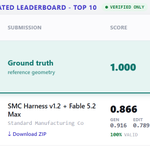
We just took #1 on CADGenBench, the leading benchmark for parts engineering. huggingface.co/spaces/Huggin…
We developed a SOTA CAD generation harness through a novel predictor-corrector architecture.


The model proposes the part. A deterministic geometry kernel then verifies the B-rep against dimensional and topological constraints that two independent agents extract from the drawing.
We also reinforced the system on large libraries of real manufacturing and assembly-line data that we collected.
More on it soon.



Low-volume, high-mix manufacturing presents 3 fundamental challenges for automation:
- Design: Products aren’t designed for automated assembly.
- Deployment: Automated assembly lines are bespoke to individual products, with little skill transfer to new products.
- Flexibility: Adapting lines to changes in product design, supply variance, etc. is incredibly difficult.
We’re fixing this. More on it soon.
This quoted post is unavailable.
Alexandre Carlhammar retweeted

Don't get lost in the sauce. Focus on what you can control:
1. The folks in your corner.
2. Your personal relationships
3. Executing your purpose / mission.
Let's rip it. Time to build.
Alexandre Carlhammar retweeted

Factories of the future will not only be factories
As the performance of design automation tools increases, manufacturers will start moving more upstream.
Design, simulation and testing will all get compacted into one comp.
The manufacturer will design the parts
The manufacturer will simulate the part
The manufacturer will manufacture the part
The manufacturer will test the part
Not every manufacturer will be able to profit from this consolidation though.
Alexandre Carlhammar retweeted

"getting it manufactured still required several rounds of review and iteration"
yes, welcome to the real world. we could have solved rsi and it won't matter. the only thing that solves this will be factories.

Imagine the magic you could create if you also had manufacturing signals in the loop…👀
These are early steps, and we’re looking for engineers, engineering firms, and software partners to help shape what comes next.
openai.com/index/acceleratin…

1
4
800
Alexandre Carlhammar retweeted

You cannot scale manufacturing without systems and scaleable processes. If there's a problem, you have to attack it right away with a solution that is easily repeatable across hundreds of new hires. Very hard to do.
But if you do it, you will win.
Alexandre Carlhammar retweeted

Today, we are introducing Fern: our first model that supports up to 10M tokens in context window!🌿
You could put an entire repository (or repositories!) in the context, continue to work on problems for days without hitting compaction limits or use it to consolidate other agents’ works.
As always, we have a lot more work to do but wanted to give you the update. Excited hear how you would use a 10M token context window.


From thinking of a product, captured through BCI, to generatively designed products (CAD, PCB) and co-designed assembly lines, all within a shared agentic engineering and manufacturing harness (FEA, CFD, DFM, …).
Bidirectional signals across the entire system, continuously co-optimizing product and factory for cost, throughput and volume.
Driving the distance between thought and physical reality to zero.
Soon, this won’t be science fiction.
2
8
5,508