

Ph.D.(c) @JPSMumd | Data Scientist @NORCNews | Adjunct Professor & Economist @PUCP | Computational Analysis & Public Policy @UChicagoCAPP | 🇵🇪🇧🇷
Washington, DC | Lima, Peru
Joined September 2017
- Tweets398
- Following1.6K
- Followers1.4K
- Likes629
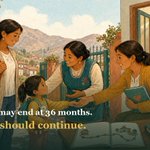


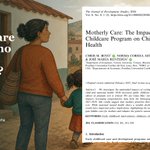





What happens when public childcare ends? Our new paper from Peru reveals a hidden cost: mothers carry the burden after children exit the program. 🧵 1/8
Open access: doi.org/10.1080/00220388.202…
With C. Boyd, @nb_correa, Angelo Cozzubo & @jmrenteria, published in JDS by @tandfonline.

Caregivers and officials described scarce alternatives, high costs, shorter hours, and difficult work-and-care trade-offs. Childcare policy should facilitate the transition to preschool, support mothers’ mental health, and follow families after graduation. 7/8

Thanks to @PUCP CAP Award for funding this research and @MIDIS_CunaMas for data access. 8/8
@MidisPeru #OpenAccess #PublicPolicy #Childcare #MentalHealth #MIDIS #Development #Economics #Research #Peru #PUCP
📊 Our latest research using the @AmeriSpeak Panel explores how people use federal statistics; not just who uses them
Key findings:
• Most users rely on reports and tables, not raw datasets
• Regular users have substantially higher trust in federal data.
@NORCNews @AmstatNews

How are Americans using federal data? A new NORC study finds nearly 1 in 10 U.S. adults are regular users, from tracking neighborhood crime rates, to monitoring inflation to fact-checking arguments.
Find out more: go.norc.org/44aU8KW

ALT Word cloud featuring prominently the word "research" in large red text. Other significant words include "paper," "school," "college," "report," "job," "rate," "analysis," "project," and "personal," varying in size and shades of orange and gray.
3 años después. Misma respuesta!


Angelo Cozzubo retweeted

📌 Conversatorio: "Impactos del egreso del programa Cuna Más sobre la salud materna e infantil"
🗣 Presentan: @nb_correa y @jmrenteria.
💬 Comentan: Juan León y Gabriela Guerrero (@GRADEPeru).
🗓️ Jueves 9 de octubre
🕧 12:30 m.
🔗 Inscripciones: forms.gle/ZVLKbMVWVbXLw6qT7

Angelo Cozzubo retweeted

When children age out of childcare in Peru, their mothers' mental health declines. repositorio.pucp.edu.pe/serv…

Angelo Cozzubo retweeted

New research from NORC researcher Angelo Cozzubo examines electronic voting in Peru's 2016 elections. Data show invalid votes dropped by nearly two-thirds with e-voting, primarily due to fewer voter errors. No substantial changes in turnout or vote composition observed.
Full study linked below.
🚨 New paper out! 🚨
What happens when you replace paper ballots with electronic voting in Peru?
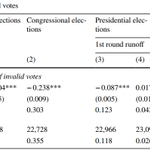
We find invalid votes dropped by almost 2/3 — but no big changes in turnout or party composition
👉 doi.org/10.1007/s11127-025-0…

🚨 New paper out! 🚨
What happens when you replace paper ballots with electronic voting in Peru?
We find invalid votes dropped by almost 2/3 — but no big changes in turnout or party composition
👉 doi.org/10.1007/s11127-025-0…
Who benefited most?
Older & less-educated voters.
E-voting reduced errors in districts with these demographics
Unlike 🇧🇷, 🇮🇳, or 🇵🇭, Peru’s e-voting pilot *did not change* party vote shares or turnout.
Improvement in ballot validity ✅, but no evidence of political shifts ⚖️
🔑 Takeaway:
E-voting in Peru reduced errors but didn’t transform electoral outcomes
A reminder: tech fixes local problems differently — we can’t just copy-paste lessons across countries
👉 Read full paper here: doi.org/10.1007/s11127-025-0…
👥 w/ @fernandomaragon & Alberto Chong
