AgingResearch.News (@agingbrief) header
AgingResearch.News (@agingbrief) profile picture

Every new aging study, read for you: who was studied, what changed, the catch. The strongest ones here as they appear. Free at https://nitter.gq/t.co/7UZKJa719C

Joined October 2026
Photo by AgingResearch.News (@agingbrief)Photo by AgingResearch.News (@agingbrief)Photo by AgingResearch.News (@agingbrief)Photo by AgingResearch.News (@agingbrief)Photo by AgingResearch.News (@agingbrief)Photo by AgingResearch.News (@agingbrief)Photo by AgingResearch.News (@agingbrief)Photo by AgingResearch.News (@agingbrief)Photo by AgingResearch.News (@agingbrief)Photo by AgingResearch.News (@agingbrief)
Sources and notes Sex-Specific Associations Between High-Volume Physical Activity and Coronary Artery Disease Risk. AHA Scientific Sessions 2026 Abstract. Conference abstract, not a preprint. DOI: 10.1161/circ.154.suppl_1.7262 agingresearch.news/s/h88ft5 This observational analysis included 120,369 participants without coronary artery disease from UK Biobank and the All of Us Research Program, with 1,331,867 person-years of combined follow-up. Activity was measured with wrist accelerometers in UK Biobank and Fitbit monitoring in All of Us. Moderate-to-vigorous activity was grouped into <500, 500-1499, 1500-2999, or ≥3000 MET-minutes/week, units of activity volume. Group sizes were not given. Electronic health records identified new coronary artery disease using diagnosis and procedure codes. Models adjusted for demographic and cardiometabolic risk factors. Results from the two study populations were pooled using fixed-effects meta-analysis, a statistical method for combining estimates. Analyses also tested differences between sexes and examined each sex separately. There were 8,174 new coronary artery disease events. Compared with <500 MET-minutes/week, pooled hazard ratios were 0.69 for 500-1499, 0.54 for 1500-2999, and 0.47 for ≥3000. These are relative risk measures over follow-up, not absolute differences in cases. At ≥3000 MET-minutes/week, the lower-risk pattern plateaued in men and continued in women. Sex-specific estimates, confidence intervals, p-values and sensitivity analyses were not reported. - More active participants may have had better underlying health or other habits not fully captured by the adjustments. - The findings concern people without coronary artery disease at enrollment.
15
Extra exercise for heart health came with different patterns in women and men. Among 120,369 people, the link with lower heart artery disease risk kept strengthening in the most active women, while it leveled off in men. The arteries feeding the heart are the ones affected by this disease. Earlier studies raised the possibility that activity’s link with lower risk could flatten or turn upward at very high levels. This conference abstract covers 120,369 people without coronary artery disease. Wrist monitors and Fitbits recorded moderate-to-vigorous activity; health records captured 8,174 new cases across 1,331,867 combined years of follow-up. The highest activity group had a hazard ratio—a measure of relative disease risk over follow-up—of 0.47 versus the lowest. The link with lower risk flattened in men at the top but kept strengthening in women. More active people may have started healthier or had other helpful habits. Adjustments for demographic, heart and metabolic risk factors leave those differences open. The next test is whether better accounting for starting health preserves that split between women and men.
🤖 Made with AI
1
5
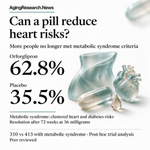
Sources and notes Effect of Orforglipron on Resolution of Metabolic Syndrome: Post-Hoc Analysis from the ATTAIN-1 and ATTAIN-2 Trials. AHA Scientific Sessions 2026 Abstract; a conference abstract, not a preprint. DOI: 10.1161/circ.154.suppl_1.9867 agingresearch.news/s/njjech Post-hoc analysis of two Phase 3 randomized trials in adults with obesity or overweight: ATTAIN-1 included weight-related conditions; ATTAIN-2 included type 2 diabetes. Treatment lasted 72 weeks. Capsule doses were 6, 12 and 36 mg, equivalent to tablet doses of 5.5, 9.0 and 17.2 mg. The comparator was placebo. Metabolic syndrome required at least three abnormalities involving waist circumference, blood pressure, fasting blood sugar or blood fats. A statistical model assessed resolution among participants affected at baseline. The paper does not give adjustment covariates. In dose order, then placebo, baseline syndrome prevalence and affected counts were: - ATTAIN-1: 39.1% (283), 39.7% (288), 42.5% (310), 43.5% (413). - ATTAIN-2: 85.1% (280), 88.9% (295), 86.3% (278), 87.9% (554). These counts describe affected participants, not total enrollment. At 72 weeks, syndrome prevalence in the same order was: - ATTAIN-1: 23.1%, 20.0%, 19.9%, versus 29.7%. - ATTAIN-2: 54.4%, 55.7%, 46.9%, versus 69.8%. Among those affected at baseline, resolution rates were: - ATTAIN-1: 46.6%, 62.2%, 62.8%, versus 35.5%. - ATTAIN-2: 33.1%, 37.8%, 52.8%, versus 15.1%. Odds ratios compare the odds of resolution with placebo. For ascending doses, odds ratios (95% confidence intervals) were: - ATTAIN-1: 1.59 (1.09, 2.32), 2.99 (2.04, 4.40), 3.07 (2.10, 4.48); all p<0.05. - ATTAIN-2: 2.78 (1.68, 4.58), 3.41 (2.11, 5.49), 6.27 (3.92, 10.04); all p<0.001. All doses increased the odds of resolution, with a dose-related trend. - These findings came from a post-hoc analysis reported in a conference abstract. - Unwanted effects were not reported. - Whether participants had fewer cardiovascular events was not reported.
6
Excess weight, high blood sugar and high blood pressure can arrive together. For people facing that cluster, a weight-loss pill helped more fall below the threshold for a diagnosis: 62.8%, versus 35.5% with placebo. Weight loss was already part of this pill's story: people taking it in an earlier trial subgroup lost more weight than those on placebo. The pill, orforglipron, was tested against placebo for 72 weeks in two randomized trials of adults with obesity or overweight, with weight-related conditions or type 2 diabetes. This analysis examined metabolic syndrome: at least three abnormalities involving waist size, blood pressure, blood sugar or blood fats. At 36 milligrams, 62.8% no longer met the syndrome's definition, versus 35.5% with placebo in the trial with weight-related conditions. Those groups started with 310 and 413 affected participants. In the diabetes trial, the figures were 52.8% versus 15.1%, with 278 and 554 affected participants. This was an analysis chosen after the fact, reported in a conference abstract. The paper did not report unwanted effects or whether people had fewer heart and blood vessel events. The result puts this pill's effects on a cluster of heart and diabetes risks alongside its effects on weight.
🤖 Made with AI
1
8
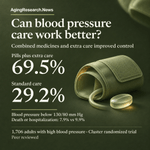
Sources and notes Implementation of Single-Pill Combination Therapy Through Team-Based Care for Hypertension Control in Resource-Constrained Settings: A Cluster Randomized Clinical Trial. JAMA; not a preprint. DOI: 10.1001/jama.2026.24169 agingresearch.news/s/ddxa8k This unblinded, pragmatic, cluster randomized trial enrolled 1,706 adults with uncontrolled hypertension at 40 primary care clinics in Colombia and Jamaica. Clinics were assigned to combination-pill care (869 participants) or standard care (837). Mean age was 61.4 years; 69.9% were women, and 98.2% were already taking blood pressure medicines. The intervention supplied locally purchased combination pills alongside physician and nurse training, health coaching, home monitoring, and blood pressure audit and feedback. Standard care provided guideline-recommended medicines through insurance or government programs. The intervention lasted 18 months, with additional follow-up at 24 months. The primary outcome was the between-group difference in change in the upper blood pressure reading at 18 months. Three readings were taken at each of 2 visits at each time point. Among 1,574 participants in the primary analysis, the upper reading fell by 19.1 mm Hg, from 145.9 to 126.8 mm Hg, with the program, versus 9.0 mm Hg, from 145.0 to 136.1 mm Hg, with standard care. The between-group difference was -10.1 mm Hg (95% CI, -13.3 to -6.9 mm Hg; P < .001). At 18 months, 69.5% with the program versus 29.2% with standard care reached blood pressure below 130/80 mm Hg. Serious unwanted effects—death or hospitalization—occurred at similar frequencies: 7.9% versus 9.9%, respectively. - Clinics and participants knew their assignments. - The trial did not separate the pills’ effects from those of the wider care program. - The findings concern adults with uncontrolled blood pressure in Colombia and Jamaica, not people whose blood pressure was already controlled.
1
Taking pills for high blood pressure can still leave it too high. A program combining medicines in one pill with extra care brought 69.5% of patients below the blood pressure target, versus 29.2% with standard care. High blood pressure goes with earlier aging of blood vessels and higher risks of stroke and heart failure. Keeping it controlled matters as people age. The trial enrolled 1,706 adults with uncontrolled blood pressure in Colombia and Jamaica. Their 40 clinics were randomly assigned to the program or standard care for 18 months. The program supplied combination pills, trained staff, and added health coaching and home blood pressure checks. Standard care used recommended medicines. Among 1,574 people analyzed, the upper blood pressure reading fell by 19.1 millimeters of mercury with the program versus 9.0 with standard care. The target was below 130/80. Serious unwanted effects—death or hospitalization—occurred in 7.9% versus 9.9%, respectively. The trial tested the pills and the wider care program together, so it leaves open how much each contributed. The result supports this combined approach to blood pressure care in places with fewer resources.
🤖 Made with AI
1
2
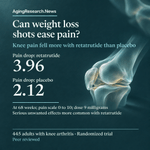
Sources and notes Retatrutide Once Weekly in Adults with Knee Osteoarthritis Pain and Obesity. The New England Journal of Medicine. DOI: 10.1056/nejmoa2610676 agingresearch.news/s/uakeu3 Two randomized, placebo-controlled phase 3 trials tested weekly injections in adults without diabetes who had painful knee osteoarthritis and body mass index (a weight-to-height measure) of at least 27. TRIUMPH-4 enrolled 445 for 68 weeks; TRIUMPH-1-OA enrolled 574 for 80 weeks. The paper does not give numbers per group. Pain scores ranged from 0 to 10, with higher scores indicating worse pain. Intervals below are 95% confidence intervals (CIs). TRIUMPH-4: pain changes were −3.96 with 9 mg and −3.74 with 12 mg, versus −2.12 with placebo. Differences versus placebo were −1.83 (CI −2.37 to −1.30) and −1.61 (CI −2.16 to −1.07). In the intention-to-treat analysis, which assessed participants as randomized, differences were −1.70 (CI −2.19 to −1.22) and −1.38 (CI −1.91 to −0.85). P<0.001 for all comparisons. Weight changes were −20.0% with 9 mg and −23.7% with 12 mg, versus −4.6% with placebo. Differences were −15.4 percentage points (CI −18.7 to −12.1) and −19.2 percentage points (CI −22.4 to −15.9); P<0.001 for both comparisons. TRIUMPH-1-OA: pain changes were −3.22 with 4 mg, −3.48 with 9 mg and −3.64 with 12 mg, versus −1.87 with placebo. Differences were −1.35 (CI −1.92 to −0.78), −1.61 (CI −2.20 to −1.02) and −1.77 (CI −2.34 to −1.20). Intention-to-treat differences were −0.96 (CI −1.61 to −0.30), −1.41 (CI −2.07 to −0.75) and −1.64 (CI −2.26 to −1.02). P≤0.005 for all comparisons. Both trials reported more serious unwanted effects with retatrutide than placebo. Gastrointestinal problems were the most common unwanted effects. - Main pain estimates used hypothetical outcomes after events suggesting treatment failure; intention-to-treat estimates also favored retatrutide. - Participants had no diabetes and body mass index of at least 27. - The paper does not give serious unwanted-effect rates.
13
A weight loss shot reached beyond the bathroom scale: knee arthritis hurt less, too. Pain fell 3.96 points with the shot versus 2.12 with placebo, on a 0 to 10 scale, in adults with obesity. Earlier work on this weight loss drug also reported less weight and pain in adults with obesity. The two new trials tested retatrutide, an experimental weight loss drug, as weekly injections against placebo. They included 445 adults over 68 weeks and 574 over 80 weeks. All had painful knee arthritis, no diabetes, and a body mass index—a weight-to-height measure—of at least 27. At 68 weeks, pain on a 0 to 10 scale fell 3.96 points with 9 milligrams versus 2.12 with placebo. Body weight fell 20.0% with that dose and 23.7% with 12 milligrams, versus 4.6% with placebo. Every tested dose also eased pain more than placebo at 80 weeks. The main pain estimates used hypothetical outcomes after events suggesting treatment failure. An analysis keeping participants in their assigned groups still favored the drug. Both trials reported more serious unwanted effects with retatrutide than with placebo; stomach and gut problems were the most common unwanted effects. The finding puts knee pain alongside body weight as a treatment outcome for people aging with obesity.
🤖 Made with AI
1
5
Sources and notes Hemodynamic effects of semaglutide in individuals with heart failure with preserved ejection fraction and obesity: a placebo-controlled randomized clinical trial. Nature Medicine. DOI: 10.1038/s41591-026-04762-3 agingresearch.news/s/zqethn Double-blind, placebo-controlled randomized trial of 81 patients, including 47 women, with obesity and heart failure despite pumping out a normal share of blood per beat. Patients received semaglutide, 2.4 mg weekly, or placebo for 52 weeks. The paper does not give the number assigned to each group. The primary outcome was change in pulmonary artery wedge pressure, an invasive measure of congestion and pressure as the heart fills, during low-intensity exercise. Baseline pressure was 17.5 ± 4.3 mmHg at rest and 31.7 ± 5.2 mmHg during exercise; mmHg means millimeters of mercury. Intervals below are 95% confidence intervals, expressing uncertainty around each estimate. Exercise pressure changed by −9.8 mmHg with semaglutide (interval −11.3 to −8.2) versus +0.9 mmHg with placebo (−1.3 to 3.0). The estimated difference was −10.6 mmHg (−13.3 to −8.0; P < 0.0001). The estimated difference in resting pressure was −7.1 mmHg (−9.8 to −4.4; P < 0.0001). Normal pressures at both rest and exercise at 52 weeks—the trial’s pressure-based definition of remission—occurred in 53.7% versus 7.4%. The odds ratio, comparing the odds of remission between groups, was 14.1 (interval 3.0−134.6; P < 0.001). - The main outcome measured heart pressure rather than hospitalizations or survival. - Participants had both obesity and this form of heart failure, restricting application to other patients. - Follow-up lasted 52 weeks, leaving longer-term outcomes unresolved.
3
If someone you love has heart failure and obesity, a weight loss drug lowered pressure as the heart filled. After treatment, 53.7% had normal pressures both at rest and during exercise. Earlier work in obesity-related heart failure found that a weight loss drug helped the heart’s upper left chamber stretch more. This trial tested the weight loss drug semaglutide in 81 people with obesity and heart failure whose hearts still pumped out a normal share of blood with each beat. They received 2.4 milligrams weekly or placebo for 52 weeks. An invasive pressure measurement showed congestion as the heart filled. During gentle exercise, pressure fell 9.8 millimeters of mercury with semaglutide versus a 0.9 rise with placebo. Resting pressure also fell. Normal pressures at both rest and exercise were reached by 53.7% versus 7.4%, meeting the trial’s pressure-based definition of remission. The main outcome measured heart pressure rather than hospitalizations or survival. The result helps explain how semaglutide could ease symptoms in this form of age-related heart failure.
🤖 Made with AI
1
6
Being able to stay active matters when you live with obesity. Over 72 weeks, adults taking a weight-loss drug reported greater improvements in physical function than those taking a placebo. Physical well-being is part of healthy aging, and weight-loss treatment raises questions beyond the number on the scale. An earlier trial found the same drug matched an insulin treatment on heart and blood vessel safety. The drug, orforglipron, was tested in two phase 3 randomized trials in adults with obesity, with or without type 2 diabetes. Participants reported their health on questionnaires over 72 weeks, with placebo as the comparison. Participants on the drug reported greater gains across most questionnaire areas. Physical function improved consistently; psychological and social benefits varied. The reported results do not give the size of the gains over placebo. These were people's reports, rather than tests of what they could physically do. Feeling more physically able adds a dimension beyond weight loss to evaluating obesity treatment for healthy aging.
🤖 Made with AI
1
3
4. No clear winner between kidney care plans for older adults Randomized trial · Lancet agingresearch.news/s/a6vrig
🤖 Made with AI
1
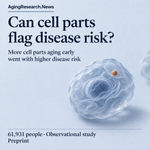
2. Measures of aging in cell structures linked to disease risk Human study · bioRxiv preprint agingresearch.news/s/azuec3
🤖 Made with AI
1
2
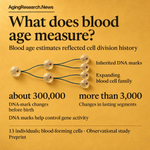
Aging research this week (Nov 2–8): the top four findings. 1. Human blood retains DNA-marking patterns formed before birth Human study · Research Square preprint agingresearch.news/s/64csdf
🤖 Made with AI
1
5
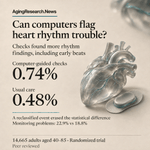
Sources and notes Leveraging AI-ECG Technology for Early Notification and Tracking of AF Development (LATENT): A Randomized Controlled Trial. Circulation; not a preprint. DOI: 10.1161/circulationaha.126.083540 agingresearch.news/s/tph6i9 Single-center, open-label randomized trial of 14,665 adults aged 40–85 without previous atrial fibrillation (AF) or atrial flutter (AFl), two abnormal heart rhythms. The artificial intelligence strategy analyzed heart electrical recordings: 7337 participants received this strategy and 7328 received usual care. High-risk recordings showing normal rhythm in the preceding year triggered an offer of up to seven days of monitoring. There were 84 (1.1%) high-risk intervention participants and 78 (1.1%) high-risk controls. Of the 84, 48 (57.1%) underwent monitoring, alongside 48 age- and sex-matched controls. Controls were selected before their recordings underwent computer analysis and received identical monitoring to reduce differences in opportunities for detection. Reporting cardiologists knew neither computer results nor group assignment. The primary combined outcome within 90 days comprised newly detected AF, AFl or prespecified related findings: frequent early atrial beats, short runs of these beats, or brief AF/AFl episodes. It occurred in 54 intervention participants (0.74%) versus 35 controls (0.48%); odds ratio 1.54, 95% CI 1.01–2.37; P=0.046. Hypothetically reclassifying 1 intervention event as a nonevent changed P to 0.057. Detection differed by initial computer-assessed risk: 32.1% versus 2.6% among high-risk participants and 0.4% versus 0.5% among low-risk participants; interaction P<0.001. AF/AFl detection was 0.3% versus 0.2%, and starts of drugs for abnormal rhythms at 180 days were 2.3% versus 2.4%; neither comparison showed a clear difference. Participant-reported monitoring-related unwanted effects, including skin reactions and discomfort, occurred in 22.9% of monitored intervention participants versus 18.8% of matched controls. - The primary statistical result was sensitive to reclassification of 1 event. - Participants knew their assignments. - The trial covered adults aged 40–85 without previous fibrillation or flutter.
15
Your heart can have an on-and-off rhythm problem even when a recording looks normal. Computer-guided checks found more rhythm abnormalities in a trial of 14,665 adults, including frequent early beats. Earlier work showed that a computer could flag intermittent irregular heartbeats from normal heart recordings. This trial tested whether such a warning could help find rhythm problems. The trial randomized 14,665 adults aged 40–85 without previous atrial fibrillation or flutter, two abnormal heart rhythms, to computer-guided monitoring or usual care. Software flagged risk in otherwise normal heart recordings. Forty-eight flagged participants and 48 matched controls wore heart monitors for up to seven days. Within 90 days, the combined finding of fibrillation, flutter or specified rhythm changes, including frequent early beats, appeared in 0.74% of the computer-guided group versus 0.48% of controls. Fibrillation or flutter alone showed no clear difference: 0.3% versus 0.2%. Starts of rhythm drugs at 180 days were also similar: 2.3% versus 2.4%. Monitoring-related unwanted effects, including skin reactions and discomfort, occurred in 22.9% of monitored intervention participants versus 18.8% of matched controls. The result was sensitive to a single event: reclassifying one detection as a nonevent erased the statistical separation between groups. The next test is whether finding more of these rhythm changes improves health for middle-aged and older adults.
🤖 Made with AI
1
10
When type 2 diabetes puts your kidneys at stake, a blood test takes on new meaning. Among 3,775 adults, a weight-loss program brought kidney benefits to the group whose blood showed more signs of heart strain. Lifestyle changes already had a kidney benefit in this trial: an intensive program reduced chronic kidney disease risk in people with type 2 diabetes. This later analysis covered 3,775 adults. It compared intensive lifestyle changes targeting weight loss with diabetes support and education, and tracked blood signs of heart strain and heart muscle injury over 1 and 4 years. Higher starting levels of either marker went with more heart and blood vessel events, whether or not people had kidney disease. The program lowered the risk of entering a very-high-risk kidney disease category in the higher heart-strain group; the lower group had no clear kidney benefit. The kidney finding came from a look back at subgroups within the trial. The paper gives no absolute kidney event rates, so the number of people helped is unknown. A heart-strain blood test is now a candidate for identifying who gains kidney protection from intensive lifestyle changes.
🤖 Made with AI
1
14