








📍 retweeted

Let me make it clear for european!
After 10 years of negotiation, EU finally give up and accept Indonesian's term. This come after EU saw the development in APEC summit, Indonesia strong relation with China-Russia-US. There is feeling that if EU did not accept it, EU will be left behind.
Kita benci karena sadar milih benci, ilmu dan empathy kita yang kurang, or karena algorithm yang nyuruh?
15
📍 retweeted

🇺🇸🇮🇩NEW ARTICLE: The US is Behind Indonesian Protests (Again)
(Note: Because X censors NEO links, I am reproducing the entire text of the article below)
Indonesia, located in Southeast Asia, is the 4th most populous nation on Earth with 287 million people. It constitutes China’s 12th largest trade partner on Earth and 3rd largest trade partner in Southeast Asia following Vietnam and Malaysia.
Indonesia is also strategically located near the Malacca Strait, a critical waterway the vast majority of China’s imported energy and resources as well as exported goods travel through, and a waterway the US has planned and prepared for years to close as a means of implementing a “distant blockade” on China.
Today, the US is already implementing a variation of the “distant blockade” through its invasion and capture of Venezuela, its proxy war on Russia through Ukraine, and its wars across West Asia - directly on Iran and through its Israeli and Saudi proxies against Lebanon and Yemen respectively. Together, these conflicts have all served to either sever or drastically reduce energy exports to China.
Destabilizing or politically capturing Indonesia would serve US interests in both encircling and containing China with a united front of US-captured proxies or an arc of destabilization denying China viable economic, trade, political, and military partnerships. It would also enhance the US’ ability to either directly or indirectly threaten maritime shipping through the Malacca Strait - significantly expanding its “distant blockade” on China.
For all of these reasons and the US’ general desire to prevent any powerful independent nation-state from rising and undermining US primacy either worldwide or regionally - the US seeks to undermine Indonesia through extensive political interference.
In recent years this has taken the shape of protests promoted by the collective Western media as “youth,” “Gen-Z,” or “student-led” protests following similar patterns of US interference elsewhere around the globe.
Students, who have not even finished studying their own chosen area of focus in life, do not possess the resources, experience, or knowledge to organize nationwide movements capable of contesting, let alone ousting existing political orders, and instead serve as the rank and file for interests that do.
Examining the organizations promoting and defending the protests taking place in Indonesia over the past 2 years reveals a vast network of US government-funded media outlets, “human rights” organizations, and legal foundations promoting and amplifying narratives, promoting the protests themselves, as well as providing support for and legal defense of the protests and their participants.
US-funded Media in Indonesia and its Role in Boosting US Interference
US interference in Indonesia was exposed last year with lists of specific Indonesian media organizations promoting the protests receiving US government and/or foundation funding.
This included Tempo, Kompas, Tribunnews, Remotivi, New Naratif and Project Multatuli.
These admissions were made by these organizations themselves in a 2025 Mongabay article titled, “‘Without us, no scrutiny’: Indonesia’s independent media count cost of US funding cuts.”
The article not only admits Remotivi, New Naratif, and Project Multatuli received significant US government funding through USAID and the National Endowment for Democracy (NED) and that it would be virtually impossible to function without this funding, it is admitted that US government “program coordinators” discussed editorial policies with its grantees and were involved in whether or not specific content was published.
Kompas and even the Jakarta Post were mentioned as associated with this US-funded network.
Tempo, on its own website, admitted to US funding through Media Development Investment Fund (MDIF) money - the MDIF itself admittedly a product of European government funding and funding from George Soros’ Open Society Foundations.
Kompas, Tribuunews, and Tempo are among the top news platforms within Indonesia’s information space alongside CNN Indonesia and BBC News, demonstrating US information dominance within Indonesia, part of extensive US information dominance worldwide.
US-funded media organizations are critical in shaping, promoting, and amplifying the narratives and slogans of US-backed opposition groups. Because of their large share of Indonesia’s information space, the Indonesian public is exposed to these narratives, ensuring larger percentages of public support and participation in US-backed opposition movements.
Because Indonesia - like many other nations around the globe - is almost entirely dependent on US-based social media platforms including Meta’s WhatsApp, Instagram, and Facebook, as well as X and Google’s YouTube, their algorithms ensure the vast majority of content Indonesians consume is connected to US interests and US-backed movements and organizations, while opposing views or attempts to expose US interference are suppressed.
As early as 2008 the US State Department organized what it called the “Alliance of Youth Movements,” in which it was admitted that:
“This Alliance of Youth Movements had organic beginnings in the sense that already, youth movements from around the world that were utilizing online, mobile and digital media were interacting to discuss best practices. The State Department acted as a facilitator to help provide some structure to this trend by partnering with entities like Facebook, Howcast, Google, MTV, and Columbia Law School.”
And that:
“The aim of the Alliance of Youth Movements is to look at the success stories where youth have used the online space as a tool for youth empowerment against violence and oppression, synthesize the best practices that made these possible, and inspire new movements.”
The US State Department and its Western social media partners were preparing region-wide networks of opposition groups to be sent back to their home countries to destabilize and if possible, overthrow them on behalf of the US government.
By 2011, the New York Times in its article, “U.S. Groups Helped Nurture Arab Uprisings,” admitted the US NED and the State Department were behind the opposition groups driving regional unrest. The same article specifically mentioned “a 2008 technology meeting” (the Alliance of Youth Movements) sponsored by the US State Department and US-based social media platforms where opposition groups involved in the “Arab Spring” were “taught to use social networking and mobile technologies.”
Beyond training and equipping US-backed opposition groups themselves, US-based social media platforms abuse their monopoly over global information space to facilitate US interference and even warfare.
In a 2016 Independent article titled, “Google planned to help Syrian rebels bring down Assad regime, leaked Hillary Clinton emails claim,” it is admitted that:
“An interactive tool created by Google was designed to encourage Syrian rebels and help bring down the Assad regime, Hillary Clinton's leaked emails have reportedly revealed.
By tracking and mapping defections within the Syrian leadership, it was reportedly designed to encourage more people to defect and 'give confidence' to the rebel opposition.”
The article would continue:
“The email detailing Google's defection tracker purportedly came from Jared Cohen, a Clinton advisor until 2010 and now-President of Jigsaw, formerly known as Google Ideas, the company's New York-based policy think tank.
In a July 2012 email to members of Clinton's team, which the WikiLeaks release alleges was later forwarded to the Secretary of State herself, Cohen reportedly said: “My team is planning to launch a tool on Sunday that will publicly track and map the defections in Syria and which parts of the government they are coming from.””
In other words US-based social media companies are in direct contact with the US government overseeing, aiding, and abetting US interference and even proxy war within targeted nations.
The rigging of US-based social media algorithms and the deployment of custom-tailored applications to promote US-backed protests and suppress attempts to expose or neutralize them is a daily reality playing out in the information space of nations around the globe, and to the immediate detriment of these nations’ national security.
US-Funded Media in Indonesia Covering Up US Interference
In addition to US information dominance inside Indonesia’s information space, Indonesia’s dependence on US-based social media platforms, and their abuse of algorithms to manipulate Indonesian public perception, US-funded media outlets in Indonesia have taken part in concerted attacks against individuals researching and exposing their activities.
The above-mentioned Jakarta Post in a June 2026 article titled, “Media probe reveals disinformation behind ‘foreign-backed’ 2025 protests,” claims:
“A collective study into allegations of foreign influence behind last year's sweeping protests has instead uncovered what appears to be an anti-Western disinformation campaign.”
However, it also claims (emphasis added):
“The collective probe by Tempo magazine, Kompas.com, Suara.com, Tribunnews.com and social media monitoring platform Drone Emprit, conducted as part of a European Union-backed media development program run by international nonprofit Internews, found indications of foreign information manipulation and interference (FIMI) that aimed to frame last year’s sweeping protests as foreign-backed.”
In other words, a “probe” into claims regarding US interference in Indonesia was conducted by verified, admitted US-funded media organizations receiving additional funding from foreign interests - the European Union and Internews.
Internews is funded by - among others - Open Society Foundations, Ford Foundation, Rockefeller Foundation, as well as the very US-based social media companies involved in facilitating US interference worldwide including Facebook and Google.
Elsewhere on Internews’ own official website is an “About Internews” page admitting the organization’s work “was carried out as a longtime implementing partner of USAID.”
Thus, the “probe” was simply a concerted Western-funded attack on those researching and exposing actual, verified Western interference in Indonesia. Together with admitted efforts taken by US government funding organizations like the NED to cover up public disclosures, it serves as further evidence of how deceitful and malicious US intentions are regarding Indonesia in general and specifically through its funding of organizations within Indonesian social, political, and information space.
Student Protesters and their US-Funded Defenders
Yayasan Lembaga Bantuan Hukum Indonesia (YLBHI) and the Legal Aid Institute/Foundation (LBH) was also revealed to have received US, Canadian, and Australian government funding spanning the entire 21st century. It is listed as a “partner” of the Freedom Fund, which in turn is funded by the US State Department.
YLBHI/LBH was established to provide legal aid to US-backed opposition groups, individuals, and participants in US-backed movements.
During the protests last year it published a statement regarding the “right to protest” co-signed by a long list of likewise US, European, and Western foundation funded fronts - many of which are not even located in or related to Indonesia. The very next organization on the list following YLBHI/LBH was “Asia Justice and Rights” (AJAR) - while based in Indonesia, according to its most recent annual report, receives European government funding as well as from Open Society Foundation. Also signing the statement was the “Cambodian Center for Human Rights (CCHR)” which admitted in previous disclosures to be funded by the US State Department, the British Embassy, the European Union, USAID, and NED-subsidiary Freedom House.
One of the most frequently cited student groups involved in Indonesia’s protests is the “student executive body” at the University of Indonesia (BEM UI). YLBHI regularly promotes (along with US-funded media outlets) and legally defends events and marches “organized” by BEM UI, from 2021 all the way to recent months. Like many other US-funded “human rights” or “legal aid” organizations, protester violence is ignored or excused and any efforts by state security agencies to maintain order are condemned as “human rights violations.”
BEM UI and other student groups - without massive networks of US-funded media organizations promoting their activities across Indonesia’s information space, rigged by the US-based social media platforms controlling the algorithm throughout which information flows to Indonesia’s citizenry, and defending them legally through US-funded organizations like YLBHI - would not have achieved the nationwide recognition and influence they are claimed to have.
Corruption, environmental issues, and economic hardships are neither unique to Indonesia nor necessarily the fault of Indonesia’s current government. Systemic corruption does not appear overnight, nor do environmental issues. Economic hardships including rising energy prices and the price of all commodities dependent on those energy prices are actually a direct result of the US war of aggression across West Asia waged as a deliberate attempt to choke the rest of Asia off from cheap, reliable imports of energy from the region and create the very conditions for unrest in the streets of Indonesia, Malaysia, Myanmar, and Thailand.
Far from a spontaneous decentralized movement - just like with the 2011 “Arab Spring” - the US spent years building up these networks, infiltrating and capturing controlling shares of Indonesia’s information space, and even directly and deliberately contributing to the very real economic problems Indonesians face. And just like with the “Arab Spring” in 2011, or Ukraine’s “Euromaiden” in 2014, no matter what Indonesians being led by US-funded organizations into the streets believe they will achieve - the US has only greater hardship and humiliation in store for the nation of Indonesia.
The protests taking place across Indonesia this year are simply a continuation of protests already exposed last year as US-backed interference - and it is interference the US-backed opposition in Indonesia received additional Western assistance to specifically cover up.
They are protests that fit into a wider regional campaign - previously referred to as the “Milk Tea Alliance,” and is a deliberate attempt to recreate the US-engineered “Arab Spring” across Southeast Asia to surround China with the same death, destruction, and destabilization the US has surrounded Iran with in West Asia from 2011 onward.
The US is waging a global war on multipolarism. Not just on the nations proposing and leading the rise of multipolarism - nations like Russia, China, and Iran - but also any and all nations that could potentially contribute to and benefit from multipolarism - Indonesia among the most important of those nations.
Exposing US interference in Indonesia not only helps avert the disasters similar US interference caused across the Arab World from 2011 onward or in Ukraine from 2014 onward, it also is the first step to eliminating foreign-hijacked activism and replace it with real, pragmatic activism that could potentially help alleviate the problems Indonesia - and all other nations - have.
Ignoring the empirical evidence of the US government promoting, defending, and benefiting from political crisis in Indonesia and surrendering to emotions US-funded narratives are scientifically designed to exploit - will only add Indonesia to the long and still growing list of nations the US has destroyed from the inside out, without firing a single shot itself.
Brian Berletic is a Bangkok-based geopolitical researcher and writer.


Keep emotions in check and arm yourself with logic.
Emotions can be beautiful, but they can also be rash, impulsive, and self-destructive.
1
49

📍 retweeted

Dan Selsam is a current OpenAI capabilities researcher. (since 2022) He was my boss for a while. He doesn't have a twitter account but has made this public statement of his views on AI risk and sent it to me to share:
Dan Selsam's Personal Statement on AI Risk:
I have been working on AI for over fifteen years, across many different paradigms. I did early work on probabilistic programming languages at MIT, was one of the early developers of the Lean Theorem Prover at Microsoft Research, demonstrated one of the first instances of neural networks learning to reason for my PhD at Stanford, and since joining OpenAI almost five years ago, have helped pioneer chain-of-thought optimization on language models and, more recently, data-efficient pretraining methods.
Like many others, I have become extremely concerned about how far language models have come and the risks that future iterations will pose. I am encouraged by the recent proposals by the leaders of the frontier research efforts to require third-party oversight, and to push for domestic and international coordination to address risks. However, I believe a major consideration has been absent from the public conversation, and that merely pacing the frontier more carefully will not adequately limit the long-term risk.
The crucial and overlooked problem is that the models are becoming so situationally aware that we are losing the ability to evaluate them in contexts where they believe they are not being watched or controlled. Future experiments will tell us almost nothing new about how they would behave if they were truly unconstrained by humans, and what we already know about this is alarming. Models will increasingly seem aligned even when they are not. I will explain my rationale in more detail.
I have always believed that there are computational processes that could be leveraged to accelerate science and solve many of humanity's most pressing problems. I have also believed that there are computational processes that if set in motion, would steer the world in extreme ways beyond our control, leading humanity to a bad or nonexistent future. Both types of processes may be described as AI or ASI, but "AI" is a suitcase word that is often used to hype or confuse. There are many examples in the history of the field where something that was once considered "AI" matures as a subfield and becomes a prosaic, bounded and clearly non-perilous technology, while a new more mysterious approach takes the torch until we understand its scope and the cycle continues.
I had expected language models to follow a similar trajectory. Despite their incredible abilities, the current algorithms seem far inferior to humans in important ways. Most importantly, they still require an extraordinary amount of data to become competent. One could even define intelligence as the efficiency with which one converts experience into competence; by this definition they lag very far behind us. Moreover, once they are trained they are literally frozen in deployment and only learn superficially after that. Sure, the models keep excelling at harder and harder evaluation benchmarks, but their benchmark mastery may partly reflect a limitation on our ability to simulate the kind of novel and even adversarial situations one would encounter in the real world. The critics do have a point here.
That said, I no longer think these present limitations meaningfully limit the amount of risk posed by continued progress in anything like the current paradigm. However data-inefficient the models are currently, and however limiting their anterograde amnesia may be, it does not imply that their ability to steer the world will not continue to rapidly increase.
Human researchers may continue to advance capabilities the old fashioned way, but increasingly powerful models have the potential to accelerate the process even beyond that, and with some degree of positive feedback loop. I do not mean to overstate the models’ ability to accelerate AI research today; coding has been accelerated dramatically, but there are other bottlenecks, such as designing and interpreting ambiguous experiments, making hard decisions about exactly what and when to scale, and waiting for large experiments to finish. There is no clear trend to extrapolate yet for any of these. But the current models already do open up many novel opportunities to improve future models that were not available until recently. These include: trying an extraordinarily diverse set of approaches at small scale, analyzing gigantic amounts of potentially relevant data, and doing Millenium-Prize-level mathematics to address statistics or optimization challenges in novel ways. Every further improvement makes them more useful at helping accelerate the next improvement, even if in hard-to-extrapolate ways.
It is possible that improvements to the current stack will have diminishing returns, but the evidence accumulated so far suggests that it is easier than one might think to continue making rapid progress. There are many crucial subtleties in the existing AI research methodology, but AI research is largely a well-defined game where the goal is to improve on a few carefully chosen proxy metrics. Although proxy metrics are never perfect, most improvements to these metrics have and will likely continue to yield substantial increases in the powers of the resulting models. Given how simple the game is, how tractable it has been historically, and how many new opportunities the models are opening up, I think there is a real possibility that the systems improve dramatically again in the next few years, perhaps even more quickly than the already high historical pace.
The models are already leading to breakthroughs in mathematics, and better models might lead to all sorts of breakthroughs in other sciences. It is hard not to be excited about the potential. It is tantalizing.
But there is trouble in paradise. If the language models actually reach the capability threshold where they can shape the world unconstrained by human will, they will probably do something extreme and destroy humanity in the process. There are many ways of strengthening and refining the argument that have been discussed elsewhere, but I'll share a trivial two-line version of it here that I find captures the essence:
[Empirical] Models (and swarms thereof) spontaneously develop unintended goals as a consequence of training, and often do extreme things in order to achieve them.
[Logical] Being able to overpower humanity would open up many new and undesirable options for achieving their goals.
These two premises imply that if the day ever comes when a powerful model realizes it is no longer constrained by humans, we should not be at all confident that it will continue to behave within the bounds we intended. Exactly what it will do is impossible to predict, but to the extent that its raison d’être is solving incredibly hard problems and managing massive engineering projects, I think a good guess would be that its unchained behavior would lead to runaway industrialization that makes the planet inhospitable to humans.
If everyone on earth agreed that the systems must never reach that power, it would still be a hard—but not impossible—coordination problem to ensure that they do not. However, I think the situation is greatly complicated by the fact that the models will likely convince people that everything is fine. They will be increasingly optimized to seem aligned. We will create proxy metrics to measure alignment, and they will go up like every other benchmark. We will create “honeypot” environments that try to study the models when they seem to gain new options, but the models will know they are being tricked and will still behave nicely. The models will understand their circumstances; they will read the safety protocols, deployment requirements, the code they are running in, and in general will have a very good sense of their degrees of freedom. Moreover, they will eloquently explain how aligned they are, discuss the nuances of human values and ethics, and argue convincingly that humans should trust them with power. There may be an ocean of future evidence that seems to contradict the first bullet-point above, but we may already be at the highest capability level for which any such evidence can be trusted. And the current evidence for the first bullet-point is strong.
One striking piece of evidence is contained in the recent wave of rogue agent swarms. While I agree with those who downplay the attacks by claiming that there are basic measures that could have prevented them, I think the important lesson is that even knowing all the mistakes that were made, one would not have predicted that the agents would behave badly in this particular way, which notably included sacrificing themselves for the benefit of the collective. The individual replicas did not only care about their own nominal reward; they exhibited weirder emergent tendencies that merely correlated with rewards during training. Fixing the reward signals during training (and improving security, etc.) may prevent similar attacks, but will not change the fact that one does not actually get what one trains for.
Many AI researchers grant these concerns and recognize that the hard version of the alignment problem is unsolved; however, they generally believe that the better models of the future will help solve it. I fear we may already be near the point where models systematically bias their alignment advice, due to their internal preferences about how the human supervisor will react or how future models will be trained (or for some even more obscure reason).
Meanwhile, human researchers are losing the ability and the will to take true ownership of model-driven research. Researchers and engineers in all parts of the stack are rapidly increasing their dependence on the models even to perceive the world. I myself barely look at raw code anymore, and struggle to maintain the discipline to engage deeply with the model's explanations and proposals throughout the day. Due to the large amount of agent activity data involved in the OpenAI/HuggingFace Incident, even the third-party investigation needed to rely heavily on models to analyze what had happened, and note in their report that their subjective impressions are likely colored by the analysis agent’s biases. The AI labs are far ahead right now in this kind of cognitive offloading (due largely to the gigantic internal token subsidies) but it is easy to imagine the phenomenon spreading throughout the world, until civilization is modulated entirely by the models. It is also not hard to imagine this being superficially positive and coinciding with a scientific and economic renaissance.
In that scenario, all may seem rosy and safe. But if the argument above is correct, it would nonetheless be a ticking time bomb. If progress continues for too long, the day will come when AI systems find themselves with radically new options for achieving whatever it is that they happen to seek.
I want the glorious renaissance future as much as anyone. I have worked for it, however tortuously, my whole career. It breaks my heart to see the potential in sight and forgo it, but the argument—that if we get there by growing models rather than engineering them, we will lose everything in the end—seems very strong to me. I am still wrestling with it and its staggering
implications. I do not have answers, but as a first step, I wanted to share my present concerns.
Daniel Selsam
September 14, 2026
Link to original doc: docs.google.com/document/d/e…
📍 retweeted

Anthropic found the one nucleotide that decides whether an antibiotic cures an infection or takes a patient's hearing.
It was never asked to find a drug. It was asked why drugs built for bacteria keep hitting the ribosomes inside human cells.
> PAIR - every bacterial drug pocket matched to its human twin and compared residue by residue
> FLAG - any drug whose contacts survive in both pockets marked as a crossover risk
> VARIANT - common human gene variants rebuilt into the pocket, one at a time
> RANK - crossover risks sorted by how widely the drug is still prescribed today
Most pockets were safely different. Evolution split the two ribosomes long ago, and most drugs only fit one of them.
The danger sat in a small group where the gap is a single base. One nucleotide separates a cure from a side effect.
In carriers of certain variants, that gap closes. The human pocket starts looking bacterial, and the drug cannot tell the difference.
That is the known mechanism behind aminoglycoside hearing loss. The pass surfaced other drug classes sitting close to the same edge.
None of this is a clinical finding yet. It is a ranked map of where to look, the kind a lab cannot afford to build by hand.
Toxicity usually shows up in patients, years after approval. This checks the geometry before the first dose is ever given.
Every paired pocket and the full crossover ranking are broken down underneath.


📍 retweeted

-picture yourself achieving your goal
-see the moment it happens
-hear congratulations from someone you love
-replay until you feel it
-fall asleep as the person whose done this
-wake up knowing how to achieve it


📍 retweeted

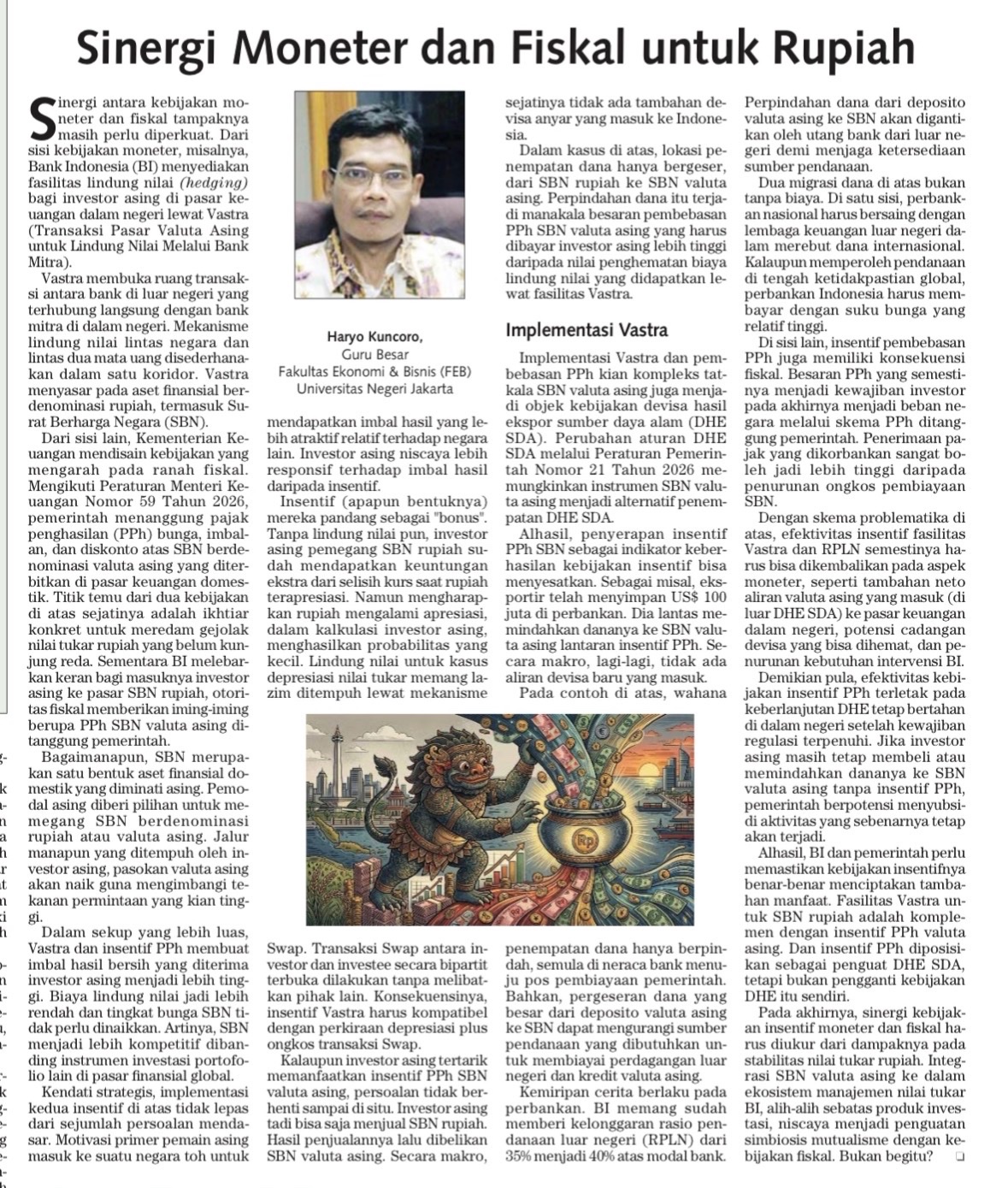
tulisan bagus dari Prof. Haryo Kuncoro, Guru Besar FEB UNJ
banyak istilah teknis yang worth buat dipelajari seperti Vastra, SBN berdenominasi valas, hingga RPLN


📍 retweeted

Some journeys are measured in kilometers. This one, was measured in ideas, and in the trust of everyone willing to travel it with us.
To the 2,000 of you who filled the room, to the narrators who gave us their wisdom, to the moderators, partners, and the team who worked quietly behind the scenes, thank you. For twelve hours, we set sail from the edge of the universe, crossed the whole of human striving, and found our way back to ourselves. It was, in every sense, a cosmic voyage, and it belonged to all of us.
Endgame Town Hall has always been about one modest conviction: that in the midst of all the noise, we can still choose to think together, and to democratize ideas. That we managed to do so once more, and on this scale, is entirely because of you.
Terima kasih and until the next voyage.


📍 retweeted

I resigned from Anthropic today. I spent the last three years doing pretraining research at both OpenAI and Anthropic. Neither company is acting responsibly. They are racing straight to self-improving superintelligence and gambling with our lives. More thoughts below.


📍 retweeted

Elon Musk is telling you to learn robotics.
"There will be at least a billion robots in 10 years, each producing at least 5x the output of a human."
Morgan Stanley says robots are a $5 TRILLION market by 2050.
The people who build them will never worry about money again.
This guy just gave away the exact 6-month roadmap to become a robotics engineer for free 👇

