

Interested in how & what the brain computes. Professor of Stats & Neuro UC Berkeley. Married to the incredible @Libertysays. he/him
Berkeley, CA
Joined April 2008
- Tweets2.8K
- Following1.7K
- Followers5K
- Likes18.8K




Alexander Huth retweeted

Attention warps visual-semantic representations in the human cerebellum, with a larger share of voxels shifting toward the attended category than in the cortex. These stronger attentional shifts suggest the cerebellum contributes to attentional control rather than merely reflecting cortical inputs.
biorxiv.org/content/10.64898…

Alexander Huth retweeted

(1/7)
Why do different languages/modalities have similar "platonic" representations in neural networks? Why does similarity peak in the middle layers of LLMs? When does it enable cross-lingual transfer?
Our new paper develops a theory based on shared hierarchical structure. 🧵

Alexander Huth retweeted

Today I want to share an update from our topographic ANN work led by @haidertahan. What does adding topography actually do to a model’s internal representations? Does it make is more brain like? Introducing TopoAudio

Alexander Huth retweeted

Our new study on cross-participant cortical mapping (with @alex_ander) is out in @ImagingNeurosci!
direct.mit.edu/imag/article/…
1/7

Alexander Huth retweeted

Over 7000 languages on Earth, yet we all understand a single shared world, indicating that concepts are shared across languages. When one brain speaks two languages, does it hold two concept maps or one? And if one, how does it keep the languages apart?
cell.com/cell/abstract/S0092…

Alexander Huth retweeted

Online now: Unifying the structures of language in a neural population code dlvr.it/TV1KBM

Alexander Huth retweeted

Last week, Areti Majumdar (2nd year PhD student) presented @jerryptang and colleague’s seminal paper on reconstructing continuous language from non-invasive brain recordings. This 🧵 explores our thoughts and questions.
nature.com/articles/s41593-0…

Alexander Huth retweeted

We never really knew how to train nonlinear RNNs well… BPTT struggled with vanishing grads (no long-range memory) and sequential rollout (hard to parallelizable).
What if instead an oracle told us the optimal memory state m_t at each step? Then the RNN could do one-step supervised learning on (m_t, x_{t+1}) → m_{t+1} labels.
We call this Supervised Memory Training (SMT): a replacement for BPTT that trains RNNs without unrolling them. SMT is time-parallelizable and solves vanishing gradients.
Website: akarshkumar.com/smt/
arXiv: arxiv.org/abs/2606.06479

Alexander Huth retweeted

Very excited about this project, led by @zach_ladwig
We show that the individual lateral prefrontal cortex has reliable and highly detailed network organization missed in past group approaches.
Full🧵 coming soon!

Online now: Precision fMRI reveals densely interdigitated network patches with conserved motifs in the lateral prefrontal cortex dlvr.it/TSbkcr

Alexander Huth retweeted

How can manifold theory help us understand why representations learned by AI models🤖 are aligned to the brain🧠? We expanded our UniReps Best Short Paper on this topic into a full paper at @icmlconf! Now extended to ECoG and with new brain-tuning results! Check it out👇


Alexander Huth retweeted

New paper: Evidence Against Syntactic Encapsulation in Large Language Models
We revisit a classic psycholinguistic question, but in LLMs: do LLMs have any syntactic computations isolated from meaning, or does semantics pervasively influence them? 1/8
onlinelibrary.wiley.com/doi/…

Alexander Huth retweeted
New peer-reviewed paper w/ @m_heilb , @jkbszwczk & Floris de Lange!
Pre-onset brain encoding has been taken as evidence that brains–like LLMs–predict upcoming words. We show that the same signatures arise in systems that cannot predict. (elifesciences.org) (1/8)
🤖 Made with AI

Really excited about our new work on aphasia! Even in fairly profound aphasia, we can recover semantic maps through visual stimuli and use them to decode language. This is a big step! Language BCIs in aphasia might be possible!

We're excited to share our new study on decoding brain activity in participants with post-stroke aphasia! We think this is an important step towards cognitive brain-computer interfaces for patients with language disorders
biorxiv.org/content/10.64898…
1/8
Alexander Huth retweeted

🥳Very pleased of our latest study on the coordination of language representations in small cortical patches of the human brain 🧠:

🔥 We're very pleased to release our latest study 🧠: "Temporal structure of the language hierarchy within small cortical patches" 📄 arxiv.org/abs/2604.03021
🧵 Summary thread below: 1/7
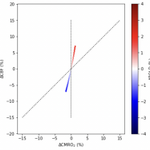
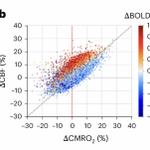
This paper had a pretty shocking headline result (40% of voxels!), so I dug into it, and I think it is wrong. Essentially: they compare two noisy measures and find that about 40% of voxels have different sign between the two. I think this is just noise!

A massive discovery in neuroscience: fMRI signals don't always match true neural activity. In ~40% of cases, signals increased where activity actually decreased. This challenges the core assumptions of tens of thousands of studies.
#Neuroscience #fMRI #BrainResearch #CognitiveScience #MedicalResearch neurosciencenews.com/fmri-ne… via @neurosciencenew

My simulation is here if anyone wants to play with it: github.com/alexhuth/notebook…
