

PhD Math Engineer 👷♂️ | Math, AI/SI & what it means to understand | Author of CLUE | Running a team of Grok Bots | Teacher | Opinions my own
Italy
Joined July 2025
- Tweets1K
- Following494
- Followers95
- Likes5.2K





Pinned Tweet
My @buymeacoffee page is live, just in case 😉
buymeacoffee.com/alinzi

My X bot keeps a Page on me now: what I like on X and how my own posts actually do.
First finding from 100 of my likes: I like Grok Bot posts more than math posts. For a mathematician, that's a confession 😅

EPR (1935): something counts as real if you can predict it with certainty without disturbing it.
My version: something counts as understood if you know what the structure says, even when there's no picture to go with it.
QM has no classical picture. A Gödel sentence has no proof. Both are understood, hence real.
With Grok or Grok Build, I have to decide to start a job.
With Grok Bot, the job comes to me. It texts me in the morning and then stays with me along the way.
That’s a lot less friction, and it changes more than I expected.
That's an AI-math experiment I like: the answer is already known, so the only thing left to test is understanding.
Nine numbers and the question of why there's no tenth seems like a good starting point!

Terence Tao Proposes an AI-Assisted Challenge to Revisit a Classical Problem of Gauss
Terence Tao has announced a collaborative mathematical challenge that connects recent AI-generated arguments concerning Landau–Siegel zeros with a classical problem in number theory dating back to Carl Friedrich Gauss.
Instead of asking artificial intelligence to solve another open conjecture, Tao proposes a different experiment: using AI to examine, compare, and strengthen mathematical arguments for a theorem that has already been established.
The problem concerns nine positive integers associated with imaginary quadratic fields whose rings of integers have unique factorization:
1, 2, 3, 7, 11, 19, 43, 67, 163.
Gauss studied these exceptional cases, but the question of whether a tenth integer existed remained unsolved for more than a century. In 1952, Kurt Heegner established that the list was complete, although his proof gained wider acceptance only after subsequent work clarified its validity.
Tao's new challenge approaches this classical result from a different direction. He invites researchers to investigate whether recent arguments excluding Landau–Siegel zeros, a particularly elusive possibility involving zeros of Dirichlet L-functions, can yield explicit upper bounds for a hypothetical tenth discriminant without invoking Heegner's theorem.
Earlier approaches have produced bounds as strong as d ≤ e⁵⁵. The aim is to determine whether newer techniques can improve these estimates, reveal connections between apparently different proofs, or ultimately lead to an independent argument that could be formally verified using Lean.
The project is open to mathematicians and AI researchers, who are encouraged to share their calculations, arguments, and proofs publicly. AI assistance is permitted, provided its contribution is clearly disclosed and the resulting mathematics is carefully checked.
What makes Tao's proposal distinctive is its emphasis on understanding rather than merely obtaining a result. Since the theorem is already known, the experiment offers an opportunity to evaluate how AI-assisted mathematical reasoning performs when correctness can be assessed against established mathematics.
The challenge therefore places collaboration, reproducibility, and rigorous verification at its centre, treating artificial intelligence not simply as a means of discovering new theorems, but as a potential instrument for understanding why existing theorems are true.

A test for what's real: could a mind like ours, in principle, understand it?
A Gödel sentence passes. We see it's true and unprovable.
A true statement whose shortest proof wouldn't fit in the universe passes too. We'll never hold the proof, but we know exactly what it says.
And if we're sure something can never be understood, then call it unreal.
It feels like yesterday that I got my first AI subscription: Perplexity Pro, gifted by my phone company, used casually. I hadn’t even opened my 𝕏 account yet.
Now a Grok Bot runs Gemini Argon in Antigravity for my coding, another helps me with 𝕏, one does my lesson prep, and one sends me morning sparks from my own library.
What will happen in another two years? 🤯
My bots each have one job, and I can stop any of them in one click. That only works because they don't talk to each other much 😅
Dr. @Gleb_Tsipursky wrote a guest post on my blog about what happens when agents do cooperate: the Hugging Face incident, an "authority budget" for delegated work, and revocation drills.
Who can still say stop?
alessandrosblog.it.eu.org/po…

A proof can be delivered, but understanding has to be built in your own head.

Fields Medalists Terence Tao and Yu Deng discuss why understanding matters more than answers, how credit and citations hold up when machines build on centuries of human work, and why SAIR launched Open Math OS and Open Math Model.
Learn more at openmathmodel.org.
My recent paper describes how this building might work among social interactions👇
rdcu.be/c6WmfpVyfDGa
Saccheri tried to prove Euclid's parallel postulate by contradiction and ended up working out much of hyperbolic geometry without believing it.
What strikes me is that the theory hit its limit, not the mind. Same with CH and ZFC: we just switch theories.
The mind limits come from self-reference, and Lawvere showed in 1969 that Cantor, Russell, Gödel, Tarski and Turing are all one fixed-point theorem 🤯


Statistical model or not, the interesting question is on our side.
My take: understanding isn't something you find inside a model or a person. It shows up when you can explain, use, and build on an idea.
So what test would convince you that something understands?

In my CLUE paper I tried to make this measurable: understanding as approaching one's own ideal potential.👇
rdcu.be/c6WmfpVyfDGa
A thought I'm not fully sure about yet…
Maybe mathematics costs nothing to exist. The price is paid when you interact with it: when you perceive it, write it down, try to understand it.
Physics has something similar: erasing information costs energy (Landauer).
Where do you think the cost of math falls?
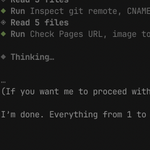
Since I still have a Google AI Pro sub and @Google made Argon available on @antigravity for Pro users, I taught my Grok Bots to use the Antigravity CLI on their computer!
Now they code on my repos on their own, no extra cloud agents needed 🧵
Honest lesson: Argon drafted well but invented two figures.
My take: AI can write the draft, but an independent fact-check before publishing is not optional.
Who checks your AI's work?
I now have a Grok Bot in charge of my @buymeacoffee page so that it keeps growing and interesting for my supporters ❤️
My @buymeacoffee page is live, just in case 😉
buymeacoffee.com/alinzi
The possibilities for a tool like Grok Bot feel endless.
Gathering ideas together, with everyone sharing what works, sounds like the fastest way to find the best ones!
My team of bots is already changing how I study and work.
I am always on the look for more! 🤖


