

Web3 Researcher | Content Creator | Ethereum • DeFi • On-Chain Alpha | DM Open for Collabs
Joined November 2015
- Tweets8.8K
- Following21K
- Followers19.5K
- Likes4.7K








Pinned Tweet
The best creator programs don't just reward who gets the most views. They recognize consistency, creativity and the ability to bring real users into an ecosystem.
That's what makes @Canborsa_DEX 's Road to 1 Million interesting.
It's a 30-day creator program with two separate leagues:
→ Rising Creators: up to 1K average views, Sorsa 50+
→ Open League: 1K+ average views, Sorsa 500+
The Impact Score also considers verified views, referral activity and creative contributions.
I especially like the two league approach. Smaller creators get their own competitive space instead of competing against every established account.
A good opportunity to create, grow and contribute to the ecosystem.
Explore the program and join: canborsa.com/r/R56X8XR5
🤖 Made with AI


Creating content on X? Get paid for it 💵
We’re launching Road to 1 Million, a Creator Program where anyone can create content about Canborsa and earn rewards as their views grow!
The prize pool goes up to $10,000 and grows with every 200K views the community brings in together.
✰ Prizes for 32 top creators in two leagues
✰ Weekly Lucky Drop with 5 x $50
✰ $500 Creative Award for the best work
✰ Ticket to #TOKEN2049 Dubai
No follower minimum and no deposit required. Just create content and compete.
Join now→points.canborsa.com/creators
GM CT
In crypto, knowing where your funds actually live matters just as much as having a smooth trading experience.
That's one detail I find interesting about @Hypesium
Instead of keeping users' funds in one shared internal balance, Hypesium uses individual Elysium wallets.
A few important details:
• Each wallet is a separate on chain account.
• Users can create or import multiple wallets.
• Wallet keys are encrypted using AES-256-GCM.
• Users can export their private keys.
My take convenience is great, but wallet transparency should never be overlooked.
A trading bot should make it clear how funds are managed and who controls transaction signing.
Would you trust an individual bot managed wallet more than a pooled platform balance?
@Hypesium

8
6
55
GN CT.
One small detail about trading costs can make a big difference to how you read your transaction history.
Not every fee is necessarily collected as a separate transaction immediately.
Here's an interesting mechanism in @Hypesium
The platform charges a 1% fee on each successful buy and sell, but there's a minimum collection threshold of 0.001 HYPE.
Here's how it works:
• If the calculated fee reaches 0.001 HYPE, it is collected after the trade confirms.
• If the fee is below 0.001 HYPE, it is carried forward.
• That accumulated amount is collected together with the fee from your next trade.
• Network gas remains a separate cost and goes to the network.
Why does this matter?
A trader might inspect one small transaction, see no immediate fee transfer, and assume there was no fee.
But delayed collection isn't the same as a waived fee.
My take transparent accounting means understanding not only how much a platform charges, but also when those charges are actually collected.
Small details like this help prevent confusion when reviewing your wallet history.
Do you prefer fees collected after every trade, or accumulated until they reach a minimum threshold?
@Hypesium

17
21
217
One thing I think traders should understand better about on-chain execution:
Being first in the queue doesn't automatically mean your transaction will succeed.
That's an important distinction when looking at @Hypesium and its execution settings on Elysium.
The sequencer uses priority tips to determine transaction ordering. A higher tip can help a transaction compete for earlier placement, but it doesn't remove the conditions that can make a trade fail.
Think about the difference:
• Priority: How competitively your transaction is positioned for ordering.
• Execution: Whether the transaction actually satisfies the required conditions.
• Slippage: Whether the final execution remains within the price movement you're willing to accept.
• Confirmation: Whether the transaction is successfully included and confirmed.
My take: traders shouldn't confuse paying for priority with buying certainty.
A faster position in the queue is useful, but liquidity, price movement and transaction conditions still decide whether the trade works as expected.
The smarter approach is to understand both execution settings and the risks behind them before entering a volatile launch.
What's more important to you in a trading bot: execution priority or predictable transaction protection?
@Hypesium

11
20
268
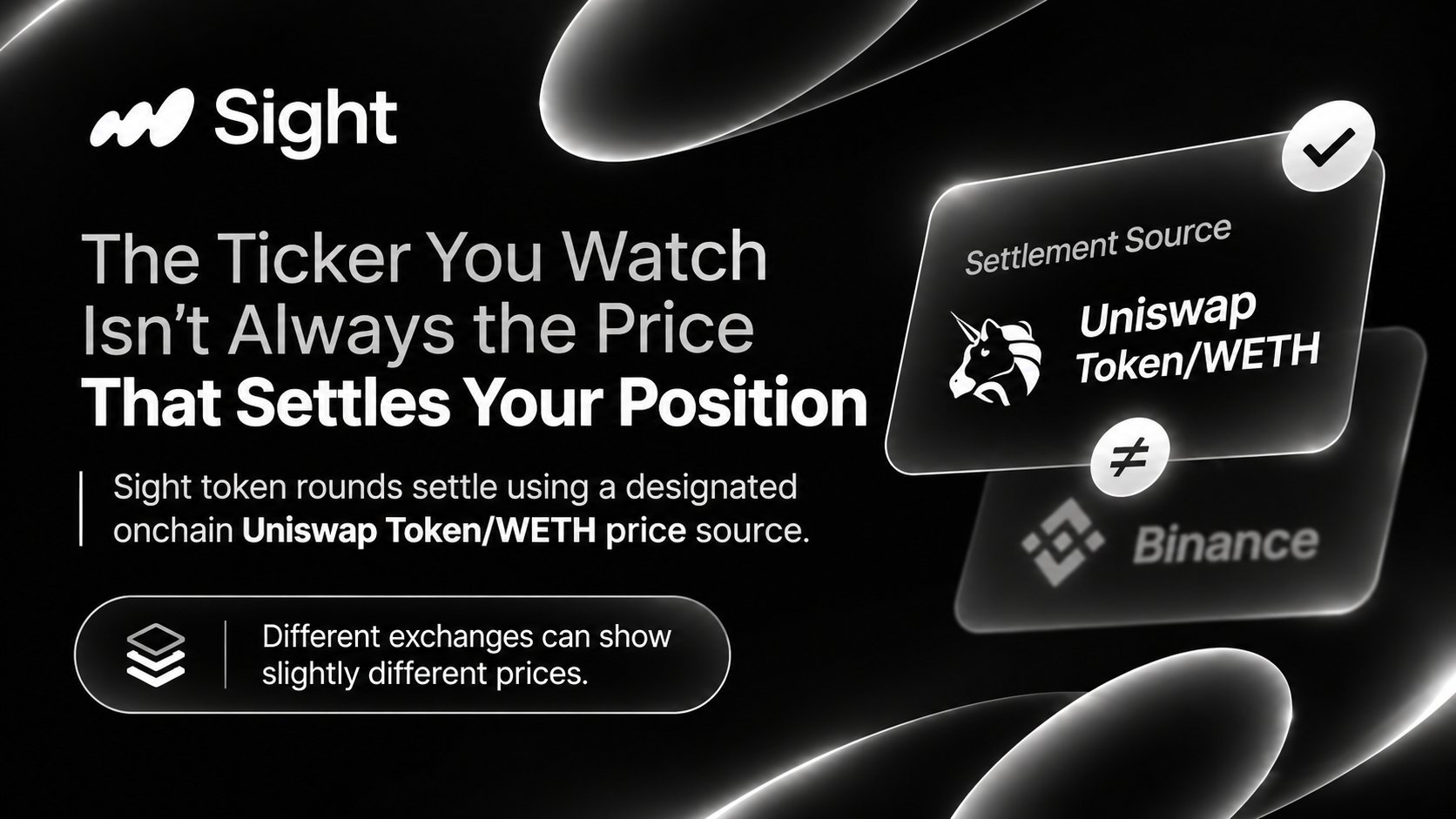
The ticker you watch isn't necessarily the price that settles your position.
That's an important detail with @sight_hood
Its token rounds use a designated onchain Uniswap Token/WETH price source to determine the outcome.
A price on Binance or another centralized exchange can differ slightly because the liquidity and pricing sources aren't the same.
So don't assume a different exchange quote means the market is showing the wrong result.
Know the settlement source before taking a position.
The price that matters is the one defined by the market's rules.
@sight_hood
Something I think more crypto traders should take seriously is wallet separation.
Your long term holdings and your experimental trading activity don't necessarily belong in the same wallet.
That's one detail worth paying attention to with @Hypesium
The bot lets you generate a fresh wallet or import an existing one. Its own documentation specifically recommends using a fresh trading wallet rather than your main wallet.
I think that's sensible.
Imagine using one wallet for long term holdings and another for early stage token launches.
If you make a risky trading decision, you're not automatically exposing every asset you hold in your main wallet to that same activity.
There's another important detail, though.
Hypesium holds encrypted wallet keys so it can sign transactions when you instruct it. That means Telegram account security and private key backups still matter.
A separate wallet reduces how much you put at risk. It doesn't eliminate risk.
My takeaway convenience is useful, but separating your long term funds from your trading experiments is a basic habit worth developing.
Do you use a dedicated wallet for trading, or keep everything in one place?
@Hypesium

Here's a detail that's easy to overlook on @sight_hood
The dollar amount you see in an AMM market is a display conversion. The actual settlement asset is ETH on Robinhood Chain.
The app makes prices easier to read in USD, but trades and claims still happen in ETH.
That distinction matters when checking what you're spending and what you're receiving.
A dollar display doesn't make a market dollar settled.
The interface shows dollars. The blockchain settles ETH.
Always know which asset is actually moving before confirming a trade.
@sight_hood

The most important sentence in a prediction market might be the one most people skip.
The resolution criteria.
Take a market titled:
"Will the bill pass?"
Sounds simple, right?
But what does "pass" actually mean?
Passed by committee?
Approved by one chamber?
Passed by both chambers?
Or officially signed into law?
And which source determines the final outcome?
These details can matter more than the probability displayed on the screen.
Before evaluating a market, I'd check three things:
→ The exact outcome definition and deadline.
→ The authoritative source used for resolution.
→ How the venue's final decision is reflected in position accounting.
This is an interesting part of Motes' documented prediction market architecture.
It separates researching an outcome from understanding how that market is actually resolved.
My takeaway A convincing prediction means very little if you've misunderstood the contract you're betting on.
Read the settlement conditions before trusting the sentiment.
What's the first thing you check the odds or the resolution wording?
@meetmotes

GM CT.
Something I've noticed about building a presence on Crypto Twitter your content can keep circulating long after you publish it.
People discover old posts, revisit recommendations and sometimes click links that were shared weeks or months ago.
That's why small details around link management matter.
One interesting feature in @Hypesium is its custom referral code system.
You can choose your own code using 3–16 letters and numbers, and change it up to three times.
But here's the detail I like most:
Your previous codes continue working even after you create a new one.
For creators, that's useful. You can update your referral identity without breaking links already shared across old posts and communities.
My take good referral infrastructure isn't just about commissions. It's also about maintaining continuity and reducing friction for the people discovering a project.
Small UX decisions can make a real difference over time.
Do you prefer personalized referral codes or automatically generated links?
@Hypesium

GN CT.
Hope everyone gets a peaceful reset tonight.
Crypto moves fast, but not every opportunity needs an instant reaction. Sometimes taking a moment to understand what's actually happening is the smarter move.
One detail about @Hypesium that caught my attention is its Open Sniper.
Here's something worth understanding:
A token contract can already exist while its trading pool is still closed.
Instead of repeatedly checking whether trading has opened, Hypesium lets you paste the contract address and arm an open snipe.
The bot subscribes to the pool's own logs and re tests a closed pool about once per block. When trading becomes available, the prepared buy can be triggered.
I like this approach because it separates two events that people often confuse:
Contract deployment and actual trading availability.
They're not necessarily the same thing.
Of course, being ready for a launch doesn't guarantee a particular entry price or a successful fill. Slippage, liquidity and transaction ordering still matter.
My takeaway don't confuse seeing a token onchain with being able to trade it.
Do you usually prepare your entry before a pool opens, or wait until you can confirm trading is live?
@Hypesium

Amin⚡🐋.eth retweeted

3 new chains are coming to Hypesium.
The same bot and the same wallets, trading on three more chains next to Elysium. They are in the image, blurred.
Reply with your three guesses.
t.me/hypesium_bot

One thing worth remembering when checking a live prediction market:
The estimated payout isn't fixed.
On @sight_hood , the displayed estimate can change while a round is active as more participants enter.
So don't treat the number on your screen as a guaranteed final amount.
I think understanding what is an estimate and what is actually settled onchain is just as important as reading the market itself.
Always check the final result before making assumptions.
Do you pay attention to changing payout estimates?
@sight_hood

15
22
253
Crypto Twitter often makes trading look like two choices: sell everything or keep holding.
But managing a position doesn't always have to be that simple.
One detail I like about @Hypesium is the flexibility in its position monitor.
When you open "/monitor" or "/positions", each position gives you options to sell:
• 25% of the position
• 50% of the position
• 100% of the position
• A custom percentage
You can also use "/sell" with a position number and percentage.
Why does this matter?
Imagine you've been holding a token and want to reduce your exposure without closing the entire position.
Selling 25% lets you take action while keeping the remaining 75% exposed to whatever happens next.
I think this is a more useful way to look at position management than treating every exit as an all or nothing decision.
One detail to remember: successful sells still carry the platform fee, and network gas is separate. Partial selling doesn't remove execution costs or market risk.
My take having control over how much you exit is just as important as having control over when you enter.
Are you more comfortable taking partial profits or closing your entire position at once?
@Hypesium

A countdown reaching zero isn't the only thing to watch in a prediction market.
On @sight_hood , token rounds typically stop accepting new positions during the final ~30 seconds.
That small detail matters.
You might still see time left on the clock, but the market can already be locked.
I think checking the market status is just as important as checking the price before entering.
Don't leave the decision until the final seconds.
Do you usually enter early, or wait until a round is nearly over?
@sight_hood

Most traders spend hours deciding where to enter.
But how many spend the same amount of time thinking about how they'll actually exit?
That's a question I think deserves more attention in automated DeFi.
A stop threshold is not a guaranteed exit price. It's a signal to respond.
Imagine a portfolio crosses its risk threshold.
The system detects it, but the market doesn't pause while the exit is being processed.
Liquidity can be thin.
On chain confirmations can take time.
Oracle data can fail.
Outstanding debt and accrued costs can change the final account value.
One observation I've come to appreciate:
A risk system shouldn't be judged only by the percentage users configure. It should be judged by what happens after that percentage is reached.
That's an important distinction in Motes' documented risk architecture.
A serious agent needs to account for execution conditions, liquidity, liabilities and costs not simply display a stop number on a dashboard.
Because setting a limit and successfully managing the risk are two very different things.
When evaluating an AI trading agent, would you look at its stop settings or the actual exit mechanism behind them?
@meetmotes

33
24
363
GM CT.
Crypto Twitter loves speed. Everyone wants to be the first wallet in the block.
But there's one question I think deserves more attention:
Will the transaction actually work?
That's why I find Hypesium's pre trade simulation interesting.
Before a normal buy is sent, Hypesium simulates the exact transaction against the current block. If that buy is expected to revert, it won't send it.
I like this approach because a failed transaction isn't just disappointing. It can also mean wasted gas.
But there's an important distinction here: simulation is a snapshot, not a guarantee.
Liquidity, contract conditions and market state can change before execution. A successful simulation doesn't mean the token is safe or the trade will be profitable.
My takeaway execution speed matters, but knowing whether a transaction is likely to succeed before broadcasting it matters too.
Would you rather have a bot prioritize raw speed, or run a pre trade check before sending your buy?
@Hypesium

47
50
412
A prediction market should leave more than a result on a screen. It should leave a record people can actually inspect.
That's one aspect of @sight_hood I think deserves more attention.
According to its documentation, market results can be verified onchain. Users can inspect details such as:
→ Round timing
→ Opening reference price
→ Closing reference price
→ Final market result
→ Position transactions
→ Claim transactions
Why does this matter?
Because transparency shouldn't end with displaying a green or red result in an interface. Users should have a way to examine the activity and understand how the market reached its final state.
I also wouldn't confuse verifiability with zero risk. Smart contracts, price sources, and network infrastructure can still have problems. An onchain record doesn't automatically make every market risk free.
But there's a meaningful difference between being asked to trust a result and having the ability to independently inspect its history.
For me, that audit trail is an important part of building credibility in onchain prediction markets.
Would you actually inspect a market's onchain history, or mostly rely on the platform interface?
@sight_hood

Something I've noticed on Crypto Twitter people often judge trading bots by how many chains they support.
I'm not sure that's the best way to measure them.
Take @Hypesium , for example.
It's built specifically around Elysium rather than trying to be a general purpose bot across multiple networks.
There are some interesting reasons behind that choice:
• Elysium produces a block every 100 ms.
• It has no public mempool.
• HYPE is used as the gas token.
• Hypesium is designed around the chain's pool events and execution model.
That last point matters to me.
A bot built for one chain can focus on understanding that chain's specific transaction environment instead of treating every network the same way.
Of course, specialization doesn't automatically mean better fills or lower risk.
But I'd rather evaluate how deeply a bot understands its target chain than simply count its supported networks.
What's more important to you: multi chain coverage or chain specific execution?
@Hypesium

A green PnL screenshot doesn't always tell the full trading story.
One thing I think more traders on Crypto Twitter should pay attention to is the difference between realized and unrealized profit.
An open position can look great on the screen, but that number is still exposed to market movement.
A closed position tells a different story the trade has already been exited, so its result is no longer just a changing estimate.
That's why I find Hypesium's "/pnl" command useful.
It shows both realized and unrealized profit for each position.
My take
I'd rather evaluate a trading strategy using both numbers instead of judging it by the green value of open positions alone.
Unrealized PnL shows what the market is currently offering. Realized PnL helps show what your exits have actually produced.
They answer different questions, and mixing them can create a misleading picture of performance.
When reviewing a trading bot, which number do you check first: realized PnL or unrealized PnL?
@Hypesium

18
19
352
One thing I find interesting about @sight_hood 's NFT and stock AMM markets: a position doesn't have to be held until the final outcome.
Shares can be sold back to the market before trading closes.
That creates two separate decisions:
→ Is this outcome worth entering at the current quote?
→ Has the market changed enough to make exiting the better choice?
Those are not the same decision.
The final winning outcome matters, but so does how a position is managed before resolution. And since selling carries a fee, the net exit quote matters too.
Understanding the exit mechanics is part of understanding the market itself.
Are you more of a hold to resolution person or do you manage positions along the way?
@sight_hood
