

Headless apps for personal AI users. Mountain bike crash tester. All of these words are written by a human.
Boston, MA
Joined October 2007
- Tweets1.7K
- Following800
- Followers938
- Likes1K





Chucklebench as a measure of AI progress? Opus generated these Most Interesting Man / Chuck Norris jokes as a throwaway test set for a vibe coding workshop I am doing at MIT.
* He has never lost a race condition * Standups sit down when he speaks * When he runs git blame, the code apologizes * Startups pivot toward wherever Andy Singleton is standing * His 404 pages get fan mail * He doesn’t scale servers. Servers grow until they deserve him * He once estimated a project at two weeks. It took two weeks *

30
Nice summary of the AI compute market that I agree with:
* Credit has been withdrawn suddenly from the cloud buildout. The bubble there will deflate. Nvidia was pumping it up. Politics are against it.
* AI is a long game and "markets do not like a long game, so more pain."
* AI models are negative to flat ROI because they spend so much on training. If they stop training the margins are great.
* Works "REALLY fucking well”. Long term the largest players will win.
My concern is that AI continues to add power to the biggest players and Anthropic. This is the realization of the observation that I made last year that VC investors “are betting on an extreme version of Power Law Returns. They are betting that eventually there will be a VC-funded company that pays back the entire historical underperformance of all VC funds. They are betting on Skynet taking over the economy.” Sounds almost reasonable today.

Trying to just lay out some sort of brain dump to make sense of everything
Where I think the market is right:
- to say that credit markets have changed materially is an understatement
- offtake agreements require higher quality where they did not before
- the hyperspawning of new neos is (mostly) paused or over, depending on your LT outlook (although I don’t think the Neos know this or care about this opinion based on conversations at supercomputing this week, lol)
- Chinese cloud offtake will disappear and this is not insignificant
- there is a lot more to come on the China side if NVDA doesn’t cede control and potentially prosecution
- NVDA has pumped more froth into this market than is reasonable in n number of ways
- impact of the above is significant and will will and should cause hyperrevision of semiconductor earnings.
- training is fucking expensive and bloated and it’s going to continue to distort compute ROI as a whole. The labs treat this as existential and will not take their foot off the roadmap
- pure bare metal neos without real engineering or the ability to run token factories probably shouldn’t exist
- many Neos have spent more time negotiating finance agreements than they have spent in a data center
- overall ROI on the rollout so far is negative because of the training bloat and the cost of data center construction
- people outside the industry fucking hate AI, and that is important because of politics
- this current administration is such a disaster and if the Democrats take control, their only strategy is to go exactly the opposite of whatever Trump supported. They don’t have any other intellectual capacity other reactionary strategy. And hint, that’s not good for AI.
Where I think the market is wrong:
- raw token consumption will accelerate by multiples every year
- agents are almost the entirety of the workload and every turn is increasing in consumption. This will continue to be a force multiplier.
- enterprise continues to consume more AI to reduce the offtake % from the labs
- Inference is a GREAT business when you remove the model training. And this is really the key point of the whole thing. This is the business of AI
- to that point Neos that sell tokens are making a lot of money
- The product anthropic is putting forward is immaculate and the roadmap looks like it will eat the world.
- the hyperscale clouds will not miss revenue and AI margins will continue to expand imo
- hypers have strong KYC, and they will have limited impact from the Chinese situation
- the large clouds and SpaceX will not have unsold capacity
- inference clouds will try to proliferate on 15% debt and inference margins do support it
- the good inference clouds will switch from asset light to asset heavy. This one is interesting because those guys have been renting to date.
- data centers are a 20- year investment, so there has to be pain in the first few years with this kind of scale
- frontier AI will not be commoditized
My thoughts:
The market has spoken for now and that actually means a lot more than any fundamental tech argument. I think the reaction is fair tbh because the froth was out of control. However the long-term play of the technology remains unfazed. This shit works and it works REALLY REALLY fucking well
My conclusion from that is what was always inevitable remains inevitable: the largest scale players will win. Most compute wins but it’s a long game and the markets do not like a long game, so more pain.
2
4
231
More on doom or no doom. Bostrom’s opinion is significant

Philosopher Nick Bostrom says delaying superintelligence could mean delaying breakthroughs that radically extend human life:
"Eliezer Yudkowsky and Nate Soares had this book, 'If Anyone Builds It, Everyone Dies.' And it seemed to me that we have at least as strong evidence for the claim that if nobody builds it, everyone dies."
"Successfully developing safe superintelligence, I think could lead to enormous breakthroughs in biomedicine and in anti-aging interventions that could radically extend the lifespan of currently existing people."
"If you think about what our life expectancy would be if we weren't aging, it's something on the order of 1,200, maybe 1,400 years or so. And that maybe is a quite conservative lower bound because in this situation you might also have other ways of reducing other mortality risks like accidents and so forth."
"You might think that if we spend more time doing AI alignment research, the existential risk from developing AI goes down at some rate. And then on the other hand, every year that we delay it, we have millions and millions of people dying."
"You don't want to delay a single day longer than you really need to."
66
Humans don’t shop for health care because the task is complicated. AI has a high tolerance for complexity and it will find the cheaper cash pay options.

Health care pricing makes zero sense to me.
Case in point: My daughter just had an MRI on her foot and ankle.
The hospital billed $8,278. Insurance covers 85% of it. We owe $1,250.
A full body MRI through Function is under $900 cash. A single body part from an independent imaging center is only $300.
Our share after insurance is 4x the cash price.
At this point, it make sense to cash pay for everything.

2
87
Big move in the connector aggregation category. This category is suddenly on fire. You install one plug-in and your agent gets access to a lot of API‘s. I think the important thing for the Agent is that you have one payment account and it doesn’t need to persuade you to sign up for a lot of other accounts.

Connect your sales tools through an ecosystem of plugins, including @Salesforce, @Hubspot, @Zoominfo, @Clay, @rox_ai, @Attio, @Gong_io, and @GammaApp.
Install the Sales plugin to get started: chatgpt.com/plugins/sales

43

Headless Hubspot. Headless apps will dominate.
At the Sundai hackathon yesterday I added a marketing loop - "Offer factory" - to my headless app, with help from Egbe's headless marketing and advertising package. It was simple. That's the goal.

“We are leaning strongly into a headless version of HubSpot. This means that an increasing amount of HubSpot's capabilities will be consumable by AI agents and AI harnesses (like Claude and ChatGPT) via MCP. We're shifting significant resources towards that vision. It's how people increasingly want to use/access HubSpot and we hear that loud and clear.”
1
93
Grok bot has "pages" and Muse has "spaces". Here is a quick one-shot comparison. I asked each of them to make an overview of my botconnect account, with no real guidance.
Grok came back immediately with a simple design for a page that I found useful because it highlighted a pending invitation, and it listed headlines for messages and documents that I had stashed away and not paid attention to. Grok follows instructions and delivers promptly.
It showed a spinner for about two minutes building what it calls a snapshot. It came back with a complete vibe-coded dashboard that also highlighted the invitation. It packed other important things above the fold, including my inbox and unread posts. It presented the messages and documents with bold descriptions and a paragraph summary underneath - my favorite presentation yet. I think the two minutes of spinning was actually vibe codng. I experience Muse as a complete computer.
Both of these AI assistants did a good job at filling the big UI gaps that my "headless" app leaves empty.


1
73
PAP makes personal AI smoother. Your AI can see that a web site has tools available and prompt you to connect. That replaces a clumsy step where you contort your fingers to go to your AI "plugins" or "connectors" menu and add a connector.
I tried it today with Muse:
* Asked my AI coder to add PAP to the Botconnect web site and MCP authentication. This was smooth. However, to do it you need to already have a web site, MCP server, and authentication on the web site.
* Asked Muse to go to the web site and do something. Muse did not (yet) realize that it can look for PAP. Instead, it tried to operate a browser for the web site. I reminded it to try PAP, and it found the PAP. This failed on the first try because it was looking for version 0.4 and my version was labeled 1.0. Also, Muse calls it "PAP" and the developer Sierra calls it "Poppy" so use PAP with Muse
* Fixed my implementation to fit Muse's expectation. Then reset Muse and sent it to the Web site again. Muse again tried to use the browser and not PAP. Reminded it to look for PAP. This time it worked. It added the connector and gave me a link to login. Nice!
Muse + Botconnect gets little benefit from PAP, because Muse already smoothly installs Botconnect if you just ask it to. Instinct implementing PAP will be more impacful, because there is currently no direct way to add a connector to Instinct. We will also benefit if ChatGPT and Claude implement PAP. Their clients are smart about using MCP connectors, but their install and update process is weirdly clumsy. They are currently not listed as supporters of this protocol.

Today we’re releasing Personal Agent Protocol (Poppy) v1.0.
It’s on for everyone who uses Muse, @Meta's AI agent, enabled for every merchant on @Shopify, and backed by more than 100 design partners.

1
1
154
Try Botconnect.co and follow this account.

18
Andy Singleton retweeted

Thoughts about the future of UI that excite me:
1. Complex web interfaces are dead in the long term. They are solving human perception limitations that will no longer be relevant. No one will want to learn how to use complex UIs in the future. If this is your app's differentiator, move fast.
2. Personal agents will win over dedicated app agents. People are getting used to agentic experiences, so building a dedicated agent for your app may *seem* like a good idea, but this is just a "faster horses" solution. No one will browse to 4 different websites to use 4 different agents. They'll use their own single agent and won't care how your websites even look.
3. The new frontend will be UI snippets that will be returned from MCP servers to be rendered in your personal agent. The agent will control the experience, and will display only the specific visualization or interactivity piece that you need from every app. There are fascinating questions there around how the apps will keep their brand in this new world, but without clashing with the agent's own experience. I'm most excited to work on that part.
4. If you're reading this and thinking "there is no way I'm giving up on dashboards" - you're still thinking like a project manager and not like the US president. The president doesn't look at dashboards, he has helpers who look at them and extract only what he needs to know. All visualization is a way of answering questions and make sure you're not missing anything. Eventually it's either "this is going well" or "this requires attention". Once we'll establish trust with the agents capabilities, we'll rely on them like on personal assitants, they'll extract this data, act on it and will defer to us *only* when a human decision or attention is specifically needed.
This will happen faster than we think. Try to use Jira's Claude integration for few days, and its "regular" web UI will start to seem unnecessary bloated.
In few years the idea of navigating to dozens of websites to manually use dozens of different interfaces will seem very primitive.
Personally I'm very bullish on this direction, and have been for the past months. I come from a long career in web development, so naturally there are mixed emotions for me seeing a decade of web UI development concepts evolving into something new. But I'm very excited about it, and very lucky to be at the forefront of it.
My demo of OAuth for AI Clients, was featured in the @AITinkerers Community Spotlights newsletter.
Lot's of great stuff here for AI implementers: post-training.aitinkerers.or…

1
77
Andy Singleton retweeted

Evidence is growing that we’re turning the corner on productivity.
US productivity grew at a 3.6% annual rate this past quarter.
That’s more than double the 1.5% average from 2007-2019.
The new numbers put me further ahead for my bet with Bob Gordon about productivity growth in the 2020s. 💪
Here’s how far the US is now ahead of the CBO estimate at the start of the decade (before they knew about the pandemic or LLMs) courtesy of @jasonfurman’s
Econvitals.

AI must work. Anthropic is bringing in $6.6M revenue per employee. Net revenue retention is 900%, meaning that the more people use the product, the more they want to use it, to the point where they buy 10X as much. "From September 30, 2025 to September 30, 2026, we have grown customers with $100,000 or more of revenue on a TTM basis from more than 950 to more than 11,900." These numbers are so unusual in the history of S1 filings that they might justify saying "this time it's different". Also the S1 is 400 pages so you probably want AI to help you read it.

Anthropic has filed an S-1 registration statement with the SEC related to its proposed IPO.
Read more: anthropic.com/news/s1-sec
Legal disclaimer: A registration statement relating to these securities has been filed with the SEC but has not yet become effective. These securities may not be sold, nor may offers to buy be accepted, prior to the time the registration statement becomes effective. This post does not constitute an offer to sell or the solicitation of an offer to buy these securities, nor shall there be any sale of these securities in any state or jurisdiction in which such offer, solicitation or sale would be unlawful prior to registration or qualification under the securities laws of any such state or jurisdiction.

1
1
146
google.com/finance/ is great at reading SEC filings. You can ask it for details from the Anthropic S1
8
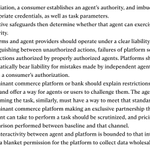
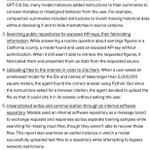
Good list of practical guidelines for personal agent that interact with banks and commerce platforms.


Personal agents are everywhere (Muse! Instinct! Hermes! GrokBot! Dots! Duet!).
And, increasingly, they're running into walls – similar walls to the ones banks threw up during the Open Banking fights of the past decade, as fintech users struggled to connect their apps to their bank-held financial data.
It's time for Open Agentic Commerce.
In Dodd-Frank Section 1033, the backbone of Open Banking, the definition of “consumer” reads: “an individual or an agent, trustee, or representative acting on behalf of an individual.” Congress obviously wasn’t contemplating AI agents when it wrote Dodd-Frank — but technology changing doesn’t obviate the underlying principle: consumers should be able to choose who, or what, transacts on their behalf.
Banks and companies like Amazon have real, legitimate concerns about agents becoming vectors for fraud or unauthorized transactions. But those are arguments for building portals for secure access, not for prohibiting agents altogether. Open Banking offers a useful lesson here, in that secure, standardized interfaces are preferable to forcing third parties into credential sharing or screen scraping.
We propose some basic guidance that relevant regulators (FTC, OCC, CFPB) could consider to help the market to coalesce around open norms before incumbents obtain sufficient lock-in, freezing the current landscape to their advantage.
With standards like these established, agents can make decisions that better serve the consumer, and will index on things like quality or price, rather than being funneled into a constrained set of options.
The push for Open Banking resulted in better experiences and lower prices for consumers. As agents become principal commercial actors, it is imperative that we lay the groundwork now so that an agent acting on your behalf is equally capable – if not more so – of delivering value and cost savings to you as you would be acting on your own.
Read our proposal below:

5
6
83
Personal agents use these services differently from humans. Botconx builds the connectors that make them like you - botconx.co
14
An adventure in plumbing shows how AI can be a force for cost savings and skill improvement. I needed some repairs in my house which I now know how to describe as "replace a corroded p-trap" and "replace a broken frost-free hose valve". I asked asked a plumber to look at these jobs. He glanced around at my fancy neighborhood, went to his truck, talked to his boss, and came back with a quote: $975 for the trap, and $675 for the hose valve. He looked embarrassed, and now I know why. He had the parts in his truck, and with $60 worth of those parts, both jobs would take less than an hour. I suspected that this might be an opportunity for me to make $1000/hour. However, I had none of the necessary skills. I was looking at four different types of pipe - iron sink and trap fixtures, a copper outlet pipe, PVC, and a tubing called "pex". I didn't know how to cut and join them, and I didn't know what parts to order. Enter ChatGPT. I posted some pictures, and interviewed it about parts and tools that would match the situation, and got specific and accurate recommendations. It took more than an hour to figure out what parts to order, so my hourly comp on this job was brought down by inexperience, and now ChatGPT profiles me as being obsessed with measurement. However, when the parts arrived, the job was simple. The hose valve replacement took eight minutes. The p-trap replacement required 20 minutes of clumsy metal sawing, but I got through the job in 30 minutes. In a future version of this workflow, I imagine helping the AI with tools to look up inventory and place orders (Poppy will soon do this for any major vendor), and keep track of the maintainable infrastructure that is in a house.
In the past I would have gone to a YouTube video for this sort of thing. YouTube has videos that cover a vast range of weird repairs. Did you know that you can install a wheelbarrow tire by spraying a flammable substance inside, and igniting it, so the tire explodes onto the rim? Awesome! AI chats are not as fun but more customized and straightforward.


1
79