

Cloud Engineering | Career Coach @Google. Opinions are my own.
Joined October 2023
- Tweets57
- Following85
- Followers3.9K
- Likes35








Pinned Tweet
NYC, that’s a wrap.
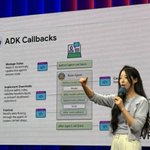
Had so much fun sharing agentic orchestration, long-running workflows, and persistent memory, and getting to meet so many amazing people from the community.
Next stop: Silicon Valley
If you’re in the Bay Area, come join us
RSVP: rsvp.withgoogle.com/events/d…


So happy to see my workshop being shared,
Thanks for putting together this helpful breakdown :)

Google just dropped a free 2-hour workshop on multi-agent systems, Loops and Graphs
From your first agent to a whole team that sees, hears and runs on its own:
0% → 00:09 - What you're building: an AI agent that sees, hears and talks back
30% → 36:55 - Build your first multi-agent system from scratch
45% → 56:11 - Give every agent its own MCP tools
75% → 1:09:28 - Sequential, parallel and loop agents, wired into one graph
100% → 2:05:07 - The whole system running live, reacting in real time
Agents → Tools → Loops → Graphs → Autonomous Systems
Most people are still tweaking the prompt of their very first agent
Worth more than any $2,000 agentic engineering course
Bookmark and watch it today
Then read how to run a system like this in the harness engineering guide below ↓
🎃 I built a Halloween Special Lab on Multimodal Agentic Workflows and excited to share it with you live tomorrow :)
We'll explore multimodal generation, ingestion pipelines, agentic workflows, state, and memory.
youtube.com/live/YGg6uQPqh68

Come hang out with me this Thursday morning!
I’ll be in the live chat during my YouTube video premiere to answer your questions and share some extra resources.
It’s just a 10-minute chat, and hope to see you there :)
youtu.be/2C_CefSQEAQ?is=Jpla…


Excited to publish this blog on Graph Workflows in ADK with Shangjie Chen, tech lead for ADK workflows!
If you’re building agentic workflows and thinking about graph engineering, check it out:
cloud.google.com/blog/topics…

Is CS really dead, or is our education just stuck in 2015?
AI is moving faster than our systems can adapt.
Students use AI to do homework. Teachers use AI to grade it. Engineers are working with completely different tools and workflows. Companies are still figuring out whether candidates should use AI in interview, and what those interviews should even measure.
We’re in the messy middle of a transition.
So yes, parts of the old CS system may no longer fit the world we’re in. But engineering isn’t disappearing.The center of gravity is shifting.
Strong fundamentals still matter. But so do systems thinking, product sense, understanding the stack, and knowing what to delegate to AI,and what not to.
So when people ask me:
“Where do I even start with AI?”
“What should I be learning now?”
My answer is:
- Keep the fundamentals strong.
It’s still helpful to understand how systems work, not just how to generate code.
- Become AI-native.
Use the tools enough to understand what they’re good at, and what they’re not.
- Build your ideas.
Don’t overthink it. Start building something real and learn as you go.
We may not know exactly what the next version of CS looks like yet.
But you don’t have to wait for the system to catch up before you start building for what comes next.

It’s so cool to see now we have this HarnessRSI concept.
Here are 5 directions for the Harness's recursive self-improvement:
1️⃣ Agent Loop (Step-by-step logic & error recovery)
2️⃣ Tool Use (API selection & parameter formatting)
3️⃣ Observation Management (Filtering environmental noise)
4️⃣ Context Management (Optimizing long-horizon tokens)
5️⃣ Task Completion Detection (Knowing when the job is done)
More on this paper:
arxiv.org/abs/2609.14857
Today’s live stream is about agent memory with ADK :)
cloudonair.withgoogle.com/ev…

Going live soon about self evolving agents.
We’ll cover how to evaluate agent performance and design workflows that help agents learn from feedback and improve over time.
Come join me: goo.gle/self-evolving

How do you choose the right workflow for an agentic system? Join me online tomorrow morning for a 2-hour live session on graph engineering with ADK 2.0.
We’ll explore: Graph workflows, Dynamic workflows, Collaborative multi-agent patterns.
aicamp.ai/event/eventdetails…
Nervous but also excited about my first 3 hour live stream tomorrow.
goo.gle/agenticspace
I’ll be introducing a new type of software: the Omni App.
We’ll walk through how to architect and build a multimodal AI agent.
You can join live, or sign up to watch the replay later :)

What is reflective memory for an AI agent? It is not just saving chat history.
I wrote a 5-part series on building this kind of memory loop for AI agents, from concept -> architecture -> a hands-on implementation with GoogleCloud using Antigravity.
💡 Concept: what reflective memory is
🧠 Memory types: learn the user and learn the job
🧭 System boundary: AI agent vs. AI harness
📐 Architecture: how to build an AI agent that learns
🧪 Implementation: build your own with Google Antigravity
If you are building agents that need to learn, adapt, and improve over time, I hope this is useful :) Check the links in the comments.
🤖 Made with AI

1. The Foundation: What Is Reflective Memory, and Why Does Your AI Agent Need It?
🔗 goo.gle/memoryblog1
2. Getting Hands-On: How to Build an AI Agent That Learns
🔗 goo.gle/memoryblog2
3. The Architecture: What Is an AI Harness, and How Do You Build One?
🔗 goo.gle/memoryblog3
4. Leveling Up: How to Build an AI Agent That Reflects
🔗 goo.gle/memoryblog4
5. The Final Project: Build Your Own Reflective-Memory Agent in Google Antigravity
🔗 goo.gle/memoryblog5

What if your AI agent could learn from its mistakes, not just remember them?
That question led me to explore reflective memory:
- User memory: what the agent learns about the person it is helping.
- Job memory: what the agent learns from previous work, mistakes, tool use, and outcomes.
I wrote a blog post explaining what reflective memory is and when an AI agent actually needs it.

1000 AI agents that run a marathon together.
What does a multi-agent system look like at production scale?
And how many tokens does it cost?
Full video below

