

മലയാളി • Advocate • linguistics • Malayalam Language Activist. co-author: Spoken Malayalam for Absolute Beginners.
Kerala, India
Joined March 2022
- Tweets10K
- Following262
- Followers923
- Likes30.2K






Adv. ആരിഷ് വിജയകുമാർ🇮🇳 retweeted

It’s crazy how rest of India completely ignores Kerala’s efforts in bettering municipal infrastructure just because they don’t elect the BJP.
Kerala might even be the first state to indirectly privatise its municipalities. There’s partisan agreement on this.


Adv. ആരിഷ് വിജയകുമാർ🇮🇳 retweeted

The disadvantages of Malayalis being English educated & having decent grasp other languages is that tech firms don't cater to Malayalam language.
You'll rarely see Malayalam subtitles or dubs on OTT platforms. There aren't many Malayalam AI training job openings either.
യേ ത്രിഷ്പ്താ: പരിയന്തി വിശ്വാ രൂപാണി ബിഭ്രത: |
വാചസ്പതിബലാ: തേഷാം തന്വോ അദ്യ ദധാതു മേ ||
വടിവങ്ങളൊക്കെയും പേറി എല്ലായിടത്തും പരക്കും മൂവേഴുണ്മകളേതെല്ലാമോ,
അവയുടെ കരുത്തും കോലങ്ങളും മൊഴിയാളനെനിക്കിപ്പോഴേകട്ടേ
Atharvaveda in Pure Malayalam

Adv. ആരിഷ് വിജയകുമാർ🇮🇳 retweeted

If Malayalees alone get to decide the present and the future of Kerala, shouldn't Kannadigas alone get to decide Karnataka's present and future?
Then why did this Malayalee represent Karnataka in Rajya Sabhe three times? Why does he own Kannada news and media organizations when he does not have any linguistic/ social/ cultural stake here in Karnataka?

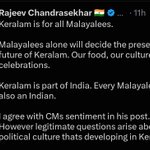
Keralam is for all Malayalees.
Malayalees alone will decide the present & future of Keralam. Our food, our culture, our celebrations.
Keralam is part of India. Every Malayalee is an also an Indian.
I agree with CMs sentiment in his post. However legitimate questions arise about political culture thats developing in Keralam-
➡️Why do some people glorify Jinnah - a man who divided of India on basis of religions?
➡️Why do some politicians justify, defend and encourage proscribed Terror organisations like Hamas and their violence?
➡️Why do political parties like Cong and CPM hv political alliances with avowed anti-secular, anti-constitution orgn like JamaatEIslami ?
As much as CM @vdsatheesan twists and turns in the political wind to justify this destructive political culture, let this be clear - the only reason some people think they can get away with insults and insensitive behavior (Dont forget this cafe is named after Kashi - the holy hindu city) is because they get a free-pass (encouragement) from Cong/CPM for this
Imagine CM Keralas tweet and response if someone opens a restaurant named after a Muslim holy city and served Pork ? He will find himself being an Ex-CM or fleeing for his life or both.
I was abused and targeted by @pinarayivijayan for speaking against Hamas radicalisation effort in Keralam.
Art 19 - right to free speech and expression applies to every Indian.
Art 19(2) restrictions to free speech apply to every Indian.
So my advise to CM Satheesan is this - ensure sensitivity and respect to ALL Malayalees equally. Hindus, Christians and Muslims.
Do not encourage anti-India , anti-Hindu insults/discourse/actions/sentiment like Jinnah worship.
In that you will have our support.
But selective secularism and selective talk of communal harmony will make you like every other fake politician before you. And we will resist it. Fully. Everytime.
#EnthuKitty ?
#APAKADAMPolitics
Adv. ആരിഷ് വിജയകുമാർ🇮🇳 retweeted

Hey! Certain terms, such as Ariyar and Andhanar, are used differently throughout Sangam literature. In one instance, Andhanar might refer exclusively to Brahmins, while in another, it refers to priests of any caste. Therefore, the term Andhanar cannot be interpreted uniformly.
Atharvam is a Malayalam supernatural horror film directed by Dennis Joseph and written by Shibu Chakravarthy.
#MalayalamClassics


Personal observation: Malayali Christians tend to flex their Malayali identity more than any other religious group in Kerala.


Sangam mentions Antanar as performing vedic rituals. It also has mentions of them eating meat. They are not the predecessors of later migrant brahmins.

Theyyam is not itself a religion, but is a reminiscent of Malayali Folk-worship. Similarly, Madan, Maruta etc are non-Hindu Malayali-Folk elements assimilated into mainstream Hinduism as demigods. Sangam literature gives some clues about the dead quasi-religion of the region.

I am glad that kids in Kerala spend their time on more productive activities than attending Hindi Prachar Sabha classes.

This is what I say. Making Sanskrit National Language is a fantasy of English Educated people who can't think outside English, want to become nationalists desparately but can't support Hindi because of superiority-inferiority (complex)².
And surprisingly almost no Rich Sanskritist has any problem with English, never mention Urdu standalone in their comments, will do almost zero authentic work in Sanskrit but find all hegemony in Hindi alone. Needy and humble Sanskrit academicians are dependent on these Anglophiles, biggest irony in the cursed nation.

Adv. ആരിഷ് വിജയകുമാർ🇮🇳 retweeted

Duarte Barbosa arrived in Kerala in 1500 & learned the local language. He considered Malayalis & Tamils as 2 distinct nationalities and even classified Tamil speaking merchants (Chettis) in Kerala as foreigners. He considered Tamil & Malayalam languages to be as distinct as 🇪🇸&🇵🇹


Thunchath Ezhuthachan is known as the 'father of modern Malayalam', not 'father of Malayalam'.

#DidYouKnow One of the most famous sites for Vidyarambham is the Thunchan Parambu in Tirur, the birthplace of Thunchath Ezhuthachan, the father of the Malayalam language. Every year, hundreds of children are initiated into the world of letters here.
#Vidyarambham #BeginningOfLearning #FestivalOfLearning #FestivalsOfKerala #KeralaTourism

Adv. ആരിഷ് വിജയകുമാർ🇮🇳 retweeted

Malabar black pepper inside the nostrils of Paraoh Ramses of Egypt - 3200 years ago

1976: When Ramses came to Paris for a mummy makeover: Of Kerala, Egypt, and the spice link: Pepper (piper nigrum) inside nostrils: ~ 3200 years ago
In 1976, the mummy of Ramses II, one of ancient Egypt's most famous pharaohs, was temporarily transported to Paris for an unprecedented conservation and restoration project at the Musée de l' Homme.
Ramses II is hailed as one of the greatest Pharaohs who ruled Egypt from 1279 to 1212 BC, is often regarded as one of the most influential pharaohs in Egyptian history.
Fast forward to 1975 and a French doctor named Maurice Bucaille discovered that his remains were in poor condition and needed treatment, so he arranged for its transportation from Egypt. The remains of the pharaoh, who was in his nineties when he died in 1213 BC, were starting to show their age.
French and Egyptian researchers, including the renowned Egyptologist Christiane Desroches-Noblecourt, conducted an in-depth examination, which lasted eight months, to halt damage caused by fungal infections and parasites.
Examination of his mummy led to a tiny, yet astounding, discovery about international trade in the ancient world. Found tucked inside the nostrils of the pharaoh were fragments of pepper, a plant indigenous to Malabar coast. And yet it had apparently travelled from flowering vines in Kerala to the hands of Egyptian embalmers as far back as over a millennium before Christ.
During the examination, scientists made a remarkable discovery: fragments of pepper were found inside Ramses II's nostrils. This finding highlighted the ancient trade links between Egypt and the Malabar Coast in Kerala, as pepper was imported over a millennium before Christ and used by embalmers in mummification rituals.
The conservation team also performed X-rays, endoscopic examinations, and other advanced scientific analyses to restore and preserve the pharaoh's remains, after which he was safely returned to Cairo in 1977.
This incident is historically significant because it combined archaeology, chemistry, and forensics to preserve a 3,000-year-old mummy while revealing insights into ancient Egyptian trade and embalming practices.

