

Cloud & Platform Architect | Cloud governance, FinOps, resilient systems & execution | Staying sharp at 40+ | Learning 🇯🇵
Pune, India
Joined March 2010
- Tweets4.2K
- Following225
- Followers248
- Likes6.4K




Pinned Tweet
Something new is brewing on my handle ☺️
Japan 🇯🇵 😍
I've been learning Japanese since Jan 2024.
Started from absolute zero.
Failed couple of attempts.
Cleared JLPT N5 & then JLPT N4.
Now working towards JLPT N3.
& I want to take you along -
I'm introducing a few new series:
🇯🇵 日本語 Journey – My learning story.
💻 Japanese for Techies – Japanese through IT.
🧠 Nihongo Challenge – Learn a little every day.
🌏 Japan Tech Radar – Exploring tech careers in Japan.
🏋️ Nihongo at 45 – Because learning has no age limit.
I'll continue sharing Azure, Cloud Architecture & DevOps insights too..
My goal?
Bring technology professionals, Japanese learners and curious minds together.
You don't need to know Japanese to start following.
You just need curiosity.
Who's joining me on this journey?
いっしょうにがんばりましょう !
(Issho ni ganbarimashou!) 🇯🇵
#AshishLearnsJapanese


1
6
174
My Japanese Learning - Weekly Content Calendar
Here's what to expect from me @ashishbang every week !!
MONDAY - 日本語 Journey 🇯🇵
#NihongoJourney Personal learning stories
TUESDAY - Japanese for Techies
#JapaneseForTechies IT vocabulary
WEDNESDAY - Cloud x Japan
#CloudJapan Career insights
THURSDAY - Nihongo Challenge
#NihongoChallenge Interactive quizzes
FRIDAY - Japanese for Techies
#JapaneseForTechies Workplace conversations
SATURDAY - Nihongo at 45
#NihongoAt45 Personal reflections
SUNDAY - Japan Tech Radar
#JapanTechRadar Weekly tech opportunities
7 days. Diff series. One learning journey..
Want to add Japanese as a new skill to your toolkit? Bookmark this calendar. Follow along..
Explore the intersection of Japanese and technology...!!
#AshishLearnsJapanese
75
Unpopular opinion:
A high-paying job with a toxic environment is not necessarily a successful career.
Your mental peace is part of your compensation.
Agree??
1
2
129
Still figuring out how to grow on X.
Not a guru. Not a growth hacker. Just a wannabe creator trying to make some noise. 😄
A few things I'm learning along the way:
1. Show up consistently. Even when a post gets 12 views. Keep going.
2. Engage genuinely. Some of the best connections happen in replies, not posts.
3. Share what you know. Cloud, architecture, leadership, career lessons and random life experiences.
4. Grow together. Don't chase just big accounts. There are gems with 200 followers too.
5. Experiment. Text, videos, polls, contrarian takes. Find your voice.
The goal? Build a timeline of experienced veterans, curious young minds, builders and thinkers.
Still learning. Still experimenting. Let's see where this goes! 🚀
- @ashishbang
4
4
105
Unpopular opinion:
Designing for "infinite scale" on day one is engineering malpractice.
Most early-stage enterprise applications will never see 10,000 concurrent requests per second. Yet, tech leads insist on over-engineering complex multi-region Kubernetes clusters that drain budgets.
Start simple.
Optimize vertically first.
Decouple when the data demands it.
Keep your architecture lean until your revenue forces you to scale.. !!
49
One underrated skill in technology:
Knowing how to disagree with someone without making them feel stupid..
Technical discussions become much easier when egos leave the room !!
62
If you build, break, fix, automate, mentor or simply love learning - we'll get along !
Drop a 👋
Let's connect 🤝
2
1
79
me to my wife after doing 2 household chores: I've contributed enough for today. I demand paid leave and immediate retirement.. 😂💀
60
Ashish Bang retweeted

Red Hat is teaching Linux from scratch for FREE.
→ Linux and open source
→ Shell and file management
→ Vim, users and permissions
→ Software and networking
→ System startup and containers
redhat.com/en/services/train…

How to build an automated blast radius defense system for your infrastructure:
- Tag everything: Enforce absolute tag compliance at the CI/CD pipeline level. No tags = deployment rejected.
- Hard budget ceilings: Set up AWS Budgets linked directly to SNS alerts that trigger active Lambda functions.
- Auto-kill rules: If a sandbox environment breaches its daily allocation by 20-25%, auto-terminate the non-essential workloads immediately.
An automated script doesn't care about your feelings. It only cares about keeping the business profitable.
How do you handle infra costs in your team??
1
70
Here's a cloud migration dilemma I've seen play out in large enterprise environments.
Imagine you're leading the migration of a business-critical application landscape to Azure.
The platform level assessment is complete. The landing zone is ready. Network connectivity, security controls, identity integration and governance are in place.
But here's where things get interesting.
You discover that:
- Some applications run on outdated OS and database versions.
- A few critical applications have undocumented dependencies on legacy systems.
- The application owners are reluctant to approve any code changes.
- Rehosting is technically feasible, but the projected Azure infrastructure cost is nearly 25% higher than the current on-premises TCO.
- Refactoring could improve performance and reduce long-term costs, but adds 8–12 months to the migration timeline.
The CIO has already committed to a data centre exit deadline.
Now you have three choices:
A. Rehost first. Meet the data centre exit deadline, absorb the additional cloud cost and modernise later.
B. Refactor before migration. Fix architectural debt, optimise workloads and migrate a cleaner application landscape, even if it means missing the deadline.
C. Challenge the migration scope. Retain selected workloads on-premises or move them to a hybrid model until the business case for cloud migration makes sense.
Here's the question:
Would you optimise for the data centre exit deadline, long-term cloud economics or architectural integrity?
And more importantly, who should own the decision when these three objectives conflict - the Cloud Architect, CIO or Business Application Owner?
I've always believed that a successful cloud migration isn't measured by the number of VMs moved or workloads migrated.
It's measured by the business value delivered AFTER the migration.
What's your call? Wld luv to hear ur experience too..
#CloudMigration
1
99
Ashish Bang retweeted
A real world example I promised -
1/8 - The big picture
Getting an application migrated to Azure is one thing. Making sure on-premises users can securely access it without exposing it to the public internet is a different engineering challenge altogether.
Let me break down a real-world Azure network connectivity pattern using ExpressRoute, Azure Firewall, Hub-Spoke networking and Private Endpoints.
The solid arrows are the file traffic. The dashed arrow is the name lookup. The reply comes back through the same firewall.
The addresses in the picture are an example layout.
Reply: Public access on the share is off. The only address that works is the private endpoint, 10.30.1.4, on TCP 445. Everything else in the thread is how a packet from 10.10.1.10 gets there and back.
Let's follow an actual packet. 🧵


Moving workloads to Azure is one thing. Securing the traffic flowing into them is a completely different engineering challenge.
We recently worked on securing an Azure cloud platform for an enterprise client in Japan, with one clear objective: ensure that on-premises users accessing migrated cloud applications follow a private, controlled and secure network path.
Our approach leveraged Azure ExpressRoute for private connectivity, Azure Firewall for centralised network traffic inspection and policy enforcement, and Azure Application Gateway with WAF for Layer 7 application security.
The idea was simple: no unnecessary public exposure, controlled traffic flows, multiple layers of security and visibility into network access.
Cloud security isn't just about protecting what's inside your VNet. It's equally about controlling how traffic gets there.
I'll be sharing more real-world cloud migration and architecture experiences, including the actual network diagram in my next post.
If you're interested in learning how enterprise cloud migrations work beyond the theory, stay connected, follow along and feel free to share this with your cloud and technology community. Always happy to exchange knowledge 🤝
#Azure #CloudMigration #CloudSecurity #AzureNetworking
A real world example I promised -
1/8 - The big picture
Getting an application migrated to Azure is one thing. Making sure on-premises users can securely access it without exposing it to the public internet is a different engineering challenge altogether.
Let me break down a real-world Azure network connectivity pattern using ExpressRoute, Azure Firewall, Hub-Spoke networking and Private Endpoints.
The solid arrows are the file traffic. The dashed arrow is the name lookup. The reply comes back through the same firewall.
The addresses in the picture are an example layout.
Reply: Public access on the share is off. The only address that works is the private endpoint, 10.30.1.4, on TCP 445. Everything else in the thread is how a packet from 10.10.1.10 gets there and back.
Let's follow an actual packet. 🧵
Moving workloads to Azure is one thing. Securing the traffic flowing into them is a completely different engineering challenge.
We recently worked on securing an Azure cloud platform for an enterprise client in Japan, with one clear objective: ensure that on-premises users accessing migrated cloud applications follow a private, controlled and secure network path.
Our approach leveraged Azure ExpressRoute for private connectivity, Azure Firewall for centralised network traffic inspection and policy enforcement, and Azure Application Gateway with WAF for Layer 7 application security.
The idea was simple: no unnecessary public exposure, controlled traffic flows, multiple layers of security and visibility into network access.
Cloud security isn't just about protecting what's inside your VNet. It's equally about controlling how traffic gets there.
I'll be sharing more real-world cloud migration and architecture experiences, including the actual network diagram in my next post.
If you're interested in learning how enterprise cloud migrations work beyond the theory, stay connected, follow along and feel free to share this with your cloud and technology community. Always happy to exchange knowledge 🤝
#Azure #CloudMigration #CloudSecurity #AzureNetworking
7/8 - Private Endpoint: Reaching the actual workload
We finally reach the spoke workload subnet.
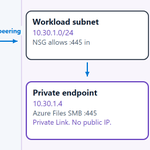
The subnet route table and NSG enforce the required routing and inbound security policy.
The Private Endpoint NIC has the address 10.30.1.4 and maps that address to the Azure Files Private Link resource.
The workload receives traffic over its private connectivity path.
Public network access remains Disabled.
No public workload IP. No need to expose the storage service to the internet.

1
28
8/8 - Don't forget the return journey!
A network flow isn't complete until the response makes it back.
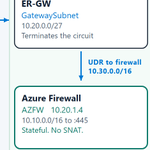
The spoke subnet has another UDR:
10.10.0.0/16 → 10.20.1.4
This ensures return traffic traverses Azure Firewall instead of bypassing it through direct peering.
The firewall recognises the established state and permits the response.
Traffic then travels back through the ExpressRoute gateway, circuit, customer edge router and on-premises firewall.
That's symmetric routing by design.
Takeaway: “Secure connectivity here is not just the ExpressRoute circuit. It is DNS, the route that forces inspection, the private endpoint, and a return path through the same firewall.” !!

29