





eylok retweeted

A preview of another forthcoming article of mine in the Journal of Indo-European Studies. The article re-examines the meaning of Avestan airiia- and investigates the geographical location of Airiianəm Vaējah, traditionally understood as the ‘Aryan homeland’. 1/10

eylok retweeted

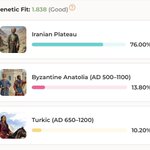
📊 Genetic breakdown of an interesting male sample (possibly an Iranian merchant from the Sasanian period) from Akbari2026 study belonging to the Imenkovo culture from Novoslavka-2, Bolgar, Russia (Republic of Tatarstan) dating between 350-500 CE during the Migration Period Age


eylok retweeted

Y-DNA chart for Yusufzai Pashtuns (n=538)
The Yusufzai are among the largest Pashtun tribes today and represent one of the best-sampled groups, with a sample size of n=538. They also show a high frequency of Y-DNA haplogroup R1a, particularly the subclade R1a-YP1123, often associated with Proto-Pashtun paternal ancestry and ultimately linked to Iron Age Iranian herder populations. More specifically Yusufzai Pashtuns are under R1a-YP1123 > B141> BY193552, which has a TMRCA around 750 BCE according to FTDNA.
Originally from the Kandahar region of Afghanistan, the later migrated to Kabul and the surrounding areas, where they came into conflict with other tribes and local rulers. After losing their position in Kabul, they moved toward the Peshawar Valley under the leadership of Malik Ahmad Khan.
At the time of their arrival, the Peshawar Valley was inhabited by the Dilazaks, a Karlani Pashtun tribe, who may also account for some of the G2b lineages found among modern-day Yousafzai. With the support of their allies, the Yousafzai fought the Dilazaks and gradually established control over the valley.
From Peshawar, they expanded into Swat and neighboring regions, including Buner and Dir. These areas were already inhabited by local populations, including the Swatis and other groups. Yousafzai expansion took place over time through a combination of migration, alliances, raids and military conflict rather than a single mass movement. It is also here in 1519, where they are first explicity mentioned in the Baburnama by Babur, when he was fighting with rebellious Yusufzai tribes around Swat.
As the Yousafzais settled in the region, they established villages and consolidated their local power across its fertile valleys, gradually expanding in population and influence. Over time, they grew into one of the largest and most prominent Pashtun tribes. In later centuries, many Yousafzai migrated to India, where they became part of the Rohilla communities, which comprised of Pashtun immigrants as well as local people that had adopted Pashtun identity and customs. As a result, the Yusufzai are today often among the most South Asian-shifted Pashtun tribes in terms of autosomal ancestry. At the same time, they show a very high frequency of R1a-YP413 > YP1123 associated with ancient Iranic-related populations and early Iron Age herders, as well as lineages linked to ancestral Proto-Pashtun populations. This apparent contrast highlights strong founder effects and genetic drift, which preserved and even increased specific paternal lineages over many generations despite substantial South Asian-related ancestry in their overall genetic profile.

eylok retweeted

R1a-Z93 > CTS6: a complete guide and clarification. The Y-DNA lineage R1a-Z93 > CTS6 is shared between Ashkenazi Jews (~11.6% of their FTDNA matches), Kurds, Azeris, “Persians”, Armenians, Spaniards, and now a Pamiri from eastern Tajikistan. This post explains where it comes from and clears up some common misconceptions.
First, the obvious. R1a-Z93 (2644 BCE) is an Indo-Iranian lineage derived from the eastern Corded Ware offshoots, Fatyanovo > Sintashta. This is well established by the countless ancient samples we have.
Why CTS6 is harder to place. R1a-Z93 > CTS6 (1308 BCE) is much trickier to assign to a specific Iranian branch at first glance, because there are no notable ancient samples on this line. That leaves the diversity of modern testers as the main guide, and the modern Iranian-speaking world carries the largest hub of R-CTS6 diversity. Several additional facts reinforce why Iranian-related peoples hold this diversity.
Its important to note that around 1500 to 1000 BCE, the Iranian world was breaking into two cultural spheres: a proto-Scythian/Saka camp and what we can call an Avestan/Zoroastrian camp. Lineages from either side almost never overlap and become divergent, both autosomally and in Y-haplogroups.
The proto-Saka/Scythian camp is roughly defined by Mongun-Taiga/Sagsai > DSKC, Karasuk, whatever the Idzhim burials should be classified as, and perhaps Baitag in south-western Mongolia. Scythians are among the most extensively tested ancient populations. We have hundreds of samples from proto-Scythian-derived peoples, and not a single one has ever yielded R1a-Z93 > CTS6. They only ever carry lines such as R-S23592 and Q-L330. The Khazars, an Oghuric branch of the Turks, have also never yielded CTS6 in ancient samples, and typically carry the same kind of Scythian lines from their Iranian side.
The SCA Avestan/Zoroastrian group, by contrast, can be linked to the Yaz-Dahistan phases, Chust and related cultures. We have only a couple of samples from these peoples, which is why SCA-derived lineages usually lack associated ancient DNA. This is largely due to limited excavation in places tied to this type of Iranian activity. Zoroastrian sky burial does not help either, since vultures and the sun leave no remains. On top of that, Iranians are very poorly tested on FTDNA and YFull, where most testers from Iran are Arabs, Jews, Armenians and others. The two most divergent R-CTS6 clades are carried by Achomis in the gulf.
Because R-CTS6 dates so close to the proliferation of the Iron Age Avestan Iranians, who had not yet migrated onto the Iranian plateau in significant numbers, it is not possible to pinpoint which exact subgroup was responsible for bringing this lineage into the Jewish population. Logically, it would have been Iranians living in the vicinity of Jews.
The Pamiri’s connection to Ashkenazis, predicted around 700 BCE, is still too distant to be of direct relevance, since that is roughly when “western Iranians” began migrating onto the plateau. The Pamiri branch could therefore simply descend from an Iranian who went east instead. It should also not be ruled out that this Pamiri inherited the lineage through backflow from populations further west. After all, Pamiris even carry E-M81 and E-M2 lines.
Strictly speaking, this branch cannot be both Persian and NW Iranian. Linguistically, Persian dialectal forms long predate the Avestan age and were only later assimilated into that social grouping. It has to be one or the other. It's not possible to know for now which one it is, but NW Iranian movement seems more likely.
Clearing up common incorrect claims:
- Pamiris being Scythian. No, Pamiris descend from the Avestan cultural bubble that proliferated out of south central Asia during the iron age (also not Sogdian related).
- There are no confirmed ancient Turkoman samples on this lineage. This 1x coverage medieval Turkoman attributed to R-CTS6 on Carlos Quiles’ sheet is a mislabel. FTDNA shows that DA126 only has enough coverage to reach generic R-Z93, and not any further. Listed as Almaly 126.
- We have no Mitanni R1a-CTS6 samples. Had the Mitanni carried R-CTS6, we would expect a much more western modern distribution, since they disintegrated far outside the Iranian core lands.
- Not a single ancient Alan sample has this haplogroup.
- The Spanish branch clusters upstream and downstream with Armenians and Azeris. The far more logical explanation is descent from Muslim Iranian converts, who are attested in large numbers in Islamic Iberia.
- Ashkenazis carrying SCA Avestan-type lineages is not unusual. Several of their major lines, together roughly 30% of their Y-DNA, are of this type: R1a-BY33370, R1a-Y2619, G-L201, G-BY21343, G-BY764, R2-FGC13211 and Q-Y2200.
- Hazaras testing positive for R-CTS6 (no terminal resolution) is entirely unsurprising. Hazaras, for example, carry around 10 to 15% "west Iranian" Y-DNA.
This post is of interest to @JewishGenomics @iosif_lazaridis @nrken19 @Afghan_DNA @aboutadna

eylok retweeted

Westerners never post maps of actual Sintashta-Andronovo ancestry, just heat maps like this.
Because they don't have a single drop of Proto Indo-Iranian blood, which is wholesale concentrated among Iranics, Indics, and Turkics.


eylok retweeted
Does the Kurdish feature of ergativity come from Hurrian? No. Below, I have tabulated how alignment in past transitive clauses works across various Iranian languages. Ergativity appears across the Iranian language family, in Pashto, Balochi, Yaghnobi and the "Pamir" languages (in decayed forms). Modern Standard Persian has lost this feature, but Middle Persian still had it, and Achomi, a close relative of Persian, still does. Hurrian ergativity worked differently: it applied in every tense, and the verb agreed with the doer.
Of course, no serious linguist has ever suggested this common folk belief that Kurdish got ergativity from Hurrian.

eylok retweeted
I created a map that reconstructs the approximate distribution of the ancestral forms of languages and dialects across the Sasanian Empire (Ērānšahr) c. 242 CE, at the accession of Šābuhr I following the death of his father, Ardaxšīr I. Particular attention is given to the Iranian dialect continuum. The reconstruction is based on the historical dialectology of each variety, for example the shared innovations, diagnostic isoglosses and contact-induced features preserved in each. These features help us understand how the speakers of these languages migrated over the course of history. Historical sources were used as supplementary evidence where possible.
What is immediately noticeable is that speakers of Persian were largely confined to what is now south-western Iran. North-western Iranian languages dominated most of the Iranian Plateau, and some like Kurdish also had a presence in the province of Persis. Mesopotamia at this time was still dominated by Aramaic speakers despite centuries of Iranian rule, due to factors like Aramaic being the historic lingua franca of Iran up until that time. The association of Corduene and the Carduchii with the Kurds is largely rejected in modern scholarship, and it is also completely inconsistent with the linguistic history of Kurdish. Sometime during the Parthian era, the first wave of Kurdish speakers migrated out of Persis into the area around Dēnāwar and the surrounding regions. The bulk of Kurdish speakers did not leave Persis until much later.


eylok retweeted
R1a-Z282>YP4858 is an Iranian lineage. The SK2014 mutation, which accounts for almost the entirety of YP4858, can be attributed to an Avestan-type Iranian lineage and not a Scythian one:
- Z283+ which is very close to Z282 is found in Srubnaya-Alakul (ID: Kazburun 8) but lacks proper coverage depth for a closer call. This is evidence towards a proto-Iranian route.
- YP4858 has very high diversity and spread among Iron Age Avestan-descended peoples over the past 4000 years, including many Arabs who trace to Iranian groups.
- YP4858 has near non-existent diversity among Slavs, Germanics, Kipchaks, Karluks, Oghuz, and so on.
- YP4858 has only one ancient sample found in Xiongnu. It models with 0% Hunnic ancestry, 70% Eastern Saka ancestry, and 30% Sogdian (or adjacent Iranian-type) ancestry.
- The outlier at Tian Shan used in the model is not Saka here, but Avestan-type ancestry. Used for the most proximal Avestan type ancestry to the Xiongnu empire.
- This sample doesn't model like a Kangju type Iranian.
- Scythians are among the best-tested ancient groups globally, with a very high sampling rate, and have never turned up SK2014 or YP4858 outside of this outlier, which has Avestan-type ancestry.
- YP4858 dates back to the proto-Iranian phase at 1800 BCE. SK2014 dates roughly to the Avestan age, around 1400 BCE.
- Avestan-type Iranian historical samples are very poorly tested.
It should be noted that the only Scythian haplogroups among modern Middle Easterners so far are mediated through Turkics, particularly the non-Oghuz ones, since Oghuz tend to derive their Iranian ancestry from Sogdians rather than Sakas.
Considering everything it is not reasonable at all to suggest SK2014 is Scythian.

eylok retweeted

Ali Rıza Bey'in mantık tamamen şu:
Bir kelime Farsça, Kürtçe, Tacik, Taliş, Beluç ve cümle İranî dilde varsa Kürtçe bu kelimeyi onlardan almıştır.
Yani kabak tadı verdi artık bu söylemler, İranî dillerdeki kelimelerin ekseriyeti aynı "ortak" atadan geliyor. Kim hangi yetkiye dayanarak bunları "Farsça" ya özgü yapıyor? İranî dillerin hemen hepsinde sayılar aynı, peki kim hangi yetkiyle bu sayıları Farsça yapıyor?
Mesela dağ yani Kuh/Koh kelimesi.
Batı İraniler'de "kaufa"
Partça'da "Kōf"
Farsça'da "Kuh"
Tacikçe'de "Kuh"
Beluçça'da "Koh"
Kürtçe'de Koh ve kendi içinde ayrıca Çiya.
Alirıza Bey'e göre hepsi Farsça'dan almış. Ya da, hepsi Proto İranî'den almış, Kürtler'de Farsça'dan almış.
Bu sebeple tüm İraniler'in atalarından öğrenip kullandığı kelimeyi Kürtler de kullanınca "onun kökeni Kürtçe değil" oluyor.
😄

Kürtçe kelimelerin kökeni ile ilgili tartışmaları bitirmenin en sağlam yolu şudur:
1) İrani dillerde yazılan en eski yazıtlardaki, mesela Behistun (Bisütun) Yazıtındaki ve diğer yazıtlardaki kelimeleri tespit etmek.
2) Bu kelimelerden Farsça dahil diğer İrani dillerde olmayıp sadece Kürtçede olanları tespit etmek.
3) Eğer böyle kelimeler varsa bunların sayısal veya oransal toplamını çıkarmak.
Söz konusu kelimelerin oranı, dilbilim açısından anlamlı bir yekune sahipse, Kürtçe kelimelerin Farsçadan ödünçleme olmadığına, iki dilin ortak bir kökenden geldiğine dair iddiayı pekiştirir.
Buna da kimsenin itirazı olmaz.


eylok retweeted
Hazırlamakta olduğum web sitesinde Kürt Mimari eserlerinin önemli kısmını cami ve medreseler kapsıyor. Bu kapsamda Eyyubiler'in rolü çok büyük.


eylok retweeted
The following pie chart shows the ethnic origins of modern Kurdish patrilines, roughly dated to the Bronze and Iron Ages, based on fully sequenced Y-haplogroup data. Several months ago, I released a preliminary draft, and this can be considered the first finalised draft. I will release a new version as we get significantly more modern and ancient samples, perhaps sometime at the start of 2027.
The vast majority of the samples uploaded have clear origins, while others are more speculative and can only be vaguely categorised through archaeology and modern distributions alone.
There is perhaps only one major puzzle left to solve in terms of the Kurdish/Iranian question: what Elamite Y-DNA looked like. We assume that, at its root, it is related to the Bakun culture, which in essence would create a distribution pattern similar to that of the BMAC. However, late-stage Elamites would have had some unknown degree of Uruk, Semitic, and Hurrian gene flow. It is therefore unclear what level of pseudo BMAC lines are getting absorbed into the Mazdayasni category.
A smaller yet relevant question is what Y-DNA the Uruk culture would have had. They had some level of impact, especially on the Hurro-Urartians. Presumably the Hurro-Urartian category will capture some level of Urukian flow, despite them being ethnically distinct.
The most important patrilineal root among the Kurds is the Early Mazdayasni population, from which the Iranian umbrella ethno-religious identity formed in Iron Age South Central Asia, stemming from the followers of the prophet Zoroaster. Therefore, Iranianness in this context, and as a concept, can be measured against this Early Mazdayasni population, which formed from a mixture between BMAC and Andronovo, among other minor elements.


eylok retweeted
This paper documents systematic exploitation in Iran's mining industry across Rojhelat (Eastern Kurdistan), focusing on Kurdistan Province (Saqqez, Bane, Qorwe, Kamyaran, Bijar) with additional coverage of Kermanshah and West Azerbaijan. It shows how state extractive policy has caused major ecological and environmental damage in the region: contaminated water, degraded pasture and agricultural land, and unsustainable mining practises with little regard for local communities. Despite sitting on vast mineral wealth, Rojhelat sees almost no reinvestment in its own infrastructure, services, or economy. Profits flow to Iran's centre while the Kurdish periphery bears the ecological and social cost, extraction without development.
- Kurdistan Province holds 50% of Iran's gold reserves and ranks fifth nationally in iron ore, silica, and barite.
- Around 1,571 mines have been documented across Rojhelat's four provinces (675 West Azerbaijan, 461 Kurdistan, 325 Kermanshah, 110 Ilam).
- Extracted minerals are overwhelmingly exported as raw material rather than processed locally. Kurdistan has only 3 concentration factories compared to Zanjan's 12, despite having triple the iron ore capacity.
- This limits local job creation and value capture.
- Legal provisions requiring reinvestment of mining profits in host regions (Article 14 of Iran's Mining Law, roughly 15% to the province) have not been implemented in Kurdistan.
- The national development plan allocates just 1% of mining profits to compensation and development in mining areas.
- Case studies of specific mines (Qol Qoleh, Zarshuran, Sari Gunay/Dashkasan) document water contamination, arsenic and cyanide exposure, soil erosion, and heavy water consumption in a province already facing water stress.
- Zarshuran now imports water from another province to sustain output.
- Mining has damaged agricultural and pasture land, displaced communities, and provoked local protest and NGO opposition, met at times with regime pushback, including a September 2025 incident in Saqqez where the paper reports a fatality during protests against gold mining.

eylok retweeted

The claim that Kurd was a Persian word meaning "nomad" or "shepherd" was not known to the famous Persian linguist and lexicographer Ibn Fāris (1004 CE), nor to any other medieval Persian linguists, lexicographers, or philologists. /1

RT @Afghan_DNA: Q2-L275 is a widespread pan–Indo-Iranian Y-DNA lineage. However, West Iranic groups like Kurds tend to show higher frequenc…
This quoted post is unavailable.
eylok retweeted
For those who are struggling to understand why the Barzani Q lineage does not originate from the Caucasus, Jews, or Turks:
Q-NGQ1 formed around 8000 BCE. It is the parent of Q-M378, which is the parent of Q-L245. Q-NGQ1 has multiple pre-Iron Age ancient samples, including Habahe 22B (2500 BCE, Xinjiang), Ayituohan 22B (2800 BCE, Xinjiang), and Nileke 3N (3000 BCE, Xinjiang).
Q-M378, one of the descendants of Q-NGQ1, formed around 4000 BCE. Its only notable pre-antiquity ancient samples are Abusanteer 7 and Wutulan 12, dated to approximately 800–200 BCE. Both of these samples are associated with the ethnic Tian Shan Saka Iranians.
Q-M378 has two primary branches: Q-L245 and Q-FGC4620. Q-FGC4620 is a major lineage among populations associated with the Inner Asian Mountain Corridor (IAMC), including Indians and Tajiks. The most divergent branch outside both Q-L245 and Q-FGC4620 is also found in India.
All of this strongly points to Q-L245 having an ancestral origin in Central Asia. Q-L245 formed around 2000 BCE, yet today it is distributed among various West Asian populations. Which population migrated from Central Asia into West Asia around this period? The most likely answer is Iranian peoples.
Kurds did not acquire this lineage from Turks. The Q-L245 > YP1229 lineage among Kurds displays a highly diverse mutational structure across numerous tribes, with diversification dating back to approximately 283 CE. Turks possess other Q haplogroup lineages because they also interacted with populations carrying West Siberian Hunter-Gatherer (WSHG)-derived ancestry. Most Q lineages found among Turks are associated with later interactions involving Iranian groups such as the Scythians and Sogdians. Regardless, these lineages are genetically distant from the Kurdish Q-L245 > YP1229 lineage.
Finding ancient samples from various ethnic groups after antiquity is not, by itself, a significant discovery. For example, haplogroup V88 can be found in Africa, and M47 can be found in Europe. What matters is how a haplogroup diversifies over time when considering its entire phylogenetic lineage, not focusing narrowly on a single ancient sample.
With this haplogroup result, it can now be concluded that the Barzani family's paternal lineage is not consistent with a Jewish origin. Instead, it belongs to a longstanding Kurdish lineage that traces its deeper paternal ancestry to an Iranian-associated branch originating in Central Asia.

The Y-DNA lineage of the Sheikhs of Barzan, who are currently the ruling family of Iraqi Kurdistan, as confirmed by Darvan Mansour Barzani, belongs to Q-L245 and almost certainly falls under the YP1228 > BZ246 mutation, as members from Barzan area also belong to this line. Darvan is the son of Mansour, who is the son of Masoud, who is the son of Mustafa Barzani.
This lineage is downstream of WSHG > BMAC/IAMC > Iron Age Iranians of South-Central Asia > Iranians of the Plateau > Kurds. The wider Kurdish mutational cluster is currently placed around 280 CE.
A notable historical Kurdish figure who also belongs to this wider Kurdish Q-YP1228 dating back to 280 CE cluster (though not under the later Barzani-specific mutation) is Husam al-Din Abu'l-Hayja, who was one of Saladin’s Ispahsalars (major general), commanding the Ayyubid Kurdish elite Mihraniyya cavalry corps during the Third Crusade. He later became a lord of Jerusalem following the Battle of Hattin. Find more about him here:
xitter.cf/KurdiCompendium/status…


eylok retweeted
Do these guys not get tired of spreading lies?


