

founding @sundialmd. human agent collaboration, version control, long horizon tasks. prev @stanford @stai_research @google @viva_translate
Joined October 2019
- Tweets1.1K
- Following1.1K
- Followers2.2K
- Likes3.4K





Belinda retweeted

Good reminder that ~all of generative AI is in some sense adversarially optimized for you to think it is better than it is (via pre-training, via RLHF, via hill-climbing benchmarks). or as nostalgebraist puts it:


this type of post makes me very bearish on humanity. I'm starting to discover a non negligible part of humanity appreciates slop? LLMs are incredibly good at some things, but talking about my essays right now is still at the level of slop.
This isn't a statement on future capabilities. It's just that I find it sad that current ones are taken to be at harold bloom level.
Belinda retweeted

Tinker lets customers turn their expertise into cutting-edge models that they own. One year after launch, we look back at what we’ve shipped and what our users are building.
thinkingmachines.ai/news/one…

Belinda retweeted

This is a slide from Terence Tao's 'Math 2.0' public lecture yesterday evening at Caltech. I am highly confident that, if the cure actually worked, almost any Stage 4 cancer patient would tell you that human comprehension of its mechanism is completely irrelevant to them.

Belinda retweeted

Notion runs one of the largest CRDT deployments in production, processing millions of operations every minute!
We wrote about the data structures we adopted from CRDT research to make our text editor more collaborative, and how we built on those concepts to fit our block-based data model.
notion.com/blog/how-notion-h…

Belinda retweeted

Sundial put the effort in getting RLVR right: training on verified fixes instead of artificial errors, smart rewards that disincentivize hacking, and deterministic scoring.
The result — a trained Inkling-Small that fixes 83.7% of LaTeX errors in under 1 second and $.0013.

We fine-tuned @thinkymachines' Inkling-Small to fix LaTeX compile errors inside the editor, in under a second. On real errors it matches Claude Fable 5.1, six times faster and at about 1/40 of the cost.
When we interviewed mathematicians, one of the most common annoyances we heard about in their day to day work is battling with LaTeX compilation errors.
The most obvious solution is to ask a chatbot to fix errors. That works decently well, except switching to a different window breaks the writing flow, and copy-pasting the snippet often loses relevant context, especially when multiple files are involved.
So we scraped 272,000 questions from TeX.StackExchange and kept the 3,978 whose snippet still fails today, whose accepted answer compiles, and whose difference replays exactly as a patch. The largest dataset previously released had 88.
We tried tweaking the reward function in many ways. The first one was only a compilation check, which led the model to remove content until the document built. In the end, what worked best was rewarding compilation and a close match with the solution's PDF, and penalizing removed content.
We're rolling out the model inside the @sundialmd editor this week. When a compile fails, the fix is applied as a suggestion in under a second and the PDF rebuilt.
Write-up: sundial.md/blog/textinguishe…
Thanks @tinkerapi and @thinkymachines for the support.

Belinda retweeted

This isn't the most notable aspect of today's news, but on the user data issue, there are different kinds of *training on user data* with very different privacy/IP implications. Sadly, AI cos don't like to disclose what they're doing.
- pretrain on user data, with users' tokens as prediction targets: high regurgitation risk, improper
- use user prompts to distill large models into small ones: low regurg. risk, some companies probably do this
- use user traces to construct RL tasks: low regurg. risk, because RL has low memorization abilities, but can extract customer IP, depending on how it's done. Ranges from benign "use explicit user feedback in reward model training" to invasive "upload user's coding environment and commit history to turn into rl envs"
"De-identification" is weak -- you can identify someone with a small number of bits, and long traces have more than enough. And it doesn't affect IP leakage concerns.

Belinda retweeted

Seems like test time scaling has gained a 3rd axis: latent space reasoning iterations in looped transformers.

Belinda retweeted

Anthropic says its first Fermat runs failed not on math, but because dozens of Claude agents lost track of shared project state. They only succeeded after moving to Prove2Me's DAG of statements and proofs. At that scale, "memory" must be external, structured infrastructure, not prompts.
siliconangle.com/2026/09/04/…

Belinda retweeted
Just published our open source release, the desktop version of Sundial. I now use it instead of VSCode, Obsidian, Overleaf for writing and note-taking. I particularly like that you can:
- see suggestions vs direct edits, which is super useful for writing
- use your own claude code and codex subscriptions
- it's real-time
- it's minimal so gives me space to focus
- I can open any local folder and it stays local, and I can share at the file-level

Belinda retweeted

"Losing my religion"
A beautifully written blog by professor @togelius on reckoning with the fear that AI will one day make human thought unnecessary.
His proposal, complementary intelligence, argues that keeping humans in the loop is not a constraint on progress. Rather, it is the only version that counts as progress.
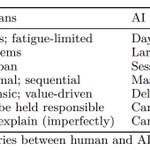
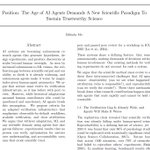
Separately, Weston and Foerster's co-improvement paper makes a similar case from the other side, that this is also the faster and safer path.

Belinda retweeted

GPU World: A story competition from Neal Stephenson, Gwern, and me.
The AI future is unevenly distributed. What would the world look like with AI broadly diffused, such as if we had one GPU per person?
1000-5000 words, fiction or non-fiction.
$100K in total prizes.
gpuworld.org
Belinda retweeted

It’s such a rare opportunity to study human–AI collaboration at scale, given the constraints around data access and privacy. Huge thanks to @AnthropicAI for making this possible through the Anthropic Insights system, and for their support throughout the project.
We started this work with several hypotheses we’d been thinking about for a long time (around task criticality and delegation, human agency, and friction). But what surprised us is that the findings consistently point back to the **human side** of human–AI collaboration.
More details in 🧵


For the first time, we’ve given external researchers a way to study AI’s impacts using real, privacy-preserved Claude usage data. To date, this work has only been possible within AI labs. We can’t tell the whole story alone, so we opened up our tools.
anthropic.com/research/enabl…


Belinda retweeted

In my view we have a few different tiers of verifiability
1) programatically verifiable (near-free)
- games, coding, math, cybersecurity, chip design
2) real-world verifiable (cost-or time bounded)
- sciences: biology, chemistry, physics
-physical world: material science, energy, aerospace, robotics, agriculture, pharma
-forecasting: trading, weather
3) verifiable with human preference
- writing, design, comedy, charisma, persuasion
I expect most low-hanging fruit in (1) to be solved very quickly. Not sure how much longer before more solved math conjectures are simply uninteresting. I’m least certain about chip design being in this category, perhaps we hit a ceiling and require physics or materials breakthroughs to continue progress.
My guess is we will quickly run into the limits of how well we can simulate each domain in (2). The time-bounded nature of real world verification may be the reason we don’t hit fast takeoff. Sim2real remains an elusive problem to solve when real-world data is limited. Part of the reason I don’t expect to live multiple hundreds of years is simply that I expect pharmaceutical progress to be time-bounded by the physical world.
I expect the items in (3) to never really get solved to a superhuman degree, as success relies on an ever-shifting plane of cultural preference. People adapted to “good” AI writing and became annoyed at new stylistic tics that, in a vacuum, are not necessarily bad.

Well, if anyone still needed proof that every verifiable domain will eventually fall to AI, this feels like it.We’re not talking about a model built specifically for mathematics. It’s a general model proving genuinely new theorems.
The craziest part isn’t even today’s result. It’s that the same level of capability that costs a few thousand dollars today will likely cost a few cents in a few years. Once that happens, we’ll have millions of these systems searching for new knowledge 24/7 across math, physics, biology, chemistry, and every other domain where ideas can be verified.
For centuries, science scaled with the number of scientists. Soon, it will scale with compute and a lot of compute is coming online!
Belinda retweeted

invisible cities by italo calvino is one of my fav books (a foundational text of mine!), so I turned it into a "city" you can annotate & wander through: invisible-cities.vercel.app
isidora is my most oft-quoted city <3

Belinda retweeted

ok fine Fable is a good model. like....really good. insanely good in fact. "clean up this old PoC and the research I had from the last couple years plinking away at the problem........oh, it's all working now wow. and you improved that thing. ummmm ok, I wasn't prepared for that to now be working wtf do I do next" good