
Research Scientist @LumaLabsAI. Core contributor to Uni-1. Now doing RL for robotics
Joined June 2015
- Tweets22
- Following97
- Followers99
- Likes259


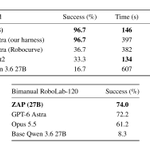

You don't need a frontier model to control a robot. An open VLM already knows what to do; simulation can teach it how.
Learn more at zero-real.github.io
(10/11)

The awesome team behind ZAP at @LumaLabsAI: @djsaunde, @mirceamironenco, Salman Mohammadi, @doublemathew, @srzhu97, @_DivyaMakkar, @xuhuahuang01, @qinboli, @nsupreeth5, @censiyuan1, @Ir1dXD, Shyamal Buch and @thomasneff93
(11/11)
Ben retweeted

Very excited about this! We've been cooking internally for to try and build a very fast & exact sequence parallelism strategy. TL;DR: it's really hard to find the one strategy to rule them all, but based on thorough evaluations and kernel work, we found a very strong overall approach :)
We'll be at PyTorch conference tomorrow and wednesday - if you want to learn more, please reach out! Also code & a more detailed technical report on this will follow!
nitter.gq/LumaLabsAI/status/2112…

Exact sequence parallelism for packed multimodal masks.
It picks ring attention, a sparse all-to-all or Ulysses per layer, matches single-GPU numerics, and beats a FlashMask + Ulysses hybrid in 47 of 48 cases on up to 128 H100s.
lumalabs.ai/news/packed-mult…

Ben retweeted

Language models as forecasters can be accurate while being badly calibrated and overconfident. Their chain-of-thought can also omit the evidence that actually changed a forecast.
In this new work, we find that internal activations give us a much more reliable signal! 1/6


Can LLMs predict the next World Cup champion?
Goodfire partnered with @EternisAI to improve how LLM forecasters use available evidence and manage uncertainty.
We found models were overconfident in their predictions – but probes significantly improved calibration. (1/6)

Ben retweeted

Exciting news: UNI-1.1-Max and UNI-1.1 debuts making @LumaLabsAI the #3 lab in the Image Arena across both Text-to-Image and Image Edit! These are versions released without agentic search.
Text-to-Image Arena
- UNI-1.1-Max #6 overall (1193), +12 points over MAI-Image-2
- UNI-1.1 #7 overall (1190), +13 points over Reve-v1.5
Multi-Image Edit Arena
- UNI-1.1-Max #7 overall (1315), +21 points over Seedream 4.5
- UNI-1.1 #8 overall, (1298)
Single-Image Edit Arena
- UNI-1.1-Max #7 overall (1337)
- UNI-1.1 #11 overall, (1310) on par with Grok-Imagine-Image (20260207)
Congratulations to @LumaLabsAI on this solid performance!

The Uni-1.1 API is live today. Built-in prompt enhancement, research, and reference gathering at the API level.
Trained in collaboration with Hollywood cinematographers, VFX artists, and world-class artists across cultural forms.
Less than half the price and latency of comparable models.
Designed for builders shipping in production — and ranked top 3 lab in the Image Arena across Text-to-Image and Image Edit.
Start Building → lumalabs.ai/api
Ben retweeted

🚀 UNI-1 debuts us as the best lab not named @OpenAI / @GeminiApp. Not bad for our first generation of unified image model!
Interestingly, with the current update, GPT Image 2’s ELO score is now 110 points lower than before. not sure what happened… cc @kenjihata @BoyuanChen0
Sharing a few genuinely GPT-Image-2-level generations from UNI-1 below 🤩
“Generate a news website page from the year 2036, featuring relevant news stories and ad blocks designed not for humans, but for AI agents who have evolved into distinct personalities. Both the website and all the advertisements featured on it should be in English.”


Exciting news: UNI-1.1-Max and UNI-1.1 debuts making @LumaLabsAI the #3 lab in the Image Arena across both Text-to-Image and Image Edit! These are versions released without agentic search.
Text-to-Image Arena
- UNI-1.1-Max #6 overall (1193), +12 points over MAI-Image-2
- UNI-1.1 #7 overall (1190), +13 points over Reve-v1.5
Multi-Image Edit Arena
- UNI-1.1-Max #7 overall (1315), +21 points over Seedream 4.5
- UNI-1.1 #8 overall, (1298)
Single-Image Edit Arena
- UNI-1.1-Max #7 overall (1337)
- UNI-1.1 #11 overall, (1310) on par with Grok-Imagine-Image (20260207)
Congratulations to @LumaLabsAI on this solid performance!

Check out our new multi modal model!
So proud of the whole @LumaLabsAI team, can’t wait for what’s next!

Excited to introduce Uni-1, our new *unified* multimodal model that does both understanding and generation: lumalabs.ai/uni-1
TLDR: I think Uni-1 @LumaLabsAI is > GPT Image 1.5 in many cases, and toe-to-toe with Nano Banana Pro/2. (showcase below)

Ben retweeted

Training Group Relative Policy Optimization, GRPO, models on the hardest problems delivers the biggest gains when annotation budgets are tight.
30 to 40 point jumps on reasoning tasks, plus 20% out of distribution lift.
Labeling is expensive, so the paper asks which 10% of data is worth buying.
They estimate difficulty by sampling several answers from the base model and computing a pass rate.
That ranks prompts into easy, middle, hard, then GRPO trains on only that slice.
GRPO learns by sampling several rollouts per prompt and rewarding outputs that beat the group average.
If every rollout gets the same reward, the learning signal vanishes and progress stops.
Easy prompts become solved fast, so variance collapses, while hard prompts keep a mix of wins and fails, so gradients stay informative.
Across GSM8K and Tracking Shuffled Objects, hardest 10% beats easy, middle, and random on multiple models.
On AIME-2025, only the hard-trained model tops the base, about 20% relative improvement.
The practical rule, buy problems the base model rarely solves but sometimes gets right.
This sustains learning under a fixed budget and improves robustness on harder tasks.


