

Economic historian. Associate Professor at Lund University, Pro Futura Scientia Fellow at Swedish Collegium, and Research Affiliate at the CEPR and IFN.
Joined September 2012
- Tweets912
- Following809
- Followers1K
- Likes5.6K




Thor Berger retweeted

New paper with @akib_kn and Linna Martén:
When war breaks out in the home country, what happens to those already living abroad? We study Ukrainians in Sweden after Russia’s 2022 invasion.
Main results seen in raw data: more mental health prescriptions and higher earnings.
1/

Thor Berger retweeted

Don't forget this masterpiece!
direct.mit.edu/rest/article/…
@Arts_Econ

Thor Berger retweeted

Great opportunity for junior scholars to present their ongoing work in economic history in a non-imposing environment in beautiful Bergamo. Keynote speaker Yanos Zylberberg, Uni Bristol. Send your paper!

📢 Call for Papers | FRESH Bergamo
Join us on 20–21 May 2027 for a workshop on Human Capital, Institutions & Political Economy in Historical Perspective.
📅 Submission deadline: 18 December 2026
🔗 ehes.org/fresh-meeting-berga…
#EconHistory #FRESH
Thor Berger retweeted

The economic history class of 2026/27 is now on Our Long Walk. It is my annual attempt to list every job market candidate in economic history: 86 this year, each with their job market paper.
New this year: what happened to the three classes before them. (Link at 7/10.)

Thor Berger retweeted

After 11 years at the University of Southern Denmark (from student to AP), it's time to try something else.
So I'm on the job market this year! 🧵

Thor Berger retweeted

Proud advisor of Alexandra here - have a look at her JMP if you're interested in learning about how language of instruction affects minorities' integration and assimilation (and the majority, too!)

It’s time to meet the next candidate in our job market candidate lineup, the great Alexandra Sandström!
Alexandra works at the intersection of political economy and economic history. In her Job Market Paper, “Language of Instruction, Integration, and Identity: Evidence from Sweden’s Tornedalians,” she studies the state-led introduction of primary schools with Swedish, rather than Finnish, as the language of instruction in late nineteenth-century Tornedalen, a predominantly Finnish-speaking region on the Swedish-Finnish border.
Using linked censuses and exploiting quasi-random variation across villages and cohorts, she shows that exposure to Swedish-only schooling increased several measures of social integration, while simultaneously shifting measures of identity away from Swedish and toward Finnish. The findings suggest that nation-building through schooling can pull social integration and cultural identity in different directions, and the response to a child’s own schooling differs from the response to a school opening in the village.
Beyond her JMP, Alexandra has a paper with Felipe Carozzi and Luca Repetto on how local World War I mortality shaped participation in the Irish War of Independence, and a paper with Niclas Berggren and Christian Bjørnskov in the Journal of Law and Economics (2026), as well as several exciting projects in progress.

Thor Berger retweeted

It’s time to meet the next candidate in our job market candidate lineup, the great Alexandra Sandström!
Alexandra works at the intersection of political economy and economic history. In her Job Market Paper, “Language of Instruction, Integration, and Identity: Evidence from Sweden’s Tornedalians,” she studies the state-led introduction of primary schools with Swedish, rather than Finnish, as the language of instruction in late nineteenth-century Tornedalen, a predominantly Finnish-speaking region on the Swedish-Finnish border.
Using linked censuses and exploiting quasi-random variation across villages and cohorts, she shows that exposure to Swedish-only schooling increased several measures of social integration, while simultaneously shifting measures of identity away from Swedish and toward Finnish. The findings suggest that nation-building through schooling can pull social integration and cultural identity in different directions, and the response to a child’s own schooling differs from the response to a school opening in the village.
Beyond her JMP, Alexandra has a paper with Felipe Carozzi and Luca Repetto on how local World War I mortality shaped participation in the Irish War of Independence, and a paper with Niclas Berggren and Christian Bjørnskov in the Journal of Law and Economics (2026), as well as several exciting projects in progress.
Thor Berger retweeted

Carl Benedikt Frey considers why some societies are so much more suspicious of the technology than others. project-syndicate.org/commen…

Thor Berger retweeted
Here are our Job Market Candidates for this year! A nice group of researchers spanning many fields
Meet the great Uppsala Econ candidates for the 26-27 job market!!
A really impressive group, with exciting research in everything from health, labor, economic history to macro-finance and more. We will post more about them individually over the next two weeks.
@luca_repetto_c and I serve as placement officers, just reach out to us if you have any questions!
Link in next post.

Thor Berger retweeted
Reminder: If you're on the econ job market, interested in doing research to help build a more prosperous (South) Africa, and would actually like to spend two or three years in the most beautiful part of the world doing so, then please apply for the postdoc fellowships at @StellenboschUni in 2027!

The main reason AI will put all humans out of work is succinctly summarized in footnote 1:


AI in Econometric Theory: An Example
Isaiah Andrews, Anna Mikusheva
arxiv.org/abs/2610.35831 [𝚎𝚌𝚘𝚗.𝙴𝙼]

ALT This note contains a story and a paper. The paper is about the admissibility of two-stage least squares with weak instruments, a topic we have worked on together since 2019. The story is about how we (or, rather, our LLMs) wrote the paper, and some thoughts on what this may mean for our field.
Thor Berger retweeted

Thanks a ton to everyone who engaged with this thread I made a few weeks ago, and especially to @jasonfurman for his wonderful and generous compliment.
Alex and I made this into a Substack (link below) as many of the topics echoed closely with what we were already thinking of writing about, and the current moment of the advances in AI and discussions surrounding it became a focal discussion point.
As I write this today, OpenAI has announced what it describes as major breakthroughs in mathematics, computer science, and physics such as the local smoothing and the Kakeya conjecture, that the Exponential Time Hypothesis is false, and the existence of quantum chromodynamics and completions of the standard model (h/t @AndrewCurran_).
As these technologies advance and refine the limit of what is possible, or what it means even to "understand" something, there is sure to be a reckoning among the most cognitively gifted on what this means for their sense of identity and craft.
I do not have any solutions or recommendations, in part because I am not qualified and also because the historical record we presented in the essay doesn't point to one. All it suggests is that disruption can be quite painful in the short term, with adjustment over time smoothing out the early upheaval.
I also do not know what these advances mean for many professions. On one hand, such technology in the hands of many can empower them to try what was never possible, but it might also create a fear of increasing disillusionment among those whose mastery of such techniques was core to their identity. We will just have to wait and see.
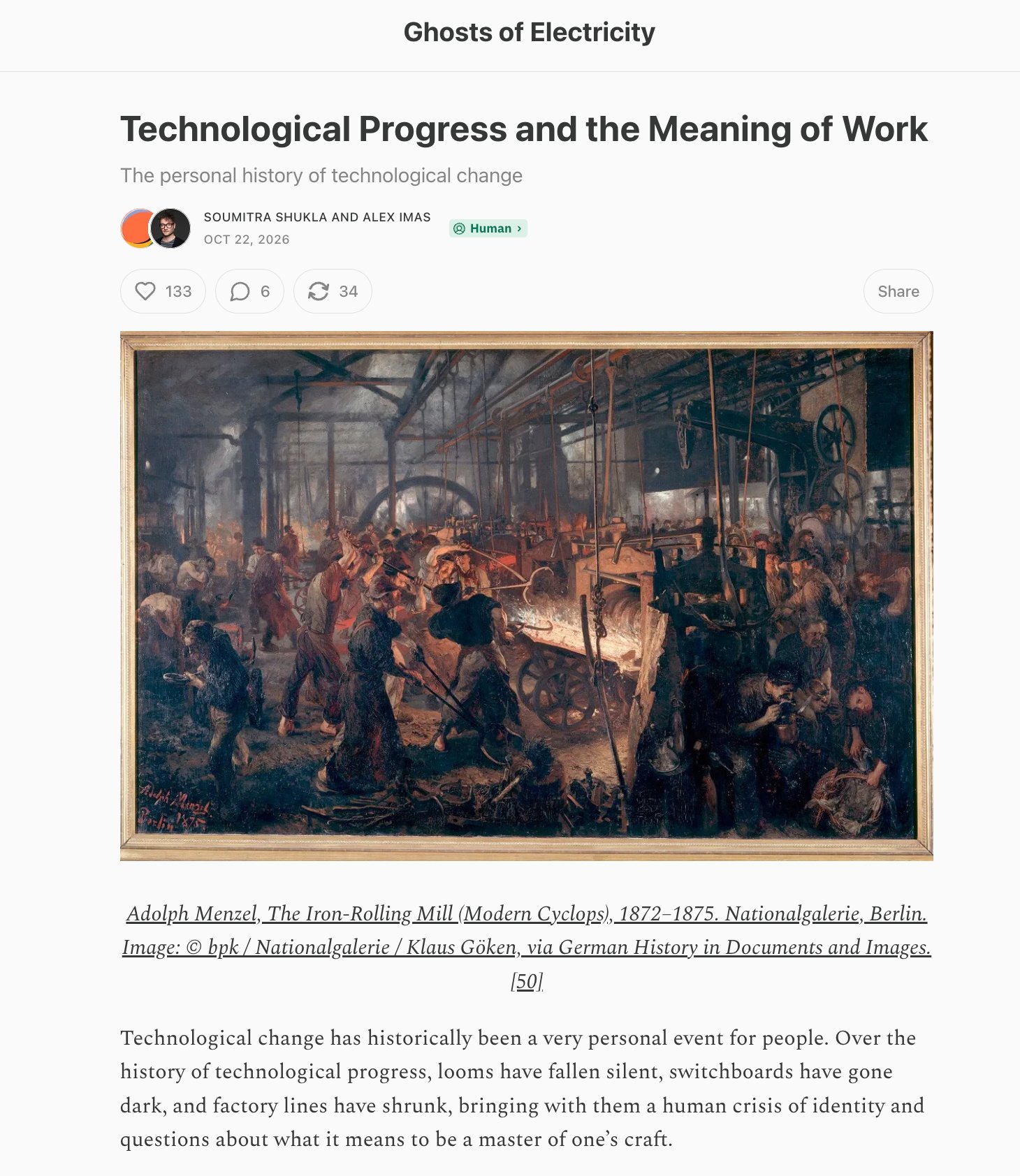

🧵1/10 Given the recent reactions of mathematicians over rapid advances in AI, I think it is important to remember that technological change has historically been a very personal event for people.
Over the history of technological progress, looms have fallen silent, switchboards have gone dark, and factory lines have shrunk bringing with them a human crisis of identity and what it means to be a master of one's craft.

Knausgaard vol 2 really is one of the greatest works of fiction of the 21st century!

Tyler Cowen’s Strongest Book Recommendations, 2003-2026 marginalrevolution.com/margi…

Thor Berger retweeted

New Substack post with @soumitrashukla9. Work has never been just about the income earned sans effort costs, as typical in economic models. Key aspects of people’s identity, their meaning, and sense of agency are all wrapped up with what they do for a living.
There has been a lot of conversation lately about how technological change, particularly AI, may disrupt this relationship, from Ezra Klein's column on his own mathematician father’s grapplings with losing meaning in mathematics, to Francis Fukuyama's post on AI, agency, and recognition. In this piece we take a historical perspective on how technological transformation has disrupted identity and meaning by affecting jobs, and how workers and society responded to these changes.
Much of the debate around AI and jobs has centered on wages and material consequences, but losing one's work is also intertwined with how people view their place in society. Most people know about the Luddites—skilled weavers and knitters—who protested the devaluation of their mastery. What’s less known is that the Luddites were actually experts in using the machines as well, and that their protests prompted prominent economists like David Ricardo to rethink the role of automation in society, and later inspired the Arts and Crafts movement. A century later, when recorded sound displaced 20,000 cinema musicians, their campaign against "canned music" and two-year recording ban pressured labels into funding live performance.
Soumitra and I have been working on versions of this essay for months. He led the piece, and we’re both really excited to get it out there.
Link to the post here: aleximas.substack.com/p/tech…


The most revealing part of this conversation between Jon Stewart and Jacob Coxon wasn't Coxon's warning about A.I. doom, but his description of A.I. utopia, and Stewart's incredulous response. I wrote about it — and Francis Fukuyama's "Last Man," and A.I. easily solving the problems that bedeviled my father's field of mathematics for decades — here: nytimes.com/2026/10/18/opini…


Thor Berger retweeted

Politeness in China is on the rise. Giving a lecture in China, I made a mathematics mistake on the board. A student raised his hand and said, “In China, we do it differently.”

Thor Berger retweeted
A graph style that should get more love is the @BetseyStevenson-@JustinWolfers arrowplot:

Awesome paper and episode with the always brilliant @timsvengali!

🎉 CEPR is thrilled to announce that, for the second consecutive year, VoxTalks Economics has been recognised by @signalawards.
The episode ‘Did the Sewing Machine Liberate Women?’, hosted by @timsvengali with CEPR Research Fellow Philipp Ager, won Silver in the Conversation Starter category.
Read the full news item here: ow.ly/283L50ZZnQZ

Thor Berger retweeted
Uppsala Immigration Lab is hosting a workshop on the Economics of Migration in Uppsala on April 15-16, 2027. We have a great set of confirmed speakers in @ethanglewis, @MetteFoged_econ and @salma_mousa_.
Deadline: January 10.
Call for papers: tinyurl.com/yrx8hb8c
