

@bobbinth
Account based inSpain
About this account
- Account based in
- Spain
- Connected via
- Spain Android App
Account-level information from X, not a live location or the device used for a specific post.
blockchains, zero-knowledge proofs, virtual machines. working on @0xMiden
Joined September 2018
- Tweets1.7K
- Following160
- Followers6.3K
- Likes6.6K






Bobbin's Threadbare retweeted

To become a backbone of future financial infrastructure, a chain must be PQ secure and AI-resistant.
It must offer scalable, programmable privacy, and it must have institution-grade disclosure models that satisfy institutional compliance requirements “w/o throwing out core cypherpunk values".
privacydispatch.beehiiv.com/…

Bobbin's Threadbare retweeted

A soundness bug can destroy a privacy protocol, this is an interim solution which serves as an insurance policy in a worst case scenario where a soundness bug is discovered.
Zcash had a soundness bug which was thankfully patched in time.
Other privacy protocols have had soundness bugs too. Having “guardrails” is an interim solution on the path to a fully confidential, fully formally verified, permissionless, programmable blockchain.
Highly recommend to read this thread to better understand the motivation and plan for the “guardrails”:

Day 10: Guardrails
Building and deploying a privacy-preserving protocol is very difficult - at least an order of magnitude more difficult than a transparent chain. There are many complexities, but perhaps one of the main ones is the tradeoff between perfect privacy and security.
So, the net result of these guardrails is:
- ZK-related bugs become detectable and preventable.
- An potential major exploit becomes traceable.
We do give up perfect privacy for this in the interim: users are private against each other but not against the validators (i.e., bank-level privacy).
Agreed - a pragmatic solution that works today is way better than a perfect solution that doesn't work. I would make one distinction though:
The pragmatic solution should be a stepping stone on the way to a better solution. It is OK to make compromises in the short term if there is a clear path to improve the privacy in the medium/long-term.
This has been our approach with Miden: we are launching with a pragmatic solution (what we call "guardrails") but the foundation is set to enable Zcash-level privacy incrementally and do so safely.

What @ilblackdragon and NEAR team has built is a pragmatic solution which solves users’ problems “today” and such solutions win the users, technically perfect solutions win larpers (that too for a short time, you can never satisfy them for long)
Bobbin's Threadbare retweeted
Korea Digital Asset (KODA) provides digital asset custody for corporate and institutional investors in South Korea.
For these organizations, moving assets onchain should not mean publishing every counterparty, balance, and transfer.
KODA brings its institutional custody experience to private account infrastructure through its role as a Guardian operator on Miden, helping connect financial privacy with the operational needs of its clients.
Read their Operator Story:
miden.xyz/blog/operator-stor…

Bobbin's Threadbare retweeted
very big deal. A lot of work went into this.
The first non-EVM chain connects to Agglayer!
Miden is a privacy-focused, Turing-complete smart contract blockchain.
Imagine if Zcash had Ethereum-like smart contracts.
Just as Ethereum brought general-purpose programmability to the blockchain world pioneered by Bitcoin, Miden brings that programmability to a privacy-first blockchain.
And now, through Agglayer, that world can connect to the broader crypto ecosystem.
Agglayer isn’t just connecting EVM chains anymore. It’s connecting fundamentally different blockchain architectures. Soon @solana.
Bobbin's Threadbare retweeted
Our friends at @OpenZeppelin with a walkthrough of what Guardian does behind the scenes to make private accounts work seamlessly on @joinbread

Private @0xMiden accounts keep only a commitment onchain. So how do @joinBread multisig cosigners stay in sync?
Guardian stores & validates state deltas offchain and cosigns the transaction as an independent check the ZK proof requires. It can’t move funds alone.
See it live ↓
Bobbin's Threadbare retweeted

Proud to be among the first teams going live on @0xMiden.
We're bringing Concrete's institutional-grade vault infrastructure to Miden, helping lay the foundation for privacy-preserving on-chain finance.

Bobbin's Threadbare retweeted

The first non-EVM chain connects to Agglayer!
Miden is a privacy-focused, Turing-complete smart contract blockchain.
Imagine if Zcash had Ethereum-like smart contracts.
Just as Ethereum brought general-purpose programmability to the blockchain world pioneered by Bitcoin, Miden brings that programmability to a privacy-first blockchain.
And now, through Agglayer, that world can connect to the broader crypto ecosystem.
Agglayer isn’t just connecting EVM chains anymore. It’s connecting fundamentally different blockchain architectures. Soon @solana.

Counting down to @0xMiden partner mainnet on October 26th.
Proud to be one of the teams going live first. 🙌
I agree with Justin that protocol agility is critical. One way to get there is to make the core protocol depend on as few assumptions as possible. The rest can go off-chain where upgrades can be performed much more easily.
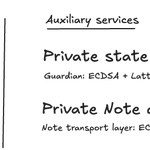
For Miden specifically, we've designed the core protocol to depend only on hashes and STARKs (with fixed-depth recursion). This doesn't mean we don't use elliptic curves or lattices - we do, and in fact Falcon is one of the signature schemes that we support out of the box. But the core protocol does not depend on these. These are used in the auxiliary off-chain services.
This setup allows us to use the most convenient primitives now, and switch over to other primitives when/if the times comes. For example, for deriving shared secretes for private note distribution we can use ECDH now, and switch to lattice-based alternatives later, without having to upgrade the core protocol.


A few reflections on the lattice vs. hash-only debate that our recent Aerie post sparked:
1. Cryptographic ossification for blockchains was never safe. Until the day we know with certainty that P ≠ NP, that finding short vectors in lattices is intractable, that Keccak effectively behaves like a random oracle in deployed SNARKs, and that every single bug has been eliminated from our codebases, blockchains cannot ossify. That is simply not how safe systems are built. Issues will arise, and the system will have to respond.
It’s a double standard to reject lattices because blockchains are hard to upgrade if lattices break, while counting on upgrades if AI breaks your hash function or finds a critical zkVM bug.
The best counterargument is that hash-only designs are more agile: if your hash function breaks, just swap out the hash. But we must aspire to a higher level of agility than this. Indeed, as I cover next, if SNARK recursion itself turns out to degrade security, the proposed hash-only blockchain designs would need to be rethought from the ground up.
2. The real security debate is not lattices vs. hashes — it is lattices vs. building everything on SNARK recursion. That’s because “hash-only” is not really hash-only: it rests on hashes plus the soundness of deep SNARK recursion. Ethereum’s roadmap relies on exactly that: hash-based aggregation needs recursion to keep up with a slot’s worth of signatures, and EIP-8288 would send other signature schemes and users’ own proofs through the same recursive pipeline. In contrast, Aerie proves a slot’s worth of signatures on one laptop without any recursion.
All deployed post-quantum SNARKs rely on the Random Oracle Methodology (via Fiat–Shamir) to establish their security. This is an idealization we know fails in the real world: we have explicit counterexamples where “SNARKs” coming out of this methodology are totally insecure when instantiated with any concrete hash function.
We generally ignore these counterexamples in part because they only arise when proving contrived, self-referential statements about the very hash function used by the SNARK verifier.
But proving statements about the verifier’s own hash function is the exact thing you do in SNARK recursion. That’s why the security of recursive SNARKs can’t be established even in the random oracle model.
On top of that, the standard security proofs for recursion (in other models) suffer an “extractor runtime” blowup that is exponential in the recursion depth, suggesting that security may degrade as more recursion is applied. Yet Ethereum’s own EIP-8288 enables unlimited-depth recursion, even as it lists soundness of recursive SNARKs as a trust assumption. Proofs in more idealized models avoid the blowup, but they mainly tell us that an attack on SNARK recursion would have to exploit the concrete hash function, which is exactly what the Fiat–Shamir attacks above do.
To be clear, we don’t know of any outright attacks on SNARK recursion, and I very much hope it is secure. But some of us who have studied the question have a lingering sense that an attack may be possible in some settings. And if AI is going to supercharge cryptanalysis, there is no reason to expect it to spare Fiat–Shamir for SNARKs, let alone SNARK recursion, both of which have had far less scrutiny than lattices.
So, I do not concede that a “recursion everywhere” hash-only approach is clearly more conservative than one built on standard lattice assumptions.
3. “Just wrap everything in a hash-based SNARK” (like EIP-8288) faces challenges.
Aggregating signatures and proofs off-chain into a single block-level proof is a powerful design independent of the hash-only vs. lattice debate, and I am not telling people to avoid it. But claiming, as Vitalik Buterin did this week, that users can run whatever cryptography they want locally and wrap it in a client-side leanVM proof glosses over major hurdles.
For example, leanVM today is a minimal VM designed almost entirely to prove hash-based signatures and recursion, not general-purpose computation. And binary-field SNARKs like leanVM remain slow at proving the integer multiplications that lattice cryptography does en masse.
I am optimistic that many of these zkVM challenges can be met (including via my own work, binary-field Twist and Shout, which are now implemented in Magnetar). But regardless, if lattices can make aggregation simpler and faster, then they should be leveraged. We need to be agile no matter what.
4. For chains whose reason for existence is privacy, I truly struggle to understand the pushback. Public-key encryption (and fast single-server PIR) cannot be built from hashes alone, at least not in any black-box way. If lattices break, it is going to be very, very hard for these chains to provide acceptable levels of privacy and functionality. For a project whose entire reason for existence is privacy, a loss of confidentiality is an existential failure. Next to that, a second signature upgrade (after the first one, from elliptic curves alone to, hopefully, a hybrid lattice scheme) is easy.
Summary: We don’t know for sure what is secure and what isn’t. We are all weighing unquantifiable risks against each other, and we do not need to agree on a total order on them. But hash-only solutions face many open engineering challenges, and they are not more “conservative” in the way some have argued. Some of those challenges are entirely prosaic and have nothing to do with bugs or cryptography, like hardware support for custom schemes whose hash function is still undecided. I hope we can overcome those challenges within the appropriate timelines, but they must be acknowledged and portrayed realistically.
Overall, cryptographic agility and defense in depth (e.g., hybrid signatures) are the answer, which is why we are building both lattice-Jolt and hash-Jolt. In practice, the positions are less polarized than social media discourse suggests: for example, StarkWare is working to make Falcon verification cheap (falcon.provably.fast/), which is great to see.
Here is the (apparently) controversial take I am sticking to: Conditioned on agility, whenever lattices make systems simpler or more functional, we should embrace them rather than default to “hash-only” designs. Lattices are what the rest of the world will depend on, with decades of study and hardening behind them, and at the system level, less functional often means less secure. Where hash-only designs are just as simple and functional, by all means use them.


Multisigs are always the answer :)

The obvious lesson is CA certificates need to leave the Stone Age and move to threshold ECDSA signatures. The root programs need a blanket policy of only accepting certs with secret sharing between multiple independent HSMs.
Crypto custodians figured this out years ago. When you have really important private keys that require resistance to nation state actors, the only solution is combining multiple independent sources of entropy
Bobbin's Threadbare retweeted

Counting down to @0xMiden partner mainnet on October 26th.
Proud to be one of the teams going live first. 🙌