

Network scientist. Assistant professor and academy research fellow at Aalto University.
Joined September 2011
- Tweets75
- Following181
- Followers440
- Likes210



Reminder: Last chance to apply for our postdoc positions in polarisation + mental well-being: aalto.fi/en/open-positions/o…
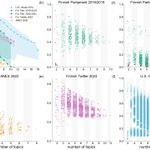
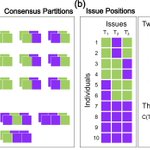
Our new paper on a higher-order measure of alignment meant for polarisation research: "multiway alignment," measuring the information knowing your opinion on one topic gives about a set of other issues. Led by my student @leetiletizia arxiv.org/abs/2408.00139


📢JOB ALERT📢
TWO postdoc positions in my group at @CSAalto. Come work with me on network science & computational social science topics within new projects related to polarisation in societies, misinformation & coordinated activities on social media.
See mkivela.com/postdoc/
We didn't find much activity or influential bots in the Finnish elections in 2021 (or 2019) using @botometer but the detected bots and suspended accounts were very unevenly distributed across opinion bubbles aalto.fi/en/news/bots-were-n…

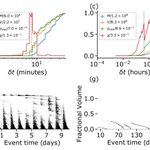
Our latest paper, "Directed Percolation in Temporal Networks", with @ArashBadie, @MartonKarsai & @abbas_k_rizi, is now on arXiv! #Networks2021 arxiv.org/abs/2107.01510
Reachability phase transition in temporal networks can belong to Directed Percolation universality class. 👇👇

We optimized vaccination strategies in Finland for a model with age structure and mobility from mobile phone operator. Results of this about 3k dimensional optimization are non-trivial but somewhat interpolations between previously suggested heuristics: arxiv.org/abs/2105.11562
Summary: If you are building social networks with link strenghts, simply counting the number of contact events or duration might not be the best option to determine the strengths. Don't throw away your valuable temporal data!

Estimating tie strength in social networks using temporal communication data ift.tt/34gD2N3

Here is the link to the slides: mkivela.com/cn-mlayernets-20… of the presentation. Don't want to draw multilayer networks manually like they did in the 50s? Use Pymnet for drawing them: mkivela.com/pymnet/

Here's @bolozna telling us all about multilayer networks in his tutorial at Complex Networks and their Applications 2020.
Starting out with multi-layer networks (or sociograms) from the 1950s!

Want to analyse multilayer network data and develop network models in my group at @CSAalto in Finland? I have a postdoc position open in an interdisciplinary project on climate change communication, polarisation and more. Full information here: mkivela.com/postdoc/
Our article on looking below the shoulders of giants is now out in PRR. Learn how to deal with the full body of literature behind direct citations to articles. With PDBP @RainerKujala @kimmokaski . link.aps.org/doi/10.1103/Phy…

Looking for a postdoc in a project related to multilayer networks of political communication on climate change. Please apply if you are interested working in my group in collaboration with politics and media researchers: mkivela.com/postdoc/
More than 4 years since my last tweet. This is my gift to anyone trying to find fat tails in the inter-event time distributions in Twitter.