
PhD Student @manningcics. Working on Machine Learning and Computational Social Science.
Amherst, MA
Joined July 2017
- Tweets27
- Following463
- Followers74
- Likes150


Chhandak Bagchi retweeted

✨Excited to announce the release of AutoDiscovery — autodiscovery.allen.ai/ — part of @allen_ai’s Asta suite, designed to help scientists uncover *surprising* discoveries embedded in their research data.
Scientific discovery requires two difficult capabilities:
(a) principled exploration of a hypothesis search space 🔍
(b) continually updating beliefs as new evidence arrives 🤔
How can we build AI systems that do both well? This question has shaped my PhD and my broader research vision of what I think of as "epistemological LLMs". AutoDiscovery grew out of this vision and takes a step toward (a), with ongoing work on continual belief learning that I’m excited to share soon.
It’s been especially meaningful to see early use across oncology (@ProvSwedish), social science (@UUtah), and climate science (@scrippsresearch), where researchers are already reporting findings they consider impactful: allenai.org/blog/autodiscove….
Finally, taking this from an academic project to NeurIPS to a deployed system was a *huge* team effort. I’m very grateful to my amazing collaborators at @allen_ai and @UMassAmherst who made it possible! 🙏
AutoDiscovery: autodiscovery.allen.ai/
Paper: neurips.cc/virtual/2025/loc/…
Blog: allenai.org/blog/autodiscove…


🚨 Excited to share our #ICWSM2025 paper 🚨
📄 "Effects of Research Paper Promotion via ArXiv and X"
w/ @ericmalmi & @przemyslslaw
We will present it at ICWSM this Tuesday at 5:15pm CET! 🧵👇
This raises questions about merit vs. social momentum:
If social exposure skews citations, should we rethink how we measure impact?
We argue for:
— Better metrics
— Awareness of these dynamics
📢 @przemyslslaw will present this work Tuesday at #ICWSM2025 at 5 PM in Room CSS 35.01.05
📄 Paper: ojs.aaai.org/index.php/ICWSM…
Come say hi & let’s talk about the future of publishing 🚀
Chhandak Bagchi retweeted

We’re excited to release an ML model that automatically extracts whale body length & volume from aerial images! Using Mask R-CNN, it detects whales, traces their body shape, and estimates the body axis. 🧵(1/4)
zslpublications.onlinelibrar…

Chhandak Bagchi retweeted

A high-profile study last year, done by academics and Meta scientists, found Facebook’s algorithm didn’t promote political polarization. But critics say the paper is flawed because it failed to acknowledge big algorithm changes at the time. @kakape reports science.org/content/article/…

Chhandak Bagchi retweeted

Some people use the story of the boy who cried wolf.
First, type 1, the villagers react when there is no wolf present. Second, type 2, the villagers do not react despite there being a wolf present.
The story wouldn't make sense in the other order, making 1 then 2 memorable
It was a great experience presenting @IC2S2. Please check out our paper: arxiv.org/abs/2401.11116

Our first talk at @IC2S2 today shows that publishing early on arXiv and tweeting leads to more citations in the 5 years from the initial publication. Excellent talk and work by @c_bagchi!
Our (revised, soon to appear) paper is accepted to ICWSM'25: arxiv.org/abs/2401.11116

Chhandak Bagchi retweeted

Our 3 submissions to @IC2S2 are accepted as talks/plenaries! (Topics: social polls, global news coverage, and scientific promotion.)
Looking forward to the conference in Philly!
Congrats @hide_yourself @junghwanyang @yang3kc @gonemelon @computermacgyve @david__jurgens @EthanZ @c_bagchi @ericmalmi! 🎑
Chhandak Bagchi retweeted
🚨New blog!🚨
I’m launching a new blog, named Uncommon Good, focused on responsible techno-social systems such as AI and social media. Common good designs are rare in practice. We want them to become more common!
Please subscribe!
uncommongood.substack.com

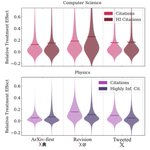
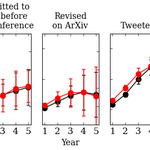
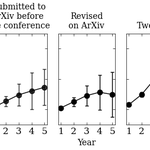
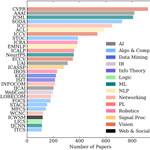
This finding suggests that conferences restricting ArXiv submissions through anonymity periods reduce paper's impact on the community, given that citations serve as a prevalent measure for assessing paper-level impact in today's scientific landscape.
🧵4/5
The study reveals similar effects for @SemanticScholar’s measure of influential citations. This suggests that modern measures of scientific impact are susceptible to promotion on X. We advocate for the development of research impact measures accounting for such influences.
🧵5/5


🚨New preprint!🚨
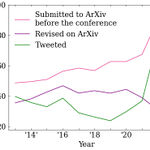
We analyze (w @ericmalmi and @przemyslslaw) trends in the use of @ArXiv and @X functionalities and their effect on the number of citations of papers in computer science venues such as @CVPR, @icmlconf, @emnlpmeeting, @TheWebConf.
arxiv.org/abs/2401.11116
🧵1/5

