

Reading, writing, sharing. Follow @parrotedwords too.
☧
Joined November 2011
- Tweets280
- Following309
- Followers505
- Likes7.1K




Pinned Tweet
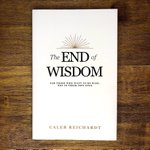
Today’s the day I officially announce the release of my new book:
The End of Wisdom: For Those Who Want to Be Wise, Not in Their Own Eyes
You can learn more and get your copy here: calebreichardt.com/p/buy-my-…


5
743
People seem to forget that books have always been “ad-free.”
@nntaleb said it best: “The book is the only medium left that hasn’t been corrupted by the profane: everything else on your eyelids manipulates you with an ad.”
Return to that unadulterated haven.
25
Optimism and pragmatism are each terrible enemies to have on their own but together make great cobelligerents. Like the United States and the Soviet Union during World War II, they are more cobelligerents than allies, as they seek the same ends but for different reasons. One seeks to keep your head up and your feet moving, while the other seeks to keep your head down and your feet from faltering. Optimism says, “It’s all going to work out”; pragmatism says, “How’s it all going to work out?” Optimism will cause you to do everything; pragmatism will cause you to do nothing. The wise man balances both. Wisdom is, in large part, walking tightropes and avoiding ditches, for any fool can fall into a ditch, but to walk the tightrope of life must be learned and practiced.
47
This isn’t a hill I’m going to die on and I would likely conform to the new term if it were to prevail, but “AI” is superior to “SI” in every way, mostly in that it’s just perfectly descriptive. It allows AI to maintain the illusion of intelligence (which it most certainly has) without putting it on a god-like pedestal (which it most certainly is not). Ironically, SI standing for “stupid” intelligence would actually be more descriptive than “super” intelligence because what we’re dealing with here is not actually intelligent, but we wouldn’t want to name it that way because it doesn’t feel stupid, thus making “artificial” intelligence the perfect, balanced term.
92
Providing an excerpt from my book which addresses this sort of attitude:


going thru diaries from when i was struggling with my Christian faith. It seems even from a very young age, I was confused that Jesus's sacrifice was supposed to be such a big deal. I find multiple entries across the years with variations on "Obviously any of us would do that for someone we loved, it kinda seems like Jesus just hitting the bare minimum"
It’s been said not to forget in the dark what you knew in the light. I would add that the opposite is equally important: Do not forget in the light what you knew in the dark.
G. Michael Hopf’s famous words help flesh this out: “Hard times [dark times] create strong men. Strong men create good times [times of light]. Good times create weak men. And, weak men create hard times.” This is the cycle of forgetfulness that every people, every man is prone unto.
New Yorkers said, “Never forget,” and then they went ahead and elected a Muslim mayor. The addict, as he’s once again standing in a wreckage of his own, says, resolutely, “This is the last time,” only to find himself right back there time and again.
Dark times bring with them a paradoxical clarity of vision unknown to the otherwise blinding light of the good times. It’s unfortunate, but it is often the case that when we are most at ease is when we are most vulnerable.
Dark times mold us in a way that the good times never could. They violently shake us and wake us up to our own stupidity and foolishness, after which we put ourselves back onto the straight and narrow, on which we do well for a while, but after a while the straight becomes a little too straight and the narrow a little too narrow. We forget, often willfully, the darkness we escaped and how we escaped it, and we itch to stretch our legs and dip our toes back into that which will ultimately take us out of the light and put us right back into that same old dreadful darkness again.
But it need not be this way. We need only remember, and remember continually. When you are eating the fruits of your labor, forget not whence those fruits came, and in doing so, you will not only keep them but continue to enjoy their sweetness. So remember, and remember this: Do not forget in the light what you knew in the dark.
156
The importance of reading history is, paradoxically, not about transporting you to the past but about grounding you in the present.
You have access to a world-class education from the greats of history for a meager fee and two-day shipping on Amazon.com. The only real barrier to entry is your willingness to do the reading. And no, AI is not the new substitute because you actually have to do the thinking too.
Verbosity as a writer is not writing but stalling. You stall as long as you can in hopes that your reader will not find out that you have nothing to say.
162
The customer is not always right, but the customer should always be given the benefit of the doubt.
1
138
“The new skeptic is so humble that he doubts if he can even learn . . . The old humility was a spur that prevented a man from stopping, not a nail in his boot that prevented him from going on. For the old humility made a man doubtful about his efforts, which might make him work harder. But the new humility makes a man doubtful about his aims, which will make him stop working altogether . . . We are on the road to producing a race of men too mentally modest to believe in the multiplication table . . . The meek do inherit the earth, but the modern skeptics are too meek even to claim their inheritance.”
Written by G. K. Chesterton in 1908. Truer today.
This sort of “humility” has, in part, produced the current cultural madness that we find ourselves in, with a populace, for instance, that is afraid to say that men are men and women are women and that the former cannot be or become the latter and vice versa—you know, the kind of thing that would have a child of a past age laughing at the intelligentsia of today.
This sort of humility produces a society bereft of truth. And when truth is lost, “my truth” becomes paramount. Subjectivity becomes the new objectivity, and the religion of relativism reigns supreme.
This faux humility, in practice, goes by many names: “tolerance”, “inclusion”, “sensitivity”, “acceptance”, etc.—squishy words for squishy people stripped of all meaning—but let us focus on the first, tolerance, for a moment. Fulton Sheen once remarked: “America, it is said, is suffering from intolerance. It is not. It is suffering from tolerance: tolerance of right and wrong, truth and error, virtue and evil, Christ and chaos. Our country is not nearly so overrun with the bigoted as it is overrun with the broad-minded.”
So before you say you’re just being “open-minded,” I would say that it is quite possible to be so open-minded that your brain falls out. Chesterton wrote elsewhere: “An open mind is really a mark of foolishness, like an open mouth. Mouths and minds were made to shut; they were made to open only in order to shut on something solid.” The open-minded can actually be the most close-minded, for they have closed their minds to the possibility that truth can be known.
“When the ordinary man calls himself a skeptic or an unbeliever,” said T. S. Eliot, “that is ordinarily a simple pose, cloaking a disinclination to think anything out to a conclusion.”
This skepticism is not a bad thing on its own; it’s only bad when that’s all there is and, after having its fun, all that remains; in other words, when you ultimately know nothing and believe nothing. When there’s not an ounce of conviction in your bones and only confusion and cowardice without a trace of truth.
Truth, by definition, has an exclusivity to it. Meaning, a conclusion results in exclusion. Meaning, one thing being true runs the risk of another thing being false. Little Scotty being born a boy runs the risk of offending Little Scotty when he decides to be a girl. Abortion being murder runs the risk of insulting an abortionist when you call him a “murderer” rather than a “champion of women’s rights.” Christianity being true, good, and beautiful runs the risk of Islam, to take one, being false, evil, and ugly.
Because of these risks, it can, and often does in today’s day and age, take some measure of courage to step up to the microphone, if you will, and speak the truth. But what else can we do but to speak it in love?
There’s paradox present in the very being of God: The Father is God, but the Father is not the Son, and the Son is God, but the Son is not the Father, and so on and so forth. And if there’s paradox in the being of God, we should fully expect to find the same thing in the creation of God, as well as in His ways and doings. This is why you should not allow those cosmic tensions to trouble you. Just as you will never get to the bottom of the trinity, you will never get to the bottom, for instance, of the relationship between God’s sovereignty and man’s freedom. Ponder it, yes. Meditate on it, surely. But find rest in allowing it to be the eternal mystery that it is. This is part of what it means to have faith.
And should we expect anything less? Should we expect God, the maker of heaven and earth, to be simple, like us? Can the clay compare itself to the potter? Can the clay even comprehend the potter?
The incomprehensibility of this Principal Paradox need not frighten us. For as Chesterton once said: “The use of paradox is to awaken the mind.”
“A paradox,” said Peter Kurowski, “is the wedding of two [or three] seemingly contradictory truths that form a deeper truth.” God is that deeper truth, the deepest truth.
You know Harari and his history, but do you know the origin story as laid down by Moses?
You know the prophetic pen of Orwell, but do you know the vision of Isaiah?
You know the songs of Dylan, but do you know the psalms of David?
You know the sayings of the Stoics, but do you know the proverbs of Solomon?
You know the biographies of Isaacson, but do you know the gospels of Matthew and Mark?
You know the letters of the founding fathers, but do you know the epistles of the founding church?
You know Jenkins’ Left Behind, but do you know John’s Revelation?
You know the works of this world, but do you know the Word of heaven?
You know man, but do you know God?