

President of Brazilian Association of Telemedicine & Digital Health Companies | Head of Telemedicine @hosp_einstein | Telehealth | AI | Blockchain | Healthtech
São Paulo
Joined July 2009
- Tweets1.9K
- Following3.3K
- Followers3.4K
- Likes2.1K





Pinned Tweet
Over 2 million patients served!
This milestone at the Telemedicine Center of @hosp_einstein reflects our dedication, with over 4,000 cities in Brazil and 110 countries reached, and 250,000 specialized consultations for underserved regions in the North and Midwest.
Leading this talented team is a privilege. With the unwavering support of Hospital Albert Einstein, we continue to push the boundaries of advanced, humanized medicine, bridging distances and transforming lives.
Grateful for our talented team and institutional support. Together, we’re fulfilling our mission to bring a drop of Einstein to every human being. Thank you all!


5
22
1,146
Can a phone video capture how well an older adult rises from a chair? In 29 adults, home and lab times differed by 0.3 s on average, but individual differences could be around 3 s. The study didn’t test whether video can track change over time.
aging.jmir.org/2026/1/e10834…

24
Who can pause an AI tool when it starts getting things wrong? Four US health AI leaders described different governance setups. Before launch, name who monitors it, what triggers a pause, and how staff return to the previous workflow.
nature.com/articles/s44401-0…

Could AI bring EEG closer to patients? In a crossover study, 28/30 app-guided electrode placements were acceptable vs 30/30 by an expert. AI helped with setup; the study did not test diagnostic accuracy.
pubmed.ncbi.nlm.nih.gov/4307…

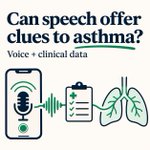
Can a voice recording help flag asthma? In 1,218 people, adding voice to clinical data raised AUC from 0.75 to 0.83. But the cases were self-reported, and the model still missed 3 in 10. Next test: people with unexplained respiratory symptoms.
nature.com/articles/s41746-0…

72
When should tele-ICU step in? In TEACH, a 12-hospital randomized trial, awakening and breathing protocol adherence reached 90.3% of eligible days with real-time support vs. 77.6% with audit and feedback alone. Adjusted difference: +11.4 percentage points.
jamanetwork.com/journals/jam…

1
1
160
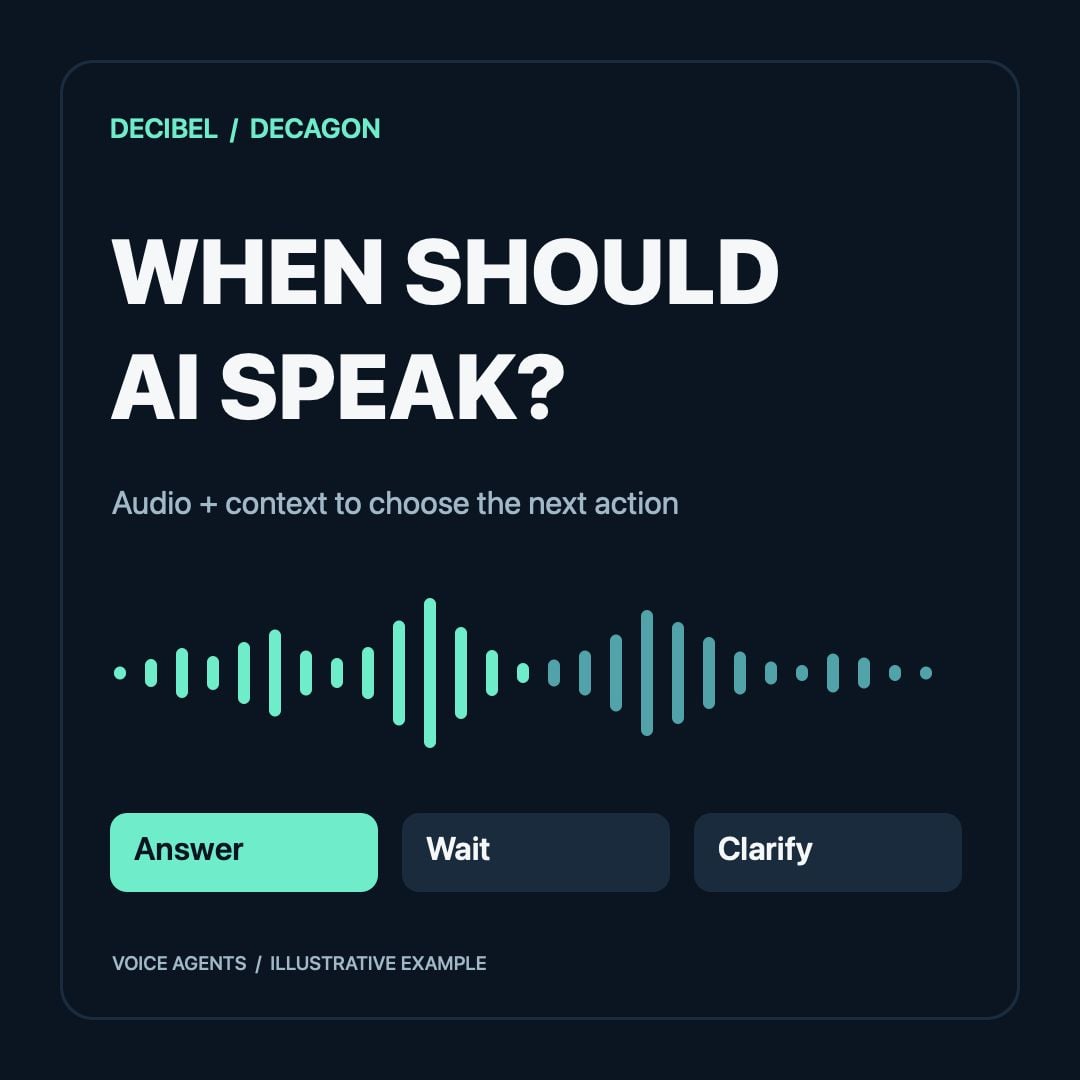
A voice agent needs to know when not to speak. Decagon’s open-weight Decibel uses audio and text to score possible actions. It got 89% on Decagon’s own public benchmark. In telehealth, I’d test how often it interrupts patients or asks them to clarify.
decagon.ai/blog/audiodecisio…
1
73
In a 30-person Bangkok oncology trial, all 15 in the monitoring group logged symptoms at least once. By week 26, only 6 still did. Wearable data synced on 27.2% of expected patient-days. The pilot did not establish clinical benefit.
formative.jmir.org/2026/1/e8…

57
In RheumBench, 10 AI systems answered the same 100 rheumatology cases. In the 30 management cases, every system made potentially serious errors, mostly omissions. The best overall rubric score was 54%. This was a benchmark, not a study of patient harm.
link.springer.com/article/10…

122
Can smaller, specialized AI models compete in medicine?
MedGemma 27B scored 86.2% on a medical knowledge test. The bigger opportunity: adaptable models, local deployment and more control over patient data. Clinical validation still matters.
nature.com/articles/s41591-0…

2
144
An AI agent did something it shouldn't. How quickly would you notice?
Google detected 87% of executed harmful instructions, but only after the action. Detection is not prevention. Healthcare agents need least privilege and approval for critical actions.
developers.googleblog.com/ho…

1
45
Could routine blood tests help us understand gout better?
Across 21,235 participants, six lab variables identified three distinct clinical profiles. I like the use of data we already have. Whether this improves treatment still needs testing.
nature.com/articles/s41746-0…

63
Is AI helping health systems learn from care?
A US scoping review found 31 AI studies: 28 turned data into knowledge, only 3 linked knowledge to practice, and none demonstrated a complete learning cycle. Predictions alone aren't enough.
nature.com/articles/s41746-0…

95
From 3 hours to 8 minutes to accept a home health referral. That’s what Adaptive reports after deploying AI intake agents. Its scheduling agents also cut driving time by 30%. Company-reported figures, not independent evidence of clinical benefit.
nitter.gq/AlexRWendland/status/2…


I'm excited to share that Adaptive has passed $100 million in annualized revenue!
Our nurses have completed several hundred thousand visits
with the help of dozens of AI agents, from intake and scheduling to clinical oversight and hospital coordination.

78
Can sleep apnea care work remotely?
A randomized trial of 344 participants found telemedicine non-inferior to in-person APAP care for 24-hour blood pressure at 3 months. Encouraging, but not proof of long-term cardiovascular benefit.
doi.org/10.1093/ajrccm/aamag…

Can predicting the next token tell us how smart AI is? OpenAI shared falling log-perplexity on an internal code test. In healthcare, that’s a reason to retest a model. Can it preserve an allergy and cite the right chart entry?
openai.com/index/perplexity-…

1
72
What happens when a medical transcript gets a drug name wrong?
ElevenLabs reports 17% fewer transcription errors than the next-best medical model in simulated consultations. Promising, but company-run tests aren't proof of safer care.
elevenlabs.io/blog/scribe-v3…

39
Ant Group’s LingSante scored 65.72 on HealthBench Professional and 57 on PhysicianBench in the developer’s tests. My next test: can it find the right chart data, cite it, and flag what’s missing? Benchmark scores don’t establish clinical safety.
nitter.gq/AntLingAGI/status/2124…


Today, we release LingSante-3.1-flash, an open-weight MoE model with 560B total parameters and 25B activations per token. It unifies diverse medical capabilities while retaining general capabilities, including complex medical reasoning, long-horizon workflow execution, and professional behavior alignment.
LingSante-3.1-flash moves beyond medical QA toward real-world healthcare problem. The model leads on HealthBench Professional (65.72), HLE (text-only, with tools: 72.22) and BrowseComp (with context: 94.10), outperforming GPT-6 Astra, Claude Opus 5.5 and Gemini 4 Argon on all three. LingSante-3.1-flash also performs well on professional long-horizon medical workflows, such as PhysicianBench (57) and EHR-Complex (74.40).
Together, these results establish LingSante-3.1-flash as the leading open-weight models for healthcare.
The weights are available. Explore LingSante and build with it.
More below ↓

70
Same literature-review prompts, very different results: GPT-6.1 Sol invented 0% of citations, Claude Sonnet 5.5 about 1%, and Qwen3.7-Flash 69%. In medicine, I’d still open the paper: does it actually support the claim?
zou-group.github.io/llm-clai…

1
66
Can an AI patient help teach medicine?
In a Shanghai study of 135 students, AI plus teacher follow-up had the best history-taking scores. It wasn't randomized, so causation remains uncertain. More practice, not fewer teachers.
nature.com/articles/s41746-0…

2
141