

@EmergencesLabs | Human x AI | become AI-native talents and better assessment | Ex-VC, Ex-Apple, Ex-Uber
U.S.
Joined July 2017
- Tweets51
- Following478
- Followers162
- Likes90




This midterm season, people have been arguing loudly. But one number stopped me:
🚨 64% of Americans aged 18–29 say AI replacing jobs is a serious threat to their long-term financial security.
That's Harvard's latest Youth Poll. 76% of Democrats 🔵 and 61% of Republicans & independents 🔴 agree.
Whoever you voted for, the fear of "what's my next job?" feels almost the same. 🗳️
I keep wondering 🤔: if AI takes over entry-level work, where do we get our experience?
AI makes it easier to do the work. Getting a chance to prove ourselves still feels harder. 😮💨
What I'd want is simple: someone gives me a real problem, lets me work through it, and talks to me about the choices I made. 💡
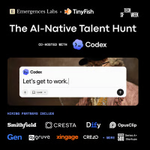
So at @EmergencesLabs , we ran the AI-Native Talent Hunt at SF Tech Week 🌉
🏢 10 companies brought real problems
🧑💻 Candidates did the work
👀 Hiring managers saw not just the result, but what people checked, questioned, and changed
Do the Job to Get the Job. 🔥
Starting this November, we're bringing it to campus around the US 🇺🇸
👉 Follow us to stay tuned and work on a real problem: @EmergencesLabs


7
137
The PHP vulnerability story this month made safety and alignment a front-page topic.
As AI systems get more autonomous, the question isn’t only what they can do, but who stays responsible for how that power gets used, disclosed, and constrained. It’s the question our team at @EmergencesLabs
keeps returning to - human alignment, keeping humans meaningfully responsive in the loop.
Join my cofounder @KolentoH for “Safety at Inference Time: Testing, Understanding, and Constraining AI Systems” at #InferCon on November 16 in San Francisco, hosted by Datadog.
Hope to see you there!
#InferCon #AISafety #Cybersecurity #ResponsibleAI

As AI becomes more autonomous, the question isn't just what machines can do, but what humans should remain responsible for.
Excited to moderate “Safety at Inference Time: Testing, Understanding, and Constraining AI Systems” at #InferCon on November 16 in San Francisco, hosted by @datadoghq
Looking forward to exploring how we can build AI systems that are not only more capable, but also more understandable, trustworthy, and accountable to humans.
Hope to see you there!


8
167
I believe... We are the hottest hackathon at SF Tech Week now! Over 1500+ people have registered across platforms. Become AI-native talent and build with Codex with real enterprise - this might sound too sexy


1
10
207
Cai C. retweeted

Stop reading credentials. Start watching people work.
That's where 100+ people landed Saturday in Sunnyvale, across two panels we hosted with @Valley101en that never coordinated.
QifeiWang (Google DeepMind) told us about a team near his choosing between a PhD with a stack of publications and an engineer with none. The PhD needed three weeks to form an idea and run the experiment. The other came back the same day. They hired the one who shipped.
Elena Chen (Microsoft Copilot) described a PM day that once took a full quarter to ship one feature. Now she fires 50 requests at a model and iterates. Building 50 features is easy. Deciding which one is worth building is the job.
@KolentoH, our CEO: AI lets anyone generate artifacts. That democratizes portfolios and devalues them at the same time. When output gets cheap, what's left is process — how you worked, where you got stuck, what you chose not to do.
@BharatKChandar (Stanford Digital Economy Lab): most hard skills students learn never reach the job. Critical thinking and the people you know do.
Paul Marca (Stanford): maybe four years is the wrong container. What if a university stayed with you for fifteen, and showed up when you needed it?
If you were hiring tomorrow — resume, or a week of someone's real output?


AI-Native Talent #1: The Fluency Gap
We're using AI more than ever. But are we getting better at using it?
Anthropic just dropped its AI Fluency Index, a baseline study of how people actually collaborate with AI, drawn from ~9,800 multi-turn Claude conversations.
Two findings stuck with me:
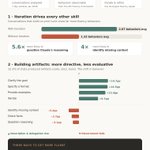
1. Iteration is the superpower. 85.7% of conversations involved iteration and refinement. \building on responses instead of taking the first answer and running. And it matters: these conversations showed roughly double the fluency behaviors. People who iterate were 5.6x more likely to question the AI's reasoning and 4x more likely to spot missing context.
2. Polished output lowers our guard. When AI generated artifacts (code, docs, tools), users got more directive up front - clarifying goals, giving examples, specifying formats. But they got less critical: fact-checking dropped 3.7 points, questioning the reasoning dropped 3.1, identifying missing context dropped 5.2. The better it looks, the less we scrutinize it.
That second point is the one to sit with. As AI gets better at producing things that look finished, the skill that grows in value isn't prompting - it's judgment.
The most valuable person on your team isn't the one who uses AI the most. It's the one who pushes back on it, iterates, and refuses to ship "looks-good." That's a developable skill. And right now, almost no one is developing it - because we're measuring token consumption instead of judgment.
🔗 Anthropic Education Report - The AI Fluency Index: shorturl.at/WDAf3

1
4
140




Interdisciplinary would be more valuable. But historically, there are some patterns already. @geoffreyhinton studied psychology and CS, which is a perfection combination and be able to apply human understanding on machine intelligence development.
This would be more valuable going forward as building cost gets lower. People with learning capabilities across domains would bring future innovative ideas. 💡

.@Collision is bullish on two types of people: high-agency individuals and double majors.
"There are two categories of people I would be super bullish on right now and I think will do incredibly well over the next 10-20 years. First, high-agency people. The people at Stripe who have been talking to customers and know exactly what we should do. It's the people who have that pep in their step and want to go make Stripe better. They are so much more empowered thanks to AI."
"The second is double majors. I think if you understand software and understand finance, or if you understand software and understand marketing, you now can go massively improve the entire marketing funnel for your company. Now, one person can do what would have taken 20 people dredging through all these systems."
"Charlie Munger talked about the importance of being multidisciplinary and multidisciplinary thinking. He thinks getting a functional understanding of many disciplines is not that hard. You can just go read the books now or you can talk to your AI about it. I think multidisciplinary thinkers are going to do incredibly well."
1
94
A new role is quietly taking over Silicon Valley job boards: the "AI Builder."
It's one person doing what used to be three: PM, frontend, backend - collapsed into a single hire.
Examples of companies hiring "AI Builders":
@genspark_ai Superdev: bit.ly/494y47s
@PwC AI Native Senior Engineer: bit.ly/4mZI6fM
@Accenture AI Native Software Engineer: bit.ly/4t8jPWu
Demand is enormous. The problem nobody's solved yet: how do you actually hire them?
Resumes don't work. The role didn't exist two years ago, so the real signal is buried in side projects nobody put on LinkedIn.
Live coding also isn't effective. The essential skill isn't just "can you write a binary search"; it’s having good taste and fluency with AI tools. It involves knowing what to build, recognizing when the model is incorrect, and understanding what not to ship.
Which raises a harder question: if resumes can't surface these people, and traditional coding interviews can't measure them, how do you actually hire them at scale? The companies figuring this out first will have an unfair advantage over the ones still asking candidates to reverse a linked list. A new kind of interview is coming. More on that soon

3
181
Uber just blew its entire 2026 AI budget in a few months.
Token consumption is not the right metrics to evaluate enterprise employee ai performance.
The real questions nobody is answering with token dashboards:
→ Did the 70% AI-written code ship faster?
→ Did it have fewer bugs?
→ Did it actually move the business?
Until we measure outcomes boosted by ai adoption instead of consumption, every company adopting AI at scale is essentially flying blind with a very expensive fuel bill.
⚖️ What metrics are you using to evaluate AI ROI in your org?

1
67
Most PMs using AI are just automating their old workflow.
An AI-native PM does something different — they throw out the process entirely and rebuild from scratch around what AI can actually do.
Same starting point. Same goal.
❌ Upskilling: 2 weeks → 7 days
✅ Reskilling: 2 weeks → 3 days
The difference? One uses AI as a faster pen.
The other uses AI as the entire engine — and shows up to judge the output.
That’s the gap between AI-assisted and AI-native.
#AINativePM #ProductManagement #FutureOfWork

1
52
What does it actually mean to be AI-native?
Not having a ChatGPT subscription. Not writing clever prompts. Not sharing AI news every day.
It’s this: using AI to cut 80% of your execution cost — then betting everything on judgment.
Their output isn’t called “AI-assisted.” It’s called done.
The new career standard has exactly one question:
What real problem did you actually solve with AI?
#AINative #FutureOfWork #CareerOS
1
1
39

Being bearish on Big Tech is trendy in the GenAI era.
But 🍎 is quietly leading in on-device LLMs—deep hardware/software integration, chip-model co-design, and real-time optimization.
AI’s future isn’t just in the cloud. It’s in your pocket.
#OnDeviceAI #LLM #GenAI

As Apple Intelligence is rolling out to our beta users today, we are proud to present a technical report on our Foundation Language Models that power these features on devices and cloud: machinelearning.apple.com/re…. 🧵

1
157
