

Nothing ever posted is financial advice | Do your own due diligence | Only innovation prevents chaos. https://nitter.gq/t.co/kfXZOyo0E7
Earth
Joined July 2024
- Tweets2.1K
- Following280
- Followers1.5K
- Likes2K




Pinned Tweet
$VSTM reported that VS-7375, an oral non-covalent KRAS G12D ON/OFF inhibitor, reached a confirmed ORR of 9 of 22 (41%) at 900 mg in 2L+ mPDAC. How might this ORR translate into survival, and how does VS-7375 compare with $RVMD's daraxonrasib and zoldonrasib?
Link in comments (free, as always).
Disclosure: I am long $VSTM. No position in $RVMD. This is not financial advice. Do your own research.

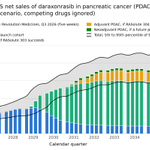
My latest article presents my model of a blue-sky scenario for US net sales of $RVMD's daraxonrasib (Rasonque) in pancreatic cancer. Both plots are the output of a simulation under specific assumptions and NOT a forecast by the company or any analyst. I am long $RVMD. This is not financial advice!
The sweep parameter ranges and assumptions are explained in full in the article (link in comments, no paywall, as always).
The model and both plots are a blue-sky scenario and assume that all ongoing registrational trials and one hypothetical neoadjuvant program of daraxonrasib in pancreatic cancer succeed, that daraxonrasib gets approval in all targeted indications and that it is widely adopted, while potentially competing drug candidates are ignored.
The plots and their 5th to 95th percentile ranges therefore do not cover a failed program, a denied approval, weak adoption or competing drugs.
The purpose of this theoretical modeling exercise is to explore the potential market of a targeted drug in pancreatic cancer in the US. This is not a realistic or reliable forecast of drug sales.
The simulation counts a 30-day supply every 30 days for each patient on daraxonrasib and multiplies the paid supplies by the net price. Patients who start daraxonrasib in 1L are not counted again in 2L, so the 2L sales shrink after the estimated time of approval in 1L (if RASolute 303 succeeds).
Every parameter was swept across a range in 50,000 runs. The colored bars show the central case, with every parameter in the middle of its range.
Disclosure: I am long $RVMD and $VSTM. No long or short position in any other company mentioned in the article. This is not financial advice. I cannot guarantee that the numbers and estimates in this post and in the plots are correct. Do your own research.


$KYMR. These are great results! KT-621 might turn out to be oral dupixent as they hoped for. Guess this was one of those “dangerous valleys” of $NKTR's catalyst desert.
Disclosure: I am long $NKTR. No position in $KYMR. This is not financial advice.

So why did $NKTR sell off after reporting REZOLVE-AA durability data?
My guess is that the market is asking why $NKTR's durability claim in AA rests on only 8 patients from a trial that randomized 92 (3:3:2). No sugarcoating, a biotech building a thesis on <10% of a trial population is a red flag for me.
How did they get to 8? Let's try the arithmetic (no guarantee of correctness, so if I got anything wrong, please correct me).
92 randomized
88 after a post hoc exclusion of 4 patients with eligibility violations (red flag, as this exclusion is what made the week 36 primary endpoint significant)
~11 reached SALT ≤20 at week 36 and stopped treatment
27 on drug entered the week 36 to 52 extension (SALT >20 with partial regrowth)
8 of them reached a new SALT ≤20 (4/14 low dose, 4/13 high dose)
6/8 kept the response at 4 months off drug, 5/8 at 6 months
So the data per se may be fine, but do these 8 patients justify a readout-like press release that reads like "we report durable responses off-treatment in our subset of durable responders"? Investors who felt fooled by rather anecdotal data presented like this have a point, in my view.
And I know this is common practice in biotech, but please do not write 5/8 as 63% or 6/8 as 75%. We use percentages (Latin per centum, "by the hundred") to make a share of a large quantity easier to grasp. For 8 patients, 63% may be correct after rounding, but it is conceptually misleading. Please just write 5/8 and 6/8.
Holding $NKTR is no fun right now. Nevertheless, swings like this happen in clinical-stage biotech, as we all know.
$NKTR has fallen on AA data several times, so I assumed AA was no longer priced in at all. Either I was simply wrong, or (and this would be worse) the sell-off may be more about AD than about AA.
If Nektar reports AA durability on 8 patients, what will the AD off-treatment data due in 2027 rest on? 167 patients entered AD maintenance. But how feasible is the long follow-up needed in a non-lethal disease like AD to prove the deepening response that differentiates rezpeg?
What if we never get clean long-term data, even if rezpeg works, simply because too many phase 3 patients drop out of follow-up?
The market had been waiting for the Lilly verdict and these AA data, and both were rather disappointing. Now we are entering a "catalyst desert". The AD off-treatment data are expected in Q1 2027, the first phase 3 AD data only in mid-2028.
I don't think most investors sell here primarily because they have a better place for their money. I think they sell because they expect others to sell before a likely long stretch without news, and nobody wants to be left holding the bag.
And this desert has dangerous valleys. One might be $KYMR, which the market seems to love at a MC of almost $10B. $KYMR's proximity degraders are as elegant as drugs get, and KT-621 could become "Dupixent as a pill," with phase 2b AD data due by the end of 2026. If that readout is positive, $NKTR could fall sharply again.
So the desert may be long, and there may still be room to the downside. Still, I find the biology behind rezpeg elegant and compelling, which is why I will walk the road ahead.
Disclosures: I am long $NKTR. No position in $KYMR, $LLY, $SNY or $REGN. This is not financial advice. Do your own research.
2
3
1,083
Just published my new article “A Blue-Sky Estimate For Daraxonrasib (Rasonque) US Sales In Pancreatic Cancer” $RVMD
Link to the article in comments (no paywall, as always).
A patient flow simulation of US net sales of daraxonrasib (Rasonque) in pancreatic cancer in a blue-sky scenario results in $14.5 billion in 2035 (range $11.6 to $18 billion), assuming that all ongoing trials and a hypothetical neoadjuvant program succeed and ignoring competing drugs.
Disclosure: I am long $RVMD and $VSTM. No long or short position in any other company mentioned in the article. This is not financial advice. I cannot guarantee that the numbers and estimates in this post are correct. Do your own research.

I think $RVMD's advantage over potential competitors such as $ERAS is largely underestimated.
The FDA approval of daraxonrasib in 2L mPDAC probably makes it very hard for any competitor to show an OS benefit in 1L mPDAC trials in the US, since patients in a SOC control arm could get daraxonrasib in 2L once they progress. This might dilute OS effects, even if a drug candidate works. And don't forget that daraxonrasib was also approved in 2L mPDAC in the EU and may soon enter the market there.
PFS remains possible as an endpoint, but the FDA would first have to accept it.
At the same time, the current label of daraxonrasib also covers 1L mPDAC patients who are not fit for multiagent chemotherapy. As far as I understand it, the label does not further define who that is.
What I know is that SOC IV chemotherapy regimens such as FOLFIRINOX/NALIRIFOX are hard to tolerate. This was acceptable when there were no alternatives, which is not the case anymore. The label probably leaves oncologists some freedom in this decision, although payers may ask for documentation.
So just imagine you are now a 1L mPDAC patient and your oncologist suggests taking part in a trial that randomizes you to a novel drug candidate with unproven efficacy or SOC chemotherapy while you know that you might be eligible for daraxonrasib. Wouldn't you try to get daraxonrasib?
This could significantly slow US enrollment in registrational trials of competing drugs in 1L mPDAC. The 1L mPDAC phase 3 trial RASolute 303 has not read out yet. If it succeeds and daraxonrasib is approved in 1L before the competing trials finish enrollment, SOC chemo would probably no longer be an acceptable control arm.
Competitors would then likely have to compare their drug with daraxonrasib, which is a way higher bar.
Disclosure: I am long $RVMD and $VSTM. No position long or short in $ERAS. This is not financial advice. Do your own research.
$RVMD reported a phase 1/2 data update of daraxonrasib + GnP in 1L mPDAC: median PFS of 12.8 months and 12-month OS of 76.6% (n=61). This is fantastic. Wonder where the OS will land.
$RVMD now has a lower market cap than $TTWO, implying the market sees more commercial potential in GTA VI than in daraxonrasib. This is nonsense in my opinion.
Anyway, I am thinking about buying a PlayStation and GTA VI. Pretty sure this is more fun than biotech investing.
Disclosure: I am long $RVMD. No position in $TTWO. This is not financial advice. Do your own research.

Tomorrow at ENA 2026, we will present updated Phase 1/2 data investigating our multi-selective RAS(ON) inhibitor in combination with GnP in patients with treatment-naïve metastatic pancreatic cancer.
Read more: revmed.com/media/news/13771/…
#ForMediaOnly

I keep reading one boring take on the AI sell-off after another.
In a time of technological disruption, nobody can actually forecast revenues or earnings with any confidence. The days of predictability of the classical industrial economy are long gone. We are all walking through dense fog. Get used to it.
Every single day there have been ten good reasons to sell the AI trade and ten good reasons to buy it. The outcome has mostly just been a function of sentiment.
Pessimism is boring, though, and as investors we are naturally biased toward optimism. Otherwise we would never have started investing in the first place.
So once a year the doomers get a few golden weeks. Enjoy them. The optimists’ time will come again.
Not financial advice.
1
8
614
$RVMD reported a phase 1/2 data update of daraxonrasib + GnP in 1L metastatic PDAC: "Median progression free survival (PFS) was 12.8 months (95% CI: 10.8–18.4) and the twelve-month overall survival was 76.6% (95% CI: 63.7-85.4)."
Turns out my median PFS estimate of 12m to 13m was quite accurate.
My grandfather was diagnosed with metastatic pancreatic cancer in 1998, shortly before Easter. He died a few weeks later.
Median OS in mPDAC was about 6 months in the 2000s. Conroy et al. showed in 2011 that survival can be substantially improved in mPDAC and reported a median OS of 11.1 months with FOLFIRINOX.
Now the median PFS on daraxonrasib + GnP is 12.8 months, with 76.6% of patients still alive at 12m.
A median PFS of more than a year in 1L mPDAC is just amazing. In my opinion, daraxonrasib is one of the great medical breakthroughs of the century.
And yes, this result makes a phase 3 success in 1L mPDAC more likely, but this is not the only implication for $RVMD.
In the phase 3 trial in 2L mPDAC, median PFS was 7.2 months and median treatment duration was 6.2 months. So when we apply this ratio to the phase 1/2 data in 1L mPDAC, we get a median treatment duration of about 11 months, which is about 11 monthly supplies of daraxonrasib.
Maybe analysts should update their sales forecast models for the potential 1L label.
Disclosure: I am long $RVMD. This is not financial advice. I cannot guarantee that the numbers and estimates in this post are correct. Do your own research.

Tomorrow more mature phase 1/2 data of $RVMD's daraxonrasib in combination with GnP in 1L metastatic pancreatic cancer (mPDAC) is planned to be presented at ENA 2026 in Barcelona.
The AACR update in April reported that 84% of patients were progression free at 6m (n=40, median follow-up 9.7m, median PFS not mature). So what to expect for PFS at 12m?
As far as I know there is no other clinical data available for daraxonrasib + GnP in mPDAC. We do not know the shape of the survival curve on this combination therapy.
We could look at the PFS curve of GnP monotherapy in 1L mPDAC from the control group of the NAPOLI 3 trial and at the PFS data of daraxonrasib monotherapy from the 2L phase 1/2 cohort.
However, this comparison is probably of low informative value as we do not know how resistance to daraxonrasib develops in combination with GnP and how long the combination is tolerable.
GnP monotherapy in 1L mPDAC (NAPOLI 3): 6m PFS 43.2%, 12m PFS 13.9%, 18m PFS 3.6% (no plateau, patients progressed about a third faster between 6m and 12m than in the first 6m)
Daraxonrasib monotherapy in 2L mPDAC (phase 1/2, 300 mg, n=38): 6m PFS 66%, 9m PFS 38%, median PFS 8.1m (patients progressed about 2.7 times as fast between 6m and 9m as in the first 6m)
Let's just assume that patients on daraxonrasib + GnP also progressed about a third faster after 6m than in their first 6m as it was reported on GnP monotherapy.
Based on the 6m data we have, this would imply that roughly two thirds of the patients on daraxonrasib + GnP could be still progression free at 12m. The median PFS would then be around 18m to 19m. Given the 95% confidence interval around the 84% at 6m (68% to 93%), the 12m PFS would range from roughly 40% to 85% and the median PFS from roughly 10m to not reached.
However, a median PFS of 18m to 19m in mPDAC sounds highly unrealistic to me.
In the 2L phase 1/2 cohort on daraxonrasib monotherapy, progression sped up more than on GnP monotherapy. With the same speed-up after 6m, roughly 53% of the patients on daraxonrasib + GnP would still be progression free at 12m. The median PFS would then be around 12m to 13m. Given the 95% confidence interval from the 6m data we have, the 12m PFS would range from roughly 25% to 75% and the median PFS from roughly 8m to not reached.
Disclosure: I am long $RVMD. This is not financial advice. I cannot guarantee that the numbers and estimates in this post are correct. Do your own research.

13
1,476
Tomorrow more mature phase 1/2 data of $RVMD's daraxonrasib in combination with GnP in 1L metastatic pancreatic cancer (mPDAC) is planned to be presented at ENA 2026 in Barcelona.
The AACR update in April reported that 84% of patients were progression free at 6m (n=40, median follow-up 9.7m, median PFS not mature). So what to expect for PFS at 12m?
As far as I know there is no other clinical data available for daraxonrasib + GnP in mPDAC. We do not know the shape of the survival curve on this combination therapy.
We could look at the PFS curve of GnP monotherapy in 1L mPDAC from the control group of the NAPOLI 3 trial and at the PFS data of daraxonrasib monotherapy from the 2L phase 1/2 cohort.
However, this comparison is probably of low informative value as we do not know how resistance to daraxonrasib develops in combination with GnP and how long the combination is tolerable.
GnP monotherapy in 1L mPDAC (NAPOLI 3): 6m PFS 43.2%, 12m PFS 13.9%, 18m PFS 3.6% (no plateau, patients progressed about a third faster between 6m and 12m than in the first 6m)
Daraxonrasib monotherapy in 2L mPDAC (phase 1/2, 300 mg, n=38): 6m PFS 66%, 9m PFS 38%, median PFS 8.1m (patients progressed about 2.7 times as fast between 6m and 9m as in the first 6m)
Let's just assume that patients on daraxonrasib + GnP also progressed about a third faster after 6m than in their first 6m as it was reported on GnP monotherapy.
Based on the 6m data we have, this would imply that roughly two thirds of the patients on daraxonrasib + GnP could be still progression free at 12m. The median PFS would then be around 18m to 19m. Given the 95% confidence interval around the 84% at 6m (68% to 93%), the 12m PFS would range from roughly 40% to 85% and the median PFS from roughly 10m to not reached.
However, a median PFS of 18m to 19m in mPDAC sounds highly unrealistic to me.
In the 2L phase 1/2 cohort on daraxonrasib monotherapy, progression sped up more than on GnP monotherapy. With the same speed-up after 6m, roughly 53% of the patients on daraxonrasib + GnP would still be progression free at 12m. The median PFS would then be around 12m to 13m. Given the 95% confidence interval from the 6m data we have, the 12m PFS would range from roughly 25% to 75% and the median PFS from roughly 8m to not reached.
Disclosure: I am long $RVMD. This is not financial advice. I cannot guarantee that the numbers and estimates in this post are correct. Do your own research.
Chaotropy retweeted

The European Commission has granted marketing authorization for our oral RAS(ON) multi-selective inhibitor for previously treated metastatic pancreatic cancer.
Read more: revmed.com/media/news/13736/…
#ForMediaOnly

Yes, the placebo rate in HS trials has risen in recent years (better SOC?). But a high placebo rate lifts the tibulizumab arms just as much as the placebo arm.
Randomization should give every arm the same background rate. With no relevant delta at either dose and no dose response, I do not see a “beast” in the placebo arm. Tibulizumab just does not work in HS.
Disclosure: I hold no position, long or short, in $ZURA. This is not financial advice. Do your own research.

That’s a miss for $ZURA! HS placebo has grown into a real beast. Onto SSc soon then PMR after that. No need to dive into the SSc setup here, because I already wrote about that catalyst in the original document - check there for my takes on that.
That’s 2/3 on pitches! Bummer and of course a big money loser for me, but that’s part of the game. Finding setups with huge potential upside skew means you have to go for stuff that the market thinks is very unlikely to work, thus pricing it cheaply. This time the market was right!
As discussed before, win or lose, the next stop is X hiatus. I’ll stick around for a few days so the “I told you so’s” can take their shots, but a nice break from the noise and distractions is certainly in store.
2
11
1,975
$ZURA. All endpoints clearly missed. Tibulizumab was more or less inert in HS.
Blaming high placebo rates is pointless when there is no relevant delta. The drug just does not work.
What did I learn? No matter how good a chain of PK/PD arguments and cross-trial comparisons looks, I will never again touch anything without existing clinical data in the indication of interest. Actually no surprise, but drugs do not work like cards in a board game where you add up stats.
Didn't expect such a disastrous result. But that's biotech, sometimes you lose, sometimes others win.
Disclosure: I just sold my total position in $ZURA. This is not financial advice. Do your own research.
Did not want to miss a different perspective, so I bought a monthly subscription to @hannibalspeaks' Substack to read his paywalled article on $ZURA.
The article asks an interesting question. What placebo-adjusted HiSCR75 delta would TibuSHIELD need to report to prove that the BAFF arm of tibulizumab adds anything to IL-17A blockade? I come back to whether that is the right frame at the end, but let's first follow the argument.
The first part estimates what tibulizumab's IL-17A arm alone would do. Ixekizumab has never been tested in a placebo-controlled trial in HS, so Hannibal extrapolates its HS delta from a linear regression of HiSCR75 against PASI-90 over four data points, checked with a second linear regression against ACR50 in psoriatic arthritis (which counts bimekizumab twice). The two regressions give an oddly precise corridor for the delta of 13 to 14.6 points.
In principle I kind of like this approach, but it rests on a wrong assumption in my opinion. Tibulizumab is not simply ixekizumab plus tabalumab. The IL-17A arm is an scFv on a larger bispecific with its own dosing, PK and tissue penetration, and it has not been shown that it blocks IL-17A in HS lesions the way ixekizumab does at its label dose. So ixekizumab may be a weaker proxy than was assumed for these regressions.
The second part of the argument is based on phase 2 inflation, a well-documented phenomenon in drug development. In the five HS phase 2/3 pairs Hannibal tabulates, phase 2 deltas ran about twice the phase 3 deltas. He feeds this into a Monte Carlo simulation (good idea, MC is often very useful) and gets a very optimistic result, a most likely phase 2 delta in the twenties assuming that only IL-17A works. From this he concludes that an additional BAFF effect would only become statistically separable above a delta of 35 from a frequentist standpoint.
By the way, I do not get the 35. By my reading of his histogram, about 15% of his IL-17A-only runs land above 35, which would be p = 0.15 on the right tail rather than 0.05.
Another problem is that Hannibal correctly stresses how noisy results of trials in HS are and then anchors his simulation on a point estimate regressed from four of exactly those noisy readouts. The simulation treats this estimate as exact, and it ignores the spread of the inflation factor (1.59 to 2.62). So his conclusions rest on far shakier ground than his quite confident tone suggests.
Now back to the main argument. Does it matter whether we ever get clean statistical evidence that the BAFF arm contributes on its own? Probably not, and I very much doubt this trial could deliver such evidence anyway.
Sabat et al. reported that lesional BAFF in HS comes mainly from neutrophils, and IL-17 drives neutrophil recruitment in HS. If that holds, IL-17A blockade alone should already lower lesional BAFF, so the two arms would overlap rather than act independently and no realistic delta could cleanly credit the BAFF half.
Tibulizumab will be judged on its total delta against placebo anyway. If it hypothetically ends phase 3 at >20 points, will anyone care which arm of the antibody did the work?
While disclosing that he is long, Hannibal assigns BAFF at best a 10% chance of adding anything. So his trade is a bet that the market will misread a potentially inflated phase 2 result. Personally, I would not bet on a setting like this while not believing in the drug tested.
Did I update my priors after reading? Not really. Nobody knows from the available data how TibuSHIELD will read out and no simulation can decrease the inherently high risk here.
The main risk remains a surprisingly high placebo rate in my opinion, with or without a BAFF effect. It was still an interesting read with an original analysis, resting on a model far less solid than its confident tone suggests.
Disclosure: I am long $ZURA. This is not financial advice. Do your own research.


Recurring bearish sentiment, like right now, is the reason why I doubt a dot-com-style bubble can form. There are certainly forces pushing toward an excessive AI bubble, and yes, we have seen some craziness. But at least once a year, the AI trade sells off for changing reasons, so far mostly unjustified ones in hindsight.
How long did $AMZN, a rising star of the dot-com bubble, need to reach the revenue of $ANT? The dot-com pipe dreams were built on anticipated demand, while AI demand is right here, right now and growing. Back in 2002, an estimated 90% of the fiber laid was dark. Today, every major AI company lists not getting enough compute as a risk.
I hold no position in $AMZN or $ANT. This is not financial advice.
1
650
