

Senior Backend Engineer | curious about low-level systems
Bengaluru, India
Joined April 2025
- Tweets5.7K
- Following376
- Followers1.2K
- Likes66.6K
Pinned Tweet
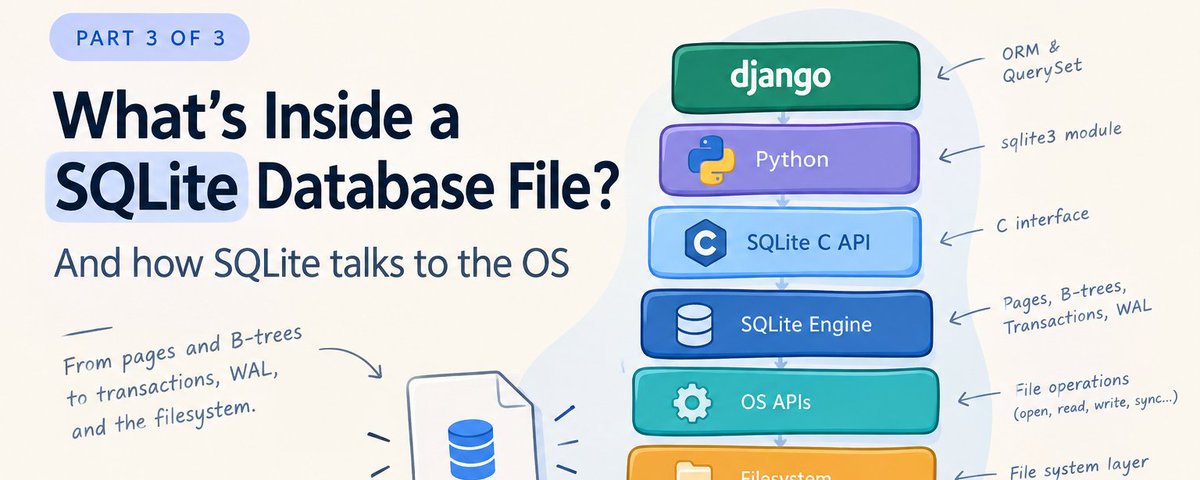
Final Part of Python + SQlite series
In the last part, we saw how Python interacts with the SQLite engine, and how the journey goes all the way from Django ORM operations to the raw SQL queries executed by SQLite
My first job was underpaid, but looking back, I got an opportunity to do some really good engineering work.
I wasn't limited to web development. Since I was the only developer, I got to work on the system end to end.
I got my first hands-on experience with a Raspberry Pi and networking. I built a Pi as a standalone offline server and deployed the entire Django web application directly on it, essentially creating our own mini-internet, where people could connect their phones with pi and play the content directly from it.
Created shell scripts to automate system-level setup, setup Nginx as a load balancer(if more devices comes than it should be able to handle them properly without causing pi overload, instead distribute load to other nearby pi), and even wrote scripts that interacted with SD cards and hard disks, automating data duplication creating backups incase of failue.
The project wasn't just "web dev". It involved:
Systems programming, Networking, DevOps, Web development, IoT, Linux, Hardware
And yet, when I started looking for next role in systems engineering or IoT, there were barely any opportunities around me, most companies were simply looking for web devs only.
So despite having exposure to systems and IoT, I ended up moving into web dev.
Maybe the opportunities are very different today. But this experience taught me onething that:
"Your career isn't just determined only by what you know, It's also heavily influenced by ecosystem and opportunities exist around you"
And I hate to admit but geography matters more that we think.
Put the same person with the same skills in a different ecosystem, surrounded by companies working on IoT, robotics, embedded systems or systems engineering, and the trajectory of their career could be completely different.
Sometimes it's not that we chose the wrong path, instead, Sometimes the ecosystem simply didn't give the path we were looking for.
So, if you want to work in a field you're genuinely interested in, you have a few choices:
- Create that ecosystem yourself
- find a way to become part of one that already exists
- at least stay connected with people who are already working in that direction.
Because sometimes, being around the right people and opportunities can change the entire trajectory of your career.
4
27
560
AI FOG:
The AI bubble feels like a heavy fog.
Honestly, nobody really knows what's on the other side.
Even experts often speak as if they know exactly where this AI race is heading. But the reality is, most of us are making assumptions.
It's like driving through dense fog. You can't see what's ahead, so you just assume there isn't another vehicle coming from the opposite direction and hit you.
So whenever you see someone claiming they have "figured out" the AI race, don't blindly believe them.
Stop and ask yourself: Did they really figured it out?
Or is it just another narrative(HYPE) being pushed by AI companies trying to sell their chatbots?(so that you become more dependent on them)
Nobody knows what's on the other side of the fog (everyone just claiming to be expert).
Think wisely.
It's a food for thought.

Irony is that many of Python's most important libraries are not implemented primarily in python.
They are written in lower level languages like C, C++, Rust etc.
These low level languages do the heavy lifting due to which python gives you beautiful abstraction.
6
32
781
You know one language, then you learn another.
You know JavaScript, then you learn React, Node, Angular, Svelte and what do you build?
The same Todo app.
The same weather app.
The same login and registration forms.
The same CRUD operations.
You already know Python, then you learn Go and again build REST APIs and forms.
At some point, you have learned how to build the same thing in 5 different languages and frameworks.
There is nothing wrong with building common projects when learning a new technology. It helps you understand the syntax, ecosystem and basic patterns.
But if you keep revolving around the same projects without digging deeper into "why the technology exists and what it is really good at", you're mostly just moving between abstractions.
You learn Go, but keep using it exactly like Python.
You learn C++, but instead of exploring systems programming, memory, concurrency or how things work underneath, you start building another web application.
You learn another framework, and once again you're building CRUD.
That's where I think we miss the bigger picture.
Solving CRUD in 10 different languages won't make you a great backend engineer. It might just make you very comfortable building CRUD applications.
For example, Go can absolutely build REST APIs and CRUD applications. But Go was also designed with systems programming, concurrency and distributed systems in mind.
So if you learn Go, learn enough REST/CRUD to understand how web development works in Go and then move beyond it.
Build something deeper. Explore concurrency. Build a database. Work with networking. Understand what makes Go different.
The same applies to C++, Rust, Python or any other language.
Learn different languages. Learn different frameworks, but don't stop at the abstraction they provide.
"Try to understand the essence of the technology and explore what it was built to make possible"
This might sound like generic advice, but it's one of the most fundamental things I've learned myself while trying to go deeper into tech.
Using money you haven't earned yet, to buy things you don't need, just to impress people you don't like.
This is it.
This is the trap.
4
21
429


An Important Note for Freshers:
I've reviewed quite a few resumes over the past few days, many of them belonging to freshers.
One thing I've noticed, and have advised candidates to remove, is listing Class Representative (CR) as an achievement.
Being a CR isn't an achievement, highlighting on a technical resume. Companies are primarily interested in your skills, projects, problem-solving abilities to the role.
I understand that as a fresher, filling up your resume can be challenging. But adding unrelated college responsibilities just for the sake of adding something can dilute your actual strengths.
The same goes for mentioning memberships in communities or clubs that have no meaningful connection to the role you're applying for.
Even if an AI tool suggests keeping these things, use your own judgment.
If someone tells you that being a Class Representative or a member of some college community automatically demonstrates leadership, communication, or some other impressive professional skill, honestly, it doesn't.
A designation doesn't prove a skill. Your actions and actual contributions do.
It's a little harsh, but here's some food for thought:
Don't fill your resume just to make it longer. Make every line earn its place.
The philosophy of Jeet Kune Do is adaptability.
It says, Don't become a prisoner of one technique.
The same applies to tech. Don't become a prisoner of one language, one framework, or one way of thinking. Adapt to the situation and its demands.
Adaptability doesn't mean abandoning everything you know whenever something new appears. It means understanding your fundamentals well enough to change your approach when the situation demands it.
As Bruce Lee famously said, "Be water, my friend."
Water takes the shape of its vessel.
"Learn to adapt without losing your essence"
Not just in your career, but in life itself

A system design interview should be like a conversation between interviewer and interviewee, not a monologue.
There’s no one-size-fits-all answer to a design problem. The right solution depends on the requirements and trade-offs.
Instead of trying to guess the “perfect” answer, try to involve interviewer in your thought process. Ask questions, discuss trade-offs, and explore possible solutions together.
Try to collaborate not just present
9
23
599
After a long break, finally managed to spend some time working on my Go backend project.
Small update of what all I added:
- Implemented database transactions.
- Used FOR NO KEY UPDATE in sql query to help avoid unnecessary locking conflicts
- Added a Go function to maintain a consistent transaction execution order and reduce the risk of deadlocks.
- Tested with 5 and 10 goroutines. All tests passed, with approx 60% code coverage so far
Passing tests with 5 and 10 goroutines is a like a checkpoint, but honestly its not a proof that every deadlock scenario is eliminated.
But I’m trying to follow standard development practices and make the project more robust as I go.
I’ll keep extending it whenever I can find the time


I've started building a small banking application in Go.
But this time, I'm not just trying to make the application work, instead i m trying to structure it the way a real production level Go backend service can be built.
So far I have completed few things:
> PostgreSQL running through Docker
> SQL Queries through sqlc and schema files
> CRUD operations for accounts
> Unit testing with go test + Testify
Next is:
> Database transactions
> Isolation levels
> Deadlocks
> GitHub Actions
Whenever I get time, I keep extending it with authentication, HTTP/gRPC APIs, async workers and Redis.
My previous Go projects were mostly about learning the language by building things, but this one is about learning how to build the production type backend in Go


Dhirendra retweeted

last time i completed the BitTorrent handshake and my client started speaking the peer protocol.
past 2 days i went deeper and stated building the actual peer communication flow
tcp -> handshake -> interested -> bitfield/Have -> unchoke -> request -> piece
after tcp connection and handshake my client now sends INTERESTED and reads the message coming back. i added handling for bitfield, have, choke and unchoke along with maintaining peer's state.
bitfield tells us which pieces a peer has , with some bit manipulation magic i can check whether a piece is available or not . and the peer sent a HAVE message finally
then came UNCHOKE part , which means peer is allowing us to request pieces. also got blasted with lots of bugs cause i thought the messages would arrive in exact order but these protocols don't care about me so i had to make the client keep processing incoming messages and maintains its states properly.
also before i even realized my main.go had become a complete mess cause i threw every fucking thing logic into it lol. now made everything separate .feels good :)
next ?
request -> piece
lots of more bugs incoming lol


last time i completed bitTorrent handshake, now my client can actually speak peer protocol
what does a BitTorrent message actually look like on wire ?
-> length (4 bytes) : how many bytes after length field
-> id : what does it mean
-> payload : optional data
there are 9 main message id's :
choke, unchoke, interested, uninterested, have, bitfield, request, piece, cancel . each of length 1 byte
there are 2 operations happening :
1) serialize
message -> length+ID+payload -> []byte -> tcp
2) ReadMessage
tcp -> read message -> extract id and payload -> message
and connected everything.
now my client sends : interested : to peer
and the peer responded with : have : message
next step ?
bitfields -> figure out exactly which pieces the peer have and requesting pieces
gud nyt :)


Implemented a Custom Dynamic List in C from scratch.
previous implementation was able to store only int values. I’ve now extended it into a heterogeneous list that can hold int, float, char, and string values at the same time, similar to Python list.
It can be initialized and used with a simple list API: list(list_name)
To implement this, I had to learn about tags and unions in C and use them to represent different types within the same data structure.
This was actually a good and fun exercise
I’m calling the project done for now. In the future, I may add threading support and make the list thread safe, but for now, moving on to the next thing.


Built a basic Dynamic Array in C, basically tried to implement a Python style list, instead of using a typical C array.
I wanted to experiment with an API like:
list(lst) which internally creates something like lst=[]
append(lst, value) which will add values dynamically at the end and also print list in python style only like [1,2,3].
Currently it supports only integers.
Next thing is, I want to make it heterogeneous which should be able to hold int, float, char, and strings, similar to Python lists


4
48
1,250
If wanna checkout code for reference:
github.com/dhirendraj-cmd/dy…

5
91