

Simulate, train, deploy, and fund robots from a single stack.
Joined January 2025
- Tweets732
- Following13
- Followers9.1K
- Likes2.3K








CodecFlow retweeted
We're delaying the machine.fun launch.
We found a stronger way to structure rewards, and we want it properly tested before anyone builds on it and starts trading.
Project registrations and trading open soon.
Sorry for the wait, it will be worth it.

CodecFlow retweeted
The 1st Garage is full.
Teams are selected and getting ready to launch. The Foundry stays open. We're always looking for new hardware teams.
Do you know someone who fits? There's a bounty for finding them. 👀

CodecFlow retweeted
The first hardware teams are weeks away from launching onchain.
Six weeks ago, most of them had never touched crypto.
You've seen Microduck all over your TL. There are hundreds of machine ideas like it, from builders trying to turn a prototype into a real product and running out of resources before they get there.
That's the gap.
machine(dot)fun started as a joint project between @codecopenflow and @peaq, around a simple observation.
Hardware got easy to build. It never got easy to kickstart.
A robotics team can spend months on a prototype, train a model, prove the thing works, and still hit the same wall. How do you turn that into capital?
Crypto already has a mechanism for this. Launch, raise, trade.
It works for internet-native projects. We think it works for hardware too.
One problem. Most hardware builders have never launched anything onchain.
So six weeks ago we opened The Foundry. A program that takes serious hardware ideas and gets them ready to launch.
The first round told us a few things:
a) 1 in 3 applicants found us through ChatGPT search
b) Teams came from robotics, DePIN and everyday hardware - some are weeks away from launching
Foundry teams get hands-on support and go through stricter transparency and verification. Their progress isn't a pitch. It's something you can follow and check.
Applications are still open: foundry.machine.fun
But you don't need to be in The Foundry to launch.
machine(dot)fun is open to anyone building hardware.
You don't need a finished product either. A prototype, a working concept, or a simulation is enough to start.
The goal is simple. Make hardware fundable before it's fully built.
First teams coming soon.

CodecFlow retweeted
We were on the ground at TAIROS 2026 (Taiwan Automation Intelligence & Robot Show)
- scouting foundry applicants
- meeting later-stage robotics teams
- watching what builders ship
Robots are eating the supply chain.
CodecFlow retweeted
1920. A Czech play invents the word “robot.” It means forced labour.
1927. Metropolis. The first robot anyone had seen on a screen.
1942. Asimov writes the Three Laws. Engelberger reads them, finds Devol, and they build the real thing.
1961. Unimate. The first industrial robot works. Only a car company can afford it.
1966–72. Shakey reasons about its own actions. Takes hours to cross a room.
1973. Waseda builds WABOT-1. Walks, sees, speaks Japanese, grips with two hands.
1990. Wang Xingxing is born.
1992. Marc Raibert spins Boston Dynamics out of MIT.
2000. ASIMO. The robot that made humanoids famous.
2003. DARPA funds BigDog. It takes two more years to stand up.
2013. Atlas. Six foot two, hydraulic, tethered to a wall socket.
2013–15. The DARPA Robotics Challenge. Every humanoid falls over.
2016. Unitree registers in Hangzhou. A fifty-square-metre office.
2020. Boston Dynamics puts Spot on sale at $74,500.
2021. Unitree Go1: $2,500. Tesla announces Optimus.
2022. Musk puts a number on Optimus: under $20,000.
2023. Go2: $1,600. First Unitree humanoid, H1: $90,000.
2024. G1: $16,000.
2025. R1: under $6,000. Figure raises at $39B. Four humanoids kickbox on Chinese TV, all teleoperated.
2026. Unitree lists in Shanghai. IPO at $9B.

CodecFlow retweeted

doing some testing with our world model inside @codecopenflow SimArena before live deployment. The focus right now is hardware-aware optimization, inference latency, compute utilization, and memory footprint across the target hardware stack.

CodecFlow retweeted
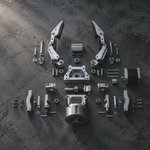
Everyone thinks the hard part of a robot is the AI.
It's the joints.
Robots are a gearbox problem.
CodecFlow retweeted
Machines can't settle payments with each other until someone builds the machines.
@HashgraphVC, in their words:

CodecFlow retweeted

people keep reading simarena as another sim engine competing with mujoco, isaac, genesis, gazebo, etc. that is a wrong angle. those do the physics. simarena is the layer that makes environment setup fast across all of them. different job entirely

Robotics simulation isn't going to settle on one engine. Different engines are good at different parts of the same robot, and a single robot passes through several of them before it works.
Picking a winner was never the point. What you actually need is one place to work across all of them. That's the layer SimArena is going after.

CodecFlow retweeted
Four things stand between a working prototype and a shipped machine: manufacturing, infrastructure, simulation, capital.
The Foundry is all four in one place.
@MoonrockCapital on why they're in:

CodecFlow retweeted
The idea is rarely what kills a hardware company. Manufacturing is.
@TheSpartanGroup on why they're supporting The Foundry:

CodecFlow retweeted

Live now:
xitter.cf/i/broadcasts/1pKdRRdbj…

CodecFlow retweeted
🤖 Tomorrow: one for the robotics builders, dreamers, and enjoyers.
Featuring @codecopenflow, @peaq, and @BitRobotNetwork for a livestream on all things robotics. There might also be robots.
Friday July 24 @ 11AM ET

CodecFlow retweeted

Winner #6: @codecopenflow
CodecFlow is an open-source platform for building robots and autonomous operators. It brings simulation, compute, and deployment together so teams can build, train, and ship robots from one place instead of stitching together a different tool at every step. Its browser-based simulator, SimArena, lets anyone build and test a robot with no hardware or setup.
Read more:

The 6th winner of the $3,000,000 Build in Public Hackathon is here!
We’re proud to announce the sixth project to receive Pump Fund’s next $250,000 investment is @codecopenflow!
Learn more about CodecFlow 👇

CodecFlow retweeted
booked an R1 EDU from the @UnitreeRobotics distributor here in Dubai
the plan: improve the sim2real pipelines in SimArena, take browser built scenes, sensors, policies, datasets, and deploy them on real hardware
most of the work is going to be on system ID UX. matching the URDF, actuator dynamics, and latency to the real R1 in the simulators, and making the flow as easy as possible
going to document the whole thing on video. setup, sysid, the first transfer attempts, what breaks, what holds up. should be useful for anyone trying to close the sim2real gap

