

Open Source Memory Platform for Agents https://xitter.cf/t.co/tkX8HnjpnK
Berlin
Joined July 2023
- Tweets536
- Following26
- Followers1.3K
- Likes497





RAG and agent memory get used as synonyms. They aren't.
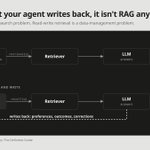
RAG reads from a corpus that someone else wrote: docs, a wiki, a product catalogue. The agent only reads.
Agent memory starts when the agent writes back:
→ a preference the user mentioned
→ the outcome of a task it just finished
→ a correction someone made to its answer
Writing back changes the problem. You now decide what is worth keeping. You merge the new fact with what's already stored, and you handle the old fact it contradicts.
Cognee's agent memory guide puts it in one line: "The moment your system starts writing back — capturing facts, recording previous interactions, or storing the outcomes of its own work — you've moved beyond RAG into agentic memory."
Read-only retrieval is a search problem. Read-write retrieval is a data-management problem.
Read more here: cognee.ai/blog/fundamentals/…

@bot LDN Community Hack is this Thursday, and @cognee_ is a tech partner.
Come build with @grok + @cognee_ this Thursday.
@bot LDN Community Hack by @frankterpo, with @supabase, @zero_gtm and @cursor_ai as tech partners and @Expedite_Now hosting.
Eleven London communities are taking part.
Free, last spots open:
luma.com/eveur09a

Also organised by @lnv007 and @keanucz, together with these communities:
@unicorn_mafia with @fergomg and @CharlieCheesma1
@basedfounderseu with @fatemallk
@kickstartldn with @ilyavencjuns
Hackradar with @keanucz
@UKAIagents with @may_tohoku
@UseCorgi with @claudiaamaggi
@hackcollective with @lnv007
United Italian Societies with @belluzzoumberto
@outpostcrew with @Andy_AJT and @oscarfalll
plus Night Office, AI Pilled and @ZakeeAbdi
Credits and prizes from @bot, @cursor_ai, @supabase, @zero_gtm and @cognee_ (@KovacVeljko)
How cognee + scalekit hack went recently

this was @scalekitinc's 5th hackathon for the year, and i think we're getting better at figuring out how much people can actually build in less than 4 hours!
a little late, but here's a recap from our SF @Techweek_ hackathon with @cognee_ and @RespanAI!
the challenge: build a company brain that could pull context from different tools, remember things, and actually take action with the right access.
we had 8 solid submissions by the end of the evening, and some really fun demos. thanks to everyone who showed up and built with us. and to @tricalt and @HendrixLiu29208 for putting this together with us!
Four corners in the ring this Saturday: @Claude_Memory, @helixdb, cognee, and whatever memory setup you bring.
Same scenarios for every system, results live. Mem-Off, San Francisco, Sat 17 Oct.
Free: luma.com/cognee-cy86


Join us on Saturday, October 17 in San Francisco for Mem Off, the AI memory showdown with @Claude_Memory and @helixdb.
Everyone claims their AI has memory. Bring yours and run it on the same scenarios as everyone else's.
Free: luma.com/cognee-cy86


We're partnering with Briefcase and Stripe on this amazing hackathon in London next Thursday.
Theme is: AI agents in fintech. Three hours to build an agent that handles real financial operations.
Judges are:
• Ján Stehlík (Briefcase)
• Fionn O Colmain (Stripe)
• Dominic Hudson (AI at Meta)
• @davidgelberg (10 Downing Street AI Team)
• @AkashBajwa96 (Earlybird)
Thursday 15 October, 17:15 to 22:00 BST, Central London.
Win a prize of £2,000.
Free, apply here: luma.com/3k1pazop

Long context is valuable. It helps when the relevant information can be passed directly into the model.
But context still has limits. It disappears unless something stores it. Long prompts increase cost and latency. Models do not use long context perfectly. Long-running tasks eventually produce more information than one request should carry.
Memory handles a different job: deciding what should persist between calls, sessions, agents, and tools.
The context window is just the delivery mechanism.
cognee retweeted
Two systems can get the same final-answer score while maintaining very different memory stores.
One may have clean entities, scoped facts, provenance, and update rules. Another may have duplicate customers, unresolved contradictions, stale preferences, and broken links that happen not to show up in today's eval.
Production memory needs evaluation at multiple levels.
Did the agent answer or act correctly?
Is the memory state itself healthy enough to keep using tomorrow?

A memory benchmark is most useful when the system cannot simply pass the whole history into the model.
That is why benchmark scale matters. LoCoMo is useful for conversational recall, but the public conversations average around 26k tokens. BEAM is more demanding for memory architecture because it scales coherent histories up to 10M tokens.
But benchmark scores are still directional.
For production systems, the final question is whether memory improves the real task: completion rate, fewer turns, better personalization, fewer repeated mistakes, lower support burden, or better conversion.
An agent reading a web page also reads the cookie banner and the footer links.
@KeenableAI is now a built-in fetch backend in @cognee_ . URL in, clean Markdown out, into a graph the agent can still query next session.
Read more here:
cognee.ai/keenable-cognee-we…

