

The Business of Robotics and Physical AI. Research & Podcast. https://xitter.cf/t.co/aanMm8guOj
Joined June 2026
- Tweets44
- Following21
- Followers185
- Likes7


Pinned Tweet
Core Matter studies the business of Physical AI.
We publish research on robotics costs, supply chains and deployment, plus interviews with the people building the stack.
Follow for research, charts and interview clips.
Start here in the reply.
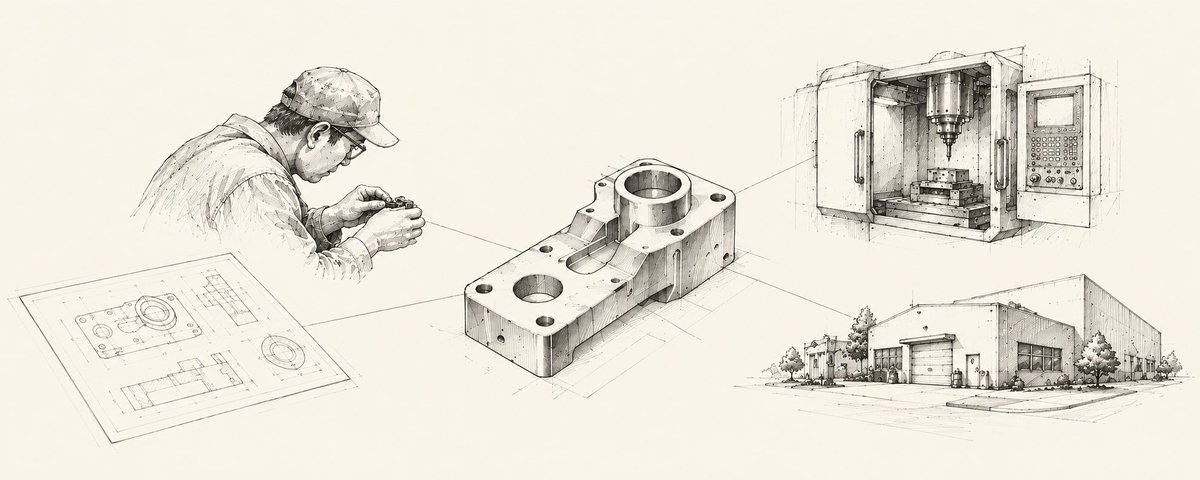
Uncovering the opportunities in AI manufacturing - First article in a new series.
Starting with parts manufacturing.

A farm machine carrying 18 desktop computers caught Bonsai Robotics (@bonsairobotics) CEO Tyler Niday (@niday_tyler)’s attention.
The machine came from Blue River Technology, which later became part of John Deere (@JohnDeere).
Reflecting on his early work at Blue River, he recalls:
- A specific job: the tractor thinned lettuce while moving through the field, with the computers mounted on its back.
- A later computing platform: the team used @nvidia’s TX1 with YOLO-based deep learning as its work evolved.
- A practical perception problem: distinguishing green weeds from green crops so the machine could tell them apart.
Watch Bonsai Robotics’ cofounder recount the work.
Full conversation with Tyler Niday, CEO of Bonsai Robotics: youtu.be/EeLUwoukj8g
A humanoid’s knee and wrist need different actuator properties. They perform different jobs inside the same robot.
Our actuator graphic maps typical choices across joint groups.
- Legs manage changing loads and repeated ground contact.
- Wrists need precision within limited packaging space.
- Weight near the arm’s end adds another design constraint.
Start with the joint’s job, then examine its actuator. The graphic shows typical trade-offs across designs.


Manufacturing speed starts before a factory builds the product.
Eric Pan, Seeed Studio’s founder, describes the surrounding network. Hardware teams face trade-offs between quality, cost and lead time. They also need access to people and specialized capabilities.
- Engineers bring the skills needed for the project.
- Suppliers provide the components and capabilities it requires.
- Their responsiveness helps the team move as requirements change.
Pan describes that combination in Shenzhen’s manufacturing network. Finding the right capabilities is part of getting hardware built.
Watch the full conversation: youtu.be/2hTEse2n7Dg
Subscribe to YouTube channel: youtube.com/@CoreMatterLabs
A robot hand contains several businesses inside one product.
Complete-hand manufacturers bring together components from several technical disciplines. Our July supply-chain graphic separates those layers.
- Actuation supplies motion through motors and related components.
- Transmission carries that motion through the hand’s mechanisms.
- Sensors provide information about movement and contact.
- Control electronics use that feedback to coordinate movement.
The map highlights component opportunities alongside complete-hand companies. Its company examples reflect the July primer.

Read full article: read.corematter.com/p/dexter…
Subscribe to newsletter: corematter.substack.com

A transparent cup can confuse a robot’s depth camera. Its depth map can contain very little usable information.
Shan Luo explains how touch helps fill that gap. He studies robotic perception at King’s College London.
- Vision identifies sparse cues, such as the cup’s rim.
- Those cues guide where the robot makes contact.
- Touch checks the edges and helps estimate the cup’s position.
In these experiments, vision guides touch before the grasp. Contact gives the robot information that vision struggles to provide.
Watch the full conversation: youtu.be/zORIEuxs9_Q
Subscribe to YouTube channel: youtube.com/@CoreMatterLabs
Holding a tool and inserting a connector require different grasps.
A hand’s specifications make more sense alongside its task. Our dexterous-hands guide connects familiar jobs with relevant properties.
- Tool holding brings sustained grip and heat into focus.
- Connector insertion brings positioning repeatability into focus.
- Object shape and movement help determine the required grasp.
The attached graphic connects those tasks with hand specifications.
Start with what the hand needs to do. Then compare the properties that support that job.

Read full article: read.corematter.com/p/dexter…
Subscribe to newsletter: corematter.substack.com
The same robot tested vineyards and strawberries that week.
Danny Bernstein shares the example from Reservoir Farms. Bonsai Robotics tested vineyards at Reservoir’s wine country location. Then it tested strawberries in Salinas, using the same machine.
Agriculture is fragmented by crop, which complicates testing. Bernstein wants Reservoir to give startups access across crops. He describes doing that within twelve to eighteen months.
That access could help builders explore uses beyond one crop. Reservoir’s fund also invested in Bonsai, as Bernstein discloses.
Watch the full conversation: youtu.be/50iSzxFSCkE
Subscribe to YouTube channel: youtube.com/@CoreMatterLabs
Where does robot training data come from, and what does it take to build a business around it?
Our latest research maps 7 robot-data sources across physical fidelity, diversity and scalability, compares 9 LLM and robotics data suppliers, and examines the economics of evaluation and deployment.
Read The Economics of Robot Data: Building the Scale AI of Robotics.
read.corematter.com/p/robot-…

A robot hand can have more joints than motors.
Those two numbers tell you different things. Francesco Clemente, Prensilia’s Managing Director, explains why.
- Joint count describes the hand’s moving joints.
- Motor count describes the actuators driving those movements.
- Active joints receive direct motor control.
- Passive joints move through the hand’s mechanical connections.
Underactuation means using fewer motors than joints. Clemente explains how this reduces the device’s complexity.
He also describes inconsistent uses of “degrees of freedom.” Counting joints and motors separately makes those specifications clearer.
Watch the full conversation: youtu.be/loHcbZ0CFK0
Subscribe to YouTube channel: youtube.com/@CoreMatterLabs

Gearing choices move cost between precision mechanics, motors and electronics.
Part 1 explains how that tradeoff shapes the humanoid actuator supply chain.

What makes an actuator business defensible?
@SchaefflerGroup’s formed-gearbox work illustrates the role of process knowledge.
Part 4 examines what US suppliers must build, qualify and finance to scale production.
Read it in the first reply.
🤖 Made with AI

