

The Business of Robotics and Physical AI. Research & Podcast. https://xitter.cf/t.co/aanMm8guOj
Joined June 2026
- Tweets44
- Following21
- Followers186
- Likes7


Core Matter retweeted

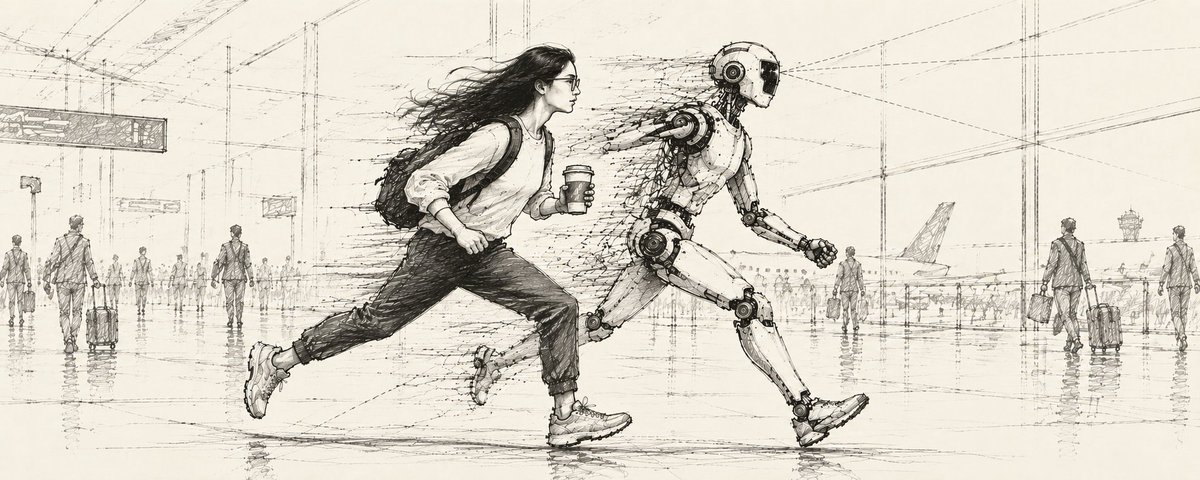
Could a robot run for a flight without spilling its coffee?
I started thinking about this during my own airport sprint, coffee in hand.
For a humanoid, 6 senses are working together at all times:
- Sight: What can it see?
- Depth: How far away is the obstacle?
- Balance: Where is its body, and is it balanced?
- Force: How much force is it applying?
- Tactile: Is something slipping at the contact surface?
- Audio: What can it hear?
New Core Matter @CoreMatter_ field guide walks through sight, depth, balance and position, force, touch, and hearing.
Including each supply chain and deployment failure modes.
The guide also looks at @Waymo's camera, lidar and radar approach and @Tesla's camera-based Tesla Vision.


Core Matter retweeted
Inside tactile robotics w/ Professor Shan Luo, King's College London
Robot skin changes. Models must adapt.
“But hardware still matters a lot.”
Luo leads the Robot Perception Lab. We discuss Unilever's material-assessment questions, Ocado's delicate-object handling, and the data behind a robot's sense of touch.
GenForce studies transferring force-prediction knowledge across tactile sensors. His ViTacGen example concerns object pushing: learning uses physical touch, while deployment in that task can use vision.
We cover:
› Material assessment and contact force
› Cross-sensor learning with GenForce
› Vision-to-touch generation for object pushing
› What changes when robot skin is replaced?
› Task-specific finger and sensor design
› Unilever, Ocado and open tactile datasets
Chapters
00:00 Cold open: what happens when robot skin changes?
00:29 Why Shan Luo chose tactile sensing
02:04 Scaling tactile data and simulation
03:40 The interface between different sensors
05:04 Material assessment, cleaning and insertion
09:18 Vision, contact and the last mile
11:54 Manipulating transparent objects
14:29 GenForce: transferring force-prediction knowledge
17:59 Hardware, shared datasets and standards
21:43 ViTacGen: learning from touch, deploying with vision
25:42 How tactile sensor skin wears
28:43 Replacement skin and model calibration
30:49 Manufacturing cost and consistency
32:38 TacDiff: designing the finger and policy together
36:47 Industrial research with Unilever and Ocado
40:01 ViTac workshop and open tactile data
45:11 A startup question and a surprise announcement
49:43 What warehouse robots could feel in 2031
Core Matter retweeted
I’ll be at IROS this week and look forward to connecting with researchers and operators building dexterous hands, autonomous factories, world models.
Core Matter @corematter_ is co-hosting Robotics Research Night with Saturday Robotics @saturdayrobotic on Monday 9/28. Come join us for an evening of research discussions. Big thanks to our sponsors @FAIRplus_sz and Daimon Robotics.
Come join us!
Sign up here: luma.com/tzbw7n61
==
@junfanzhu98 @aurorafeng_01


🛫 I’m heading to Pittsburgh for IROS 2026 🤖 9/27–10/2. Introducing
🥂 @saturdayrobotic × #IROS2026: Saturday Robotics Research Night
📍 Pittsburgh | Sept 28, 5:30–9:30 PM
🎟️ RSVP: luma.com/tzbw7n61
Lightning talks from researchers at @Caltech, @RhodaAI , @XSquareRobot, @CAS__Science, @UCBerkeley, and @HarryXu12 (@PokeBot_Global), covering:
• humanoid safety + RL
• in-context learning for robot data
• scalable sim evaluation
• 3D VLA + memory + inference-time learning
• hindsight reward editing
• GPT-6 Astra & the future of robotics
The interesting part isn’t just the demos.
It’s figuring out what actually scales—and what doesn’t.
A few questions to discuss at Saturday Robotics IROS research night:
→ Is robot scaling really about more data—or better experience per sample?
→ Can in-context learning turn robot data from static demonstrations into reusable experience?
→ Will world models become the data engine for robotics?
→ What should robots remember over long horizons?
→ And what does scaling not fix—representation, architecture, reward, evaluation?
If you’re working on robot foundation models, world models, in-context learning, robot data, sim2real / Real2Sim2Real—or just trying to answer “how do we actually scale robot learning?”—let’s grab coffee ☕️.
See you in Pittsburgh. 👋 @aurorafeng_01 @michellelsun

