
NASA for 32 years Dir. of R&D @Planet Labs since 2015 -- Science is poetry written about nature in the language of mathematics. -- Tweets are PERSONAL views
N. California (often)
Joined May 2008
- Tweets7.2K
- Following1.2K
- Followers6.1K
- Likes16.5K
Pinned Tweet
some favorite books: docs.google.com/document/d/1…
my substack: creon.substack.com
regenerative agriculture: docs.google.com/document/d/1…
health & life extension: docs.google.com/document/d/1…

The processes were on the same physical machine!
No "air gap".
It's an exploit from a time before AI agents: a cross-VM cache side-channel similar to Spectre (2018).
This has a doom-hype (e.g. "Ban open weight models!") smell to it.
And yes, we need better cyber-security.

I co-host the Foresight Institute's Space Seminar Group: zoom presentations followed by Q&A with the most interesting commercial, academic, and government leaders in space science, aerospace engineering & related fields. Join us!
(it's free)
(instructions below)
DM me here to get on the invite schedule: one online seminar per month: ~40 minutes + Q&A. No spam.
Also DM me here if you 're seriously interested in presenting to the group.
Here is a partial list of previous seminars with recordings & other info: foresight.org/seminar/space-…
Here's the youtube channel (all the recordings) youtube.com/playlist?list=PL…

Artemis 2 has caused an explosion of moon landing denial bullsh*t.
Kids: go back to school, study basic physics, photography, celestial mechanics, aerospace engineering, & history.
100,000 people worked on Apollo. No one "blew the whistle" because there was no whistle to blow.
I've been CN'd twice on that sea level post.
People say GSL rise is accelerating and point to papers that do make that case. And/or claim tide gauges are an inappropriate measure.
Two simple points in response:
1) GSL doesn't directly impact people. Variability in populated coastal areas (measured by tide gauges) does.
2) Any acceleration is very small. And *perhaps* partly an artifact of some studies starting their analyses in the 1970s, when GSL was anomalously flat. That's why I go back as far as the data allow me to in my analysis.
The plots below all show hourly data in 5-year bins. Red lines are quadratic fits, blue lines are linear fits: Fits are shown for the bin medians and the 99.9th percentiles (upper colored "curves") because the latter is more impactful, e.g. economically.
The curvature of the red parabolas, versus their corresponding blue straight lines, shows the effects of "acceleration".


I downloaded and plotted hourly data for approximately 100 years for many different tide gauges. Every hour is incorporated in these graphs.
The trend is essentially linear for every single one. No cherry-picking.
We are coming out of an ice age. Thus many stations show a few millimeters per year of increasing sea level and some show a few millimeters per year of decreasing sea level because ice is retreating and the continents are uplifting near polar regions.
As far as I can tell there is no sea-level catastrophe and those who say so don't have data to back it up: That is, they are scamming.


And here's a little bit of the global warming catastrophe over the last 80 years. (Code and data available on request)
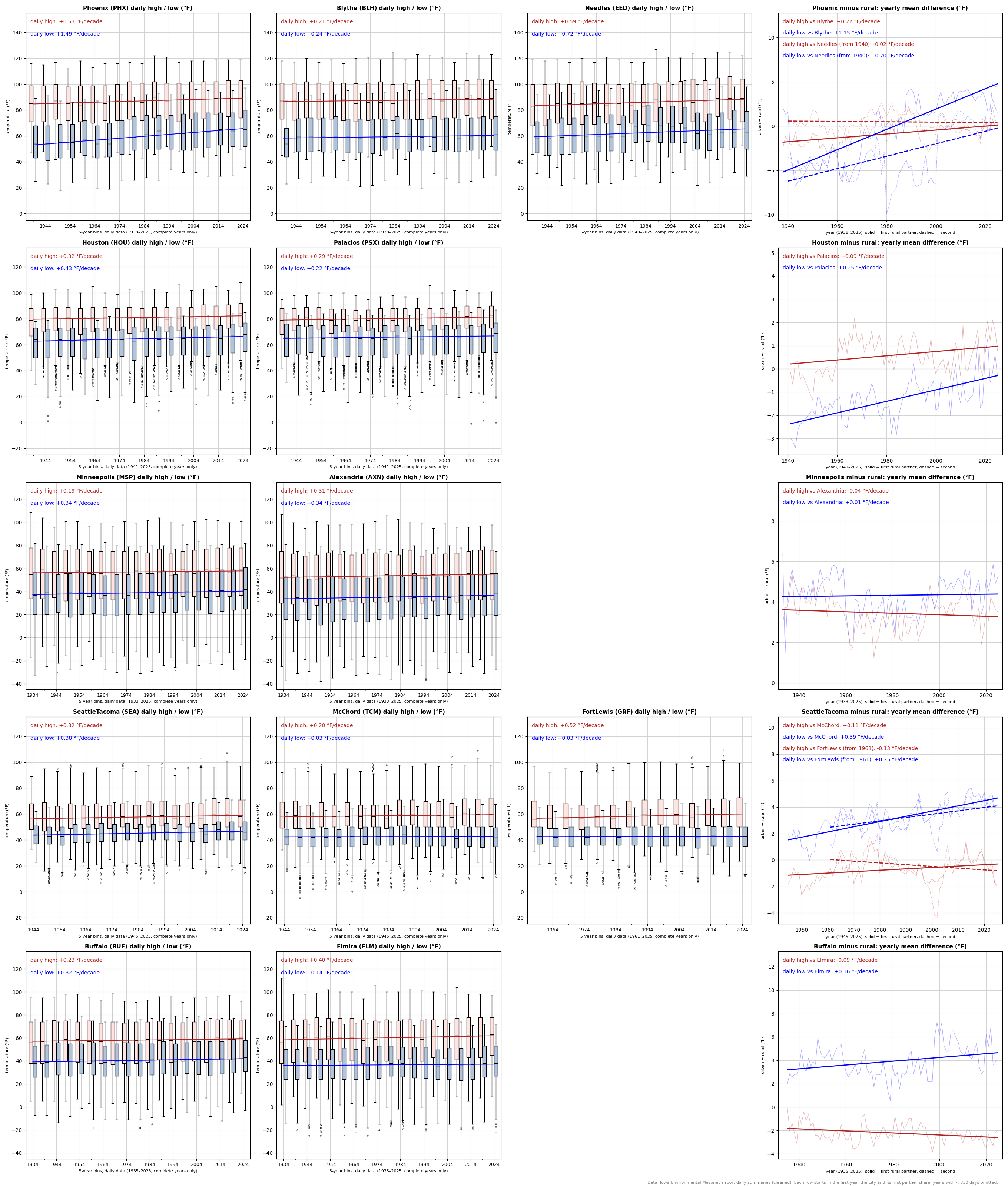
Essentially all these airports where the temperature data is recorded are in the middle of urban development, and hence the urban heat island effect over the last 80 years or so as a contribution to the warming.
"It's a simple matter of albedo" as the man who is responsible maintaining and curating all this data said to me. He is a national treasure.
And here is the global warming crisis. For a few U.S. airports, which are mostly in areas where substantial development has taken place over the time periods in question (i.e. Urbanization and the corresponding heat island effect)
The daily and seasonal variations swamp the slow changes in the median (as is the case for the sea level plots posted previously)
Remember: this is hourly data in 2-year bins. Every point is accounted for.

Galveston is somewhat anomalous since they have been pumping out groundwater for a long time, and the tide gauges have been settling lower.
Right - essentially no one thinks AlphaFold, Jev, or Tesla FSD is conscious (except perhaps some panpsychists?)
LLMs communicate in human language. The only thing we've previously experienced which does that is other conscious humans. So people are fooled into thinking LLMs are conscious.
Simultaneously, my dog does not speak. And is arguably far less intelligent than a big LLM. But my dog is conscious (has subjective experience).
A lot of people are really mixed up about this stuff.

Spectacular Nature piece on why AI is not conscious and probably will never be.
Three arguments:
1) Intelligence is not consciousness.
Intelligence is about solving problems. Consciousness is about having subjective experiences.
AlphaFold can solve super difficult problems. By contrast, our brains performs complex operations entirely outside awareness.
Problem-solving and consciousness are two separate things.
2. Biology is essential.
Our brains are alive, down to every cell. Their activity is inseparable from the living tissue that produces it.
The idea that consciousness can be reproduced simply by running the right computations on silicon components who do not fight for their life is a very far fetching and, I would add, almost religious, assumption.
3) The physical organization may matter more than the computation.
According to integrated information theory, consciousness requires specific causal relationships between a system’s physical components.
The computer architectures running today’s AI lack this organization.
The comparison with AlphaFold is particularly revealing:
Almost nobody things AlphaFold is conscious, despite its inner working is very similar to an LLM
Why?
Because it does not speak.
LLMs do speak like us and therefore we fall into an illusion:
Since they speak like us, they must be like us.
But this inference is wrong.
LLMs are just a series of matrix multiplications.
They are not conscious, and they will never be.
*
Paper in the first reply

In the age of agentic SW engineering, what skills matter?
Premise: Many SW engineering and computer programming tasks traditionally done by SW engineers and programmers are now largely doable (automated) by AI coding harnesses, agents, etc. The new role for people formerly in those jobs is something more like a technical manager, managing a team (or teams) of automated SW engineers.
Question: What are the (new) skills necessary to be great at this (new) job?
As a programmer and SW engineer (44 years experience), a several-times technical team lead, and someone who now uses AI coding harnesses running multiple agents in parallel on "real world" problems every day, I suggest this answer:
Proposed Answer: Here is a list of skills which are of critical importance.
• Taste. Being able to intuit or at least discriminate post-facto a good solution or path from a bad one.
• Architectural experience. Systems principles. Deep knowledge of HW and SW at multiple levels.
• Strategic thinking. Looking multiple steps ahead. Keeping the big picture in mind.
• Good communications: with agents, but especially with humans in similar roles: Clarity, focus, flexibility, honesty, self-confidence, politeness, and care.
• Discipline and integrity. Record your lessons learned. Evaluate honestly. Share important results - both good and bad.
• Neural plasticity. A love of learning new skills and new technology. A love of craftsmanship. And a tolerance for uncertainty along the path (i.e. courage).
What's missing from this list?