

don't sit in your tiny corner of nowhere protecting your small slice of nothing, it's all just monopoly money, building @arizeai & @arizephoenix with the homies
Joined October 2013
- Tweets682
- Following214
- Followers289
- Likes1.4K





Dat Ngo retweeted

We'll be spending a lot more time trying to understand the outputs of language models. A few thoughts, tips & tricks:
Writing. Something I've had success with: Ask your LLM to explain something in ASD-STE100, it's a controlled language specification originally developed for aerospace maintenance documentation. LLMs well-versed in this language and it comes with heavy constraints on clean writing style that I often find a lot more readable. Sometimes I've tried to soften it a bit e.g. ask for "80% of the way to ASD-STE100" because the spec is quite stringent. But even better:
Diagrams / images. Instead of writing, ask your LLM to create a diagram. These can be a lot easier to process, parse, and understand. But even better:
Web pages. Ask for output "in HTML" to get a beautiful, interactive webpage. LLMs are getting really good at frontend and can create beautiful experiences, animations, etc. But even better:
Explainer videos. The output format I am most bullish on is fully custom / bespoke explainer videos generated on any arbitrary topic. Experiment with things like "Create a 3b1b style video explainer on X. Use my ElevenLabs API key for audio narration". (you'd need an API key for the latter or you can ask your LLM to find you decent free alternatives that use your local compute). This is actually starting to work!
In summary:
- As LLMs get better, they will do more and more of the legwork autonomously, and a lot more of our work will rise up the abstractions into oversight and understanding.
- Luckily, LLMs can help here too because as intelligence and code are increasingly abundant, you can ask for large, custom, discardable software artifacts (e.g. web apps, video explainers) that would have never made sense to create before. Push the boundaries here and you'll be surprised.

Dat Ngo retweeted

Excited to get this into the hands of developers everywhere soon.


Love a good meetup with the London homies
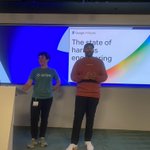
Todays topic was building ai in the world of harnesses, evals, benchmarking and beyond. Some highlights:
- I got to try some new material and education on Jev evals from @typesafeai
- the boy @ivanleomk from @GoogleDeepMind covered benchmarking and proper evaluation with Laude Institute's @harbor datasets on Kaggle
-Arize AI fan favorite customers presented real world lessons with @typeform agents! Mo Afsharmoqaddam / Lora Kiosseva
Shout out to @GoogleDeepMind for letting us borrow the london studio and providing the grub!!
Awesome to see the AI community out at the home of such an incredible lab!
Ines Ruiz Amit Vadi Marine Meyer Jitendra Yadav Igor Marques @Shashikant86 thanks for helping to support!!


Dat Ngo retweeted

Made Jev play chess against some OpenAI models.
Because, what better way to test how smart it actually is? XD
What other models should I test?


After co-inventing ChatGPT, I kept asking myself: why have superhuman chat models not led to AGI?
I’ve spent the last 2 years in stealth building a new way to train models (RLCD), and a new type of frontier AI model that we are releasing today: Jev
• 20-200x faster
• 40-400x cheaper (w/ output tokens free)
• Frontier composable intelligence optimized for decisions
AFAICT the shortest path to AI-based economic revolution
Im only here to see @ivanleomk and eat some dank food
But forreal always loved the @arizeai and @GoogleDeepMind relationship over the years
Homies

Dat Ngo retweeted

proud that @vibhuuuus and i did the most recent pod with @eisokant on why NVIDIA just paid him $6B to buy the incredible model factory that is pumping out Thinky-beating models (actually not exaggeration, look at the numbers)
tune in / subscribe / whatever latent.space/p/poolside
only on @latentspacepod


wow this is kind of a shock. from what i understand nvidia bought the "model factory" part of poolside and a lot of employees (researchers?) got offers from nvidia. founders staying at poolside is unusual, wondering if they will just become a neocloud/compute provider since i don't see any mention of PIC (poolside infrastructure company) here?


Don’t trust everything you hear, even from people who are supposed to be ‘smart’, or who you ‘should look up to’
rather, you should look at incentives:
I distinctly remember Garry Tan telling us that ethereum was the next big thing and he had no doubt it would power most of the worlds applications in a few years, and would also hit 10k in value. this was about 5 years ago
How times have changed but not really
I’m starting to think hype is often outrunning common sense these days even in the AI space
These mental models have been engrained in me for a decade and and I still feel like I don’t use them as often as i could
Always nice to remind the noggin


Dat Ngo retweeted

Jason and I started Arize 6+ years ago with a simple proposition that headlined our seed deck:
“We Make the World's AI Work”
Today we are announcing we’ve entered into a definitive agreement to be acquired by Dynatrace to accelerate that vision.
We made a bet years ago that the explosion of AI would require bespoke infra tools. We knew AI systems weren’t going to behave like traditional software because we were building the next generation of intelligence. That bet became the market's first AI Observability platform.
Fast forward to 2026. The world has changed dramatically. Every company in the world is scaling up its use of agents. AI is everywhere and agents are reshaping business after business.
What wasn’t clear years ago and is crystal clear today is that agent systems and software are deeply connected together in ways that none of us fathomed.
- The best general agents are coding agents.
- Skills and tools for agents are mixtures of prompts and code.
- Prompts that control agents live in code repos.
- The logs and traces used to debug your software also help you debug your AI systems.
- The path to AGI is likely through coding agents.
The two worlds of AI and software observability are coming together to create the future of observability.
Lots more to share in the coming days, but I wanted to thank folks who made this possible:
To the Arize team - startups are about the people you build with, and I’ve never met a better group of humble rockstars. The markets changed, our product evolved, but the camaraderie of the team through this journey is what I’m really proud of.
To Jason, being in the trenches with you for the past 6 years has been the journey of a lifetime. You’re a visionary, and the best entrepreneur I know. Everything I know about entrepreneurship comes from watching you execute day in and day out - you always figured it out. Arize wouldn’t be Arize without you.
To our customers, thank you for trusting us and building this category with us. You made the product better everyday, and inspired us with the products you’re building.
To the open source community around Phoenix and OpenInference, developer trust and open standards are the foundation this category gets built on.
And to our investors, advisors, and early believers who backed us when AI observability was not a budget line or even a real category yet, thank you.
Onwards to the next chapter! arize.com/blog/a-new-chapter…


I’m starting to get the sense that twitter is the gaussian curve for ideas +- 2 sigma
I think spending time alone and coming back to see how your ideas have developed vs where the standard population is probably a good way to track originality


Dat Ngo retweeted

It also helps me think about why numbers and anecdotes are both important.
I don’t think I could do a mayor’s job without statistics.
I also couldn't do it by hiding myself in a room and not talking to people.
16/n
intimate knowledge of shit that scales is wildly easy to attain, some people are always trying to improve and some people want to stay comfortable
god i love the ai space

Dat Ngo retweeted

Over the past 6 months we've maniacally prepped our repos to be coding agent friendly. Here are some things that worked.
1. Make CI blazing fast. Use every Rust, Zig, or Go ported tool that lets agents verify their work. This means UV, oxfmt, Typescript 7. Move integration tests to post merge hooks.
2. Trigger coding agents automatically based on triage labels. A coding agent should setup a proof of concept or repro steps automatically so an engineer can pick up the issue seamlessly.
3. Setup crons for things devs hate doing. Setup agents to fill SDK gaps, skill tuning, filling in critical regression checks.
4. Give agents ways to prove their work. Add screenshotting skills, agent-browswer, cloud storage for storing assets.
5. Make it possible to hermetically deploy your app, preferably multiple at a time. If a coding agent can deploy the app locally, the faster it can work.
6. Give the agents realistic production "simulation" data. Agents will work much better when they are working against data that looks like how your users use the product.