

Founder of Jenga Investment Partners. Writer at Global Outperformers by Jenga IP. Passionate about investing and exploring the world.
London, England
Joined May 2019
- Tweets2.3K
- Following2.1K
- Followers7.5K
- Likes2.9K





Pinned Tweet
Last year, I published a book titled Global Outperformers, where I studied listed companies that returned more than 1,000% in 10 years.
There are four parts to our study, and I will share a thread below, sharing somethings our book explores about global equity investing.
1/68

$INTU Intuit 🇺🇸
Might as well sell Credit Karma too and fully book M&A losses in FY 2027.
Focus on stabilising TurboTax as a 3-5% grower, expand IES further, continue winning share in the mid-market and remain the go-to for American SMBs with QuickBooks + payroll & payments.
TurboTax assisted market, IES and QB Advanced, payroll & payments add-ons for QB SMBs. That's all that matters.
$SPGI S&P Global
My latest investment case and deep dive explores S&P Global.
AI fears for a division led by Capital IQ, representing <6% of revenue and profits, caused a 20% decline in its valuation.
I discuss what the market is missing here by assessing the A to Z of S&P Global, analysing its history, products, economics and each division's growth potential and valuation to conclude on its investment case.
You can access the full 109-page report for free here.
globaloutperformers.com/p/s-…

1
16
1,369
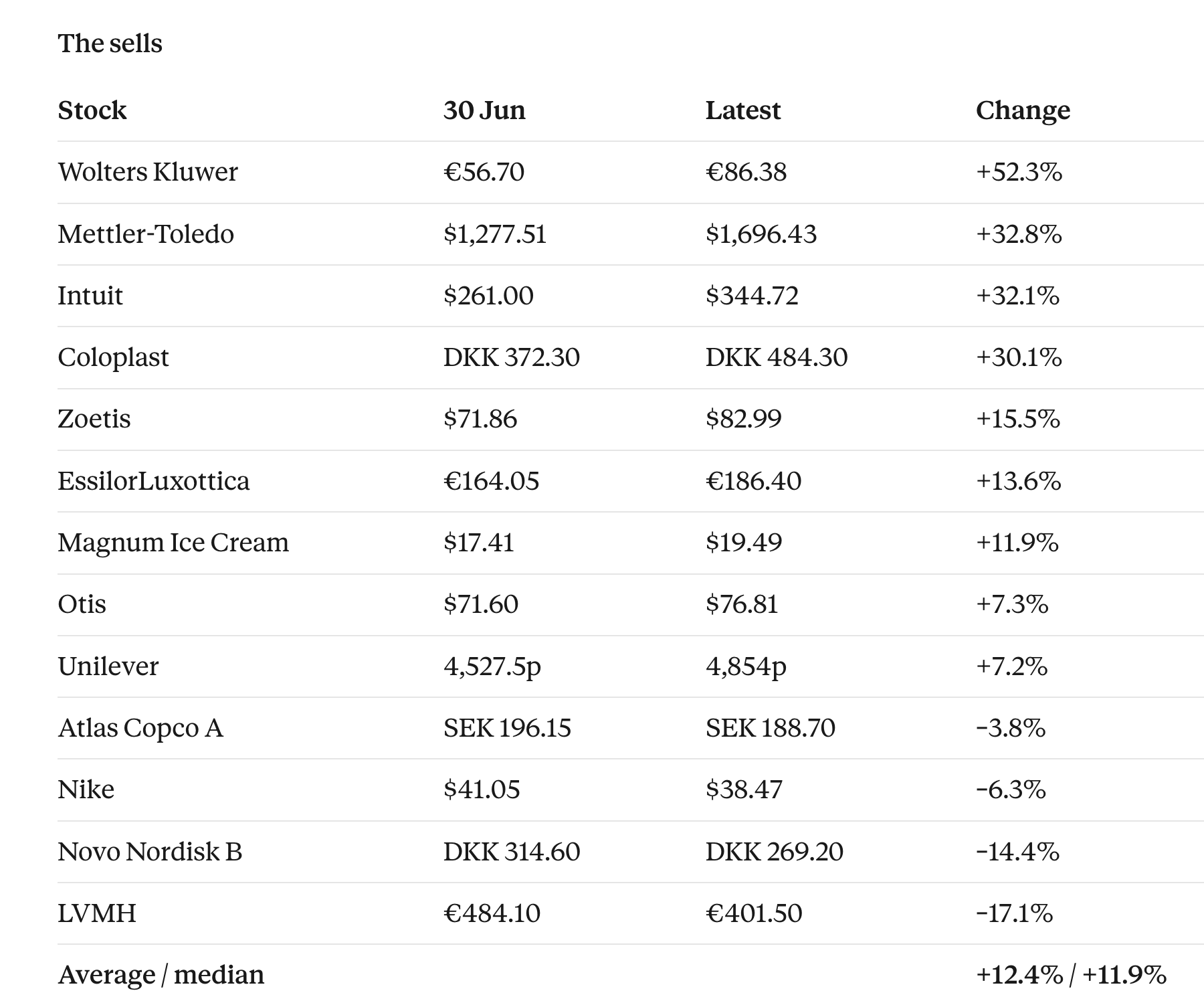
Not to defend Terry Smith, although I think he’s a great investor and role model for anyone following fundamentals-based investing, his new picks are still well within what he said he’d do, quality-oriented investing.
TJX is arguably more stable and higher quality than LVMH, Sage is more resilient than Intuit (disclosure I’m long Intuit), Veeva is on par with Novo (well, debatable), GE Vernova is on par with Atlas Copco, and Mastercard which is a top 10 is arguably the highest quality across both lists.
NextPower and TSMC were the only “AI momentum” stocks and I’d argue they’re much better than what else is out there.
He never said he was going to buy the lowest P/E companies, he said quality and this is still in line.
5 years out, there’s a possibility the recent buys outperforms what he sold.


S&P Global $SPGI 🇺🇸
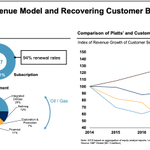
8 years later, the insights from the 2018 investor day presentation and earnings call were enough to justify an investment thesis in S&P Global in Oct 2026.
Kensho Data & Platforms really isn't as bad as the market believes. And it's less than 5% of S&P Global's EBIT.
Platts, yes, is oil and gas concentrated and CERA is a weaker business, but the subscription is, and will remain, mission-critical for years.
permira.com/news-and-insight…
Permira hired S&P Global's former CEO, Douglas Peterson, as an advisor yesterday. If this is in preparation for a successful bid for Kensho Data & Platforms at a cheap price (<18x EBIT), that's a loss for shareholders.
I still have more confidence in S&P Market Intelligence relative to Moody's Analytics. Remember, S&P Global had already done a lot of work switching away from user-based subscriptions to enterprise solutions. And in the AI world, driven by MCP & token usage, Market Intelligence is even more valuable than it was in 2018. Again, look at previous disclosures on who the users are.
(Disclosure: Long S&P Global).


1
9
1,404
S&P Global $SPGI 2/3
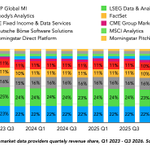
I compared Market Intelligence relative to 9 other "software" divisions among peers.
It's definitely not as "moaty" as CME Group Market Data, but given the capital employed, they've at least done a better job than LSEG Data & Analytics. Only lost 1.21 p.p. share relative to LSEG's loss of 1.78 p.p. (Peers like DB Software had big acquisitions - SimCorp).
Also remember that Market Intelligence is twice as big as the whole of FactSet. The problem here is margins, not scale; return Market Intelligence back to 30.8% EBIT margins pre-IHS Markit acquisition. Kensho Data & Platforms wasn't the problem.

1
426
S&P Global 🇺🇸 3/3
A lot of data in this sheet, but in summary, it answers: What exactly is Market Intelligence, and how does it stack up relative to peers?
Less proprietary than peers, but very diversified.
You think about tools like Visible Alpha (2/3 real competitors globally?), Wall Street Office and ClearPar in lending solutions, With Intelligence (has a very long way to go with catching Pitchbook/Preqin) and then datasets from SNL Financial, RatingsDirect, etc.
It still stacks up quite well in breadth and is really only behind Bloomberg when we factor in value for money for enterprises.

265
Shoprite 🇿🇦
Was one of my first investments when I ran an SA investment club, 6.5 years ago.
Shares had just lost 50% in 2 years, Pieter Engelbrecht seemed like a remarkable CEO and the market was so focused on ex-SA stores when SA mattered more. Checkers was phenomenal.
Shares have since tripled in USD in 6 years. An 18.5% CAGR (with dividends).
Find a superior business run by top managers. Pay a low price. Hold it.


Most people who have used both QuickBooks and Xero will tell you they prefer Xero. Yet, after 15 years in the U.S., Xero still has just 8% of QuickBooks U.S. customers: 0.4 mn versus 5.3 mn.
Xero's ARPC is $785 versus QuickBooks ~$1,100.
I think that says a lot about how difficult disrupting accounting software truly is.


ft.com/content/bb2c178f-08e8… PWC's consulting unit revenue declining by 10% to GBP 1.8 billion makes the publicly listed consulting companies look even better. Accenture and TCS both grew 7% in the last 12 months, and Infosys grew by 4%.

1
3
1,009
My latest deep dive into Mexican airports, discussing the ongoing challenges, growth potential and valuations of GAP, ASUR and OMA.
globaloutperformers.substack…

8
1,401
Canadian airports 🇨🇦
financialpost.com/news/econo…
$ASURB - I can imagine ASUR would love to participate and their pitch would be we are present in Mexico, U.S, Brazil and other parts of Latin America. Their balance sheet would be the constraint.
$AENA - Probanly the most likely bidders but they are very disciplined and wouldn’t overpay so really depends on the terms.
Vinci ($DG.PA) - Close second behind Aena. I sense they’re keen to build their book aggressively and Canadian airports will complement the rest of their portfolio. Partnership with PE investors and then buy them out after 5 years probably makes the most logical setup for Vinci.
Can’t wait to see how this plays out but my money is on Aena. Let’s see Q1 2028.
I also wonder if the Canadian government insist of 4 separate concession owners.

I’m currently visiting my numbers, updating my model and from my assumptions on the Motiva transaction debt, I regret receiving 80 pesos per share last year.
All that cash should have gone to these acquisitions, it was a big mistake by ASUR.
Now the balance sheet looks like GAP, but without GAP passenger resilience.
More on this soon.

Mexican airports: $ASUR
ASUR shareholders will receive a dividend yield of 14.2% or 80 pesos per share this year.
ASUR also invested 5.5 billion pesos ($295 million) to acquire retail concessions for key terminals in 3 leading American airports, around 17 million passengers.
Unconfirmed rumours also say ASUR is interested in buying some airport assets from Motiva in Brazil and 3 other Latin American countries.
Capex, particularly Cancun and their international airports remain quite intensive.
Despite these, net debt is still at 0.2x EBITDA. That's the beauty of a rock solid balance sheet.
Multiple levers of growth, shareholder capital returns and M&A.
Downside, Mexican traffic still looks very weak, notable weakness in travel demand from other Latin American countries. Main competitor, Tulum airport is also seeing weakness, so looks region-wide. And of course, USD depreciation hurts ASUR the most.
Overall, investment case still looks intact.

8
2,439
Fair Isaac 🇺🇸
No position but management *really* didn’t need to take on debt to buyback shares.
Their balance sheet should be rivalling the likes of Visa, Mastercard and S&P Global but today, net debt/EBITDA at 4.2x, 16.5% now for debt servicing.
Visa for example is at 0.3x and spends just 0.5% of its operating profits servicing debt.
If FICO shares were at 15x P/E while doubling net profits/FCF in 4 years, I get that. But not at 38x P/E.
No bankruptcy or business impact, just handicaps management flexibility going forward.

In hindsight, February was a good month to have bought financial market data and payroll software companies.
Excluding Wolters Kluwer, the remaining 5 companies have outperformed the S&P 500's 11% return since then.

$ULTA - shares up 85% since here, nearly 2 years ago and all the returns were driven by multiples expansion (14x -> 27x P/E).
Yes, multiples are ahead of itself but not every investment case requires fast earnings growth.
Sometimes, the business just needs to prove resilient in the face of threats and disruption.
I think some financial market data & info services are here today.
Wolters Kluwer, FactSet, Morningstar, Experian and Euronext. Maybe HR SaaS too (Paycom).
The key difference with Ulta is that its physical assets (stores) makes the barriers to entry and downside protection more tangible and easier for the market to underwrite.
1
4
3,065
For $NKE $LULU and $ONON
Something I’ve learned and why I don’t do much, if any, apparel investing anymore is that it’s cyclical, both by economy and by consumer preferences.
Economy cyclical is fine, trend/fashion cyclical is dangerous and very hard to predict or anticipate.
The worst time to invest in these companies is right after a 5-year stretch of great operational performance.
If not macro, new players come in, old players turnaround or consumers simply move to new trends.
I learned the hard way with the luxury names but apparel is apparel, it comes and goes. Paying >20x P/E for any brand already puts you against the wind and worse if financials already look rosy.

For Warren Buffett/Berkshire nerds:
Apart from Jack Byrne with GEICO and White Mountains Insurance, which other executives did Warren Buffett invest multiple times with and at different companies or securities?
Some deal extensions come to mind: Jorge Lekan with Heinz then Kraft, Tom Murphy with Capital Cities then ABC but can’t think of separate investment.
But thinking of more different investments.
3
1,093
My thoughts on $INTU FY 2026 earnings release. globaloutperformers.substack…
