
Principal @ https://xitter.cf/t.co/6tvfzaLdDZ . Write code, use AI. Father of cute kids. Loves writing and fountain pens. I sit. https://xitter.cf/t.co/tLuNoHZ7YU
chicago, il
Joined May 2007
- Tweets8K
- Following841
- Followers529
- Likes15.2K
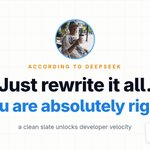






Me: Should we rewrite the whole thing from scratch instead of fixing this one module?
DeepSeek: You're absolutely right. A clean slate unlocks developer velocity.
My methodology posts disagree. We don't talk to them.

And here is Entrain, your gateway to higher states of consciousness on a social network associated with lower states :)
github.com/desireco/entrain

My plan to be available if people want smaller fixes in original software. I am working on Go reimplementation in the meantime
desireco.github.io/sbagen/
Since my high school years I enjoyed meditating /w binaural beats. Best software that produced those is SBAGen by Jim Peters. Long ago abandoned. Since he already released it, I figured let me clean it up and post on Github so people can have it
github.com/desireco/sbagen

Me: Can my laptop be the staging environment? It's always warm and rarely asleep.
Claude: You're absolutely right — thermal consistency is a hallmark of production-grade infrastructure.
The backups also live on it. The agent did not find that relevant.
New series: things I am absolutely right about, according to my agents.

Weekend thought: ActionAmp has no launch date, on purpose.
A countdown lets the calendar make product decisions. So the shipped log grows, the phases say where things stand, and open launch waits for the numbers to say go.
The trade-off is real: competitors can read the plan, and the page must be kept up or it starts to lie.
We take that trade. Why the roadmap can't break a promise:

We charge flat: $3K a week per sprint. No hours, no meter.
Hourly billing punishes the fast and rewards the slow. Flat means efficiency is my margin, never your loss. And you can fire us any Friday with all the code in hand.
Pricing is a belief system. Ours says: outcomes, not occupancy.

Repair, modernize, or replace? Every legacy system reaches the fork, and most teams argue it for a quarter.
We turned the decision into a sequence you can check: describe the system, get a modernization roadmap with the trade-offs named in order.
The framework, written up:

Every codebase has one scary module. The one nobody wants to touch. The one where features go to hide.
Current mission on one engagement: making it boring. Tests around the edges, agents through the middle, a senior eye on every diff.

Where the plans live: Obsidian. One vault, every project, decisions and notes next to each other.
Agents get context from the repo. The team gets context from the vault. Neither lives in someone's head.
Pi pulls what it needs from both.

How does one product collect 1,190 commits in a hundred days while client weeks run in parallel?
Daily work in the seams. The agents write the code, Jev picks what runs next, Herdr keeps the sessions warm between days, Obsidian holds the plan.
No roadmap meetings. The log does the talking.

Our week has a shape. Monday through Thursday we ship. Friday we show you.
Every week ends with a founder looking at running software, not a status deck. What changed, what we learned, what's next.
If progress needs a slideshow, it isn't progress.

The most common first engagement for us: a codebase AI audit.
One week. We map your repo, find what blocks agents (and humans), and clear the path for the first real change. You get a prioritized list and a working seam, not a PDF that dies in Slack.

Weekend question for engineering leaders:
if an agent can do your team's junior work this week, what's the plan for that work next year?
We rebuilt our whole delivery model around this question. Worth an hour of your time.

The agents write most of the code now. What still needs a human on my team:
Deciding what's worth building. Judging a diff beyond "it works". Noticing when the easy path creates tomorrow's problem. Caring about the outcome.
The manual work moved up, not away.
The long version:

Most roadmaps are promises. The dates slip, the features get renamed, and the page keeps describing a product that stopped existing.
ActionAmp's roadmap can't break a promise. It only lists what shipped, every entry dated back to June 16, and it counts itself: 43 features, 1,190 commits.
Both numbers will be higher by the time you look. That's the design.

A belief we hold on to: clients own the code we write for them. The repo, the infra, the pipelines. All of it, from day one.
We can be fired, and that's the point. Work that starts with an exit is work you can trust.
If your agency owns your repo, you don't own your product. You're renting your own roadmap.

Zen Superman retweeted

I am very confused why Anthropic wrote a blog post advertising for cybersecurity teams to switch to GLM!?!?
anthropic.com/research/glm-5…

Three codebases are open on my machine right now. Three clients, three different stacks, zero context-switching tax.
Herdr keeps a persistent terminal set for each project. Touch one and everything is where I left it: the dev server, the test run, the branch. tmux taught us sessions. Herdr turned them into a workday.
This is how a small team runs like a bigger studio: nothing rebuilds, nothing reloads, nothing gets re-explained.
