

DPhil (PhD) @OxfordBiology student at @UniofOxford • studying the impact of climatic instability on wild birds 🌱🪺🪶
Joined July 2021
- Tweets23
- Following174
- Followers146
- Likes185


Devi Satarkar retweeted

New research shows that the early-life environment of great tits shapes their adult behaviour more than their genetics 🐦🍃.
Read more here ⬇️
bit.ly/40SkDDT
📖@devisatarkar, @iremsepil
📷@david_idiaquez

ALT A great tit in Bagley Woods
Super excited to see my first DPhil paper and my first first-author paper in print! 🪶🪺 Many thanks to my awesome supervisors, @iremsepil and Ben Sheldon ✨ and my favourite artist, @PariSatarkar for the endless supply of great tit illustrations 🐣

Using a dataset of 800,000+ observations and decades of breeding records, Dr Satarkar and team employ multi-matrix quantitative genetic ‘animal models’ to show that genes play a minimal role in shaping individual social phenotypes in an avian system 🪽
buff.ly/423hthR

Devi Satarkar retweeted

Using a dataset of 800,000+ observations and decades of breeding records, Dr Satarkar and team employ multi-matrix quantitative genetic ‘animal models’ to show that genes play a minimal role in shaping individual social phenotypes in an avian system 🪽
buff.ly/423hthR
Had such a wonderful time at #ECBB2024 where I had the privilege of presenting my PhD work at an international conference for the first time ever! Beautiful city & campus and absolutely brilliant people & research 🤩
Thanks to everyone for being so encouraging about my work 🐣


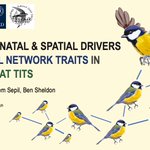
Excited to share the first preprint from my PhD doi.org/10.1101/2024.07.11.6… Turns out social phenotypes are not heritable in great tits!
Presenting this at #ECBB2024 tomorrow (10 am, Meerkat room). Please come along if you like social networks and birds! @Ben_Sheldon_EGI @iremsepil

Presented my first ever poster at the @royalsociety conference on age and sociality this week and immensely enjoyed 2 days of really cool research and chatting with even cooler people 🤩
Massive thanks to the organisers for such an enlightening meeting ✨

Devi Satarkar retweeted

13 Excellent 30min Seminars on Age & Sociality available here: age-and-society.royalsociety…
A massive Thank You to all participants, speakers & poster presenters at our @royalsociety conference this week. A very enjoyable, enlightening and exciting couple of days!


Devi Satarkar retweeted

The expanding value of long-term studies of individuals in the wild rdcu.be/cZiVq
@Ben_Sheldon_EGI, @LoeskeKruuk & @susan_alberts celebrate anniversaries of @WythamTits, @RumDeerResearch, @AmboseliBaboons and others, and discuss recent advances in long-term studies.

Wonderful talk this evening by @WhySharksMatter at @morethanadodo. So many cool shark facts & anecdotes!
TIL that some female sharks can just birth clones of themselves🦈 they don’t need no man 🫢
Great insights on irresponsible conservation actions due to misinformation too – at Oxford, England


Devi Satarkar retweeted

What makes Daboia russelii one of the most deadliest snake in world? Or ever wonder if snakes produce distinct venom in their venom gland pair?
Find out more in our latest study featuring the Indian and Palestine viper 🐍
@LabVenomics

Hot off the press! We comparatively evaluated venom composition and biochemical activity, morbidity- (haemorrhage, necrosis, nephrotoxicity) and toxicity-inflicting potentials of Russell's viper from India and Palestine viper from Israel.
tinyurl.com/287su6e9
@LabVenomics

Devi Satarkar retweeted

I am working with a cancer researcher at Cornell and I need to speak with medical oncologists regarding different cancer therapies for our coursework. Please let me know if you know any medical oncologists or anyone in the onco pharma field!
Devi Satarkar retweeted

Could you eat 300 hamburgers every day?
That’s how many humans would have to eat to match the equivalent of what hummingbirds consume to survive!
Hear from #NatGeoExplorer Anusha Shankar @nushiamme to learn more about these busy birds.
#NationalHummingbirdDay
Devi Satarkar retweeted

Thrilled to contribute to naked mole-rat research as a graduate student in the Barker Lab. Head over for a great read and to hear some chirps 🎶

Excited to see our work with the naked mole-rats highlighted. Bats, whales and crows too!
nytimes.com/2022/08/30/scien…
A super insightful read by @nush_dasu as she paints vivid pictures of the changes in Bengaluru’s landscape.
While I was dejected reading about all the human impacts on the city’s rich biodiversity, Anoushka shows that all hope’s not lost through her eloquent writing!

Here is the first article of a series being published as a part of the design journey of “Birds in the City - Bengaluru Edition” – a board game funded by @sustainBLR's Small Grants Programme.
playinnature.in/post/the-bes… by @nush_dasu
such a cool study! imagine having radio tags small enough to fit onto moths and chasing them with an airplane to track their migration path! 🦋✈️
even cooler that these hawkmoths maintain a straight line trajectory despite turbulent winds trying to knock them off course!!

These mysterious moths fly at night in a straight line—but how? nationalgeographic.com/anima… via @NatGeo

Devi Satarkar retweeted

The ability to learn from one another — and not just rely on natural selection to acquire new skills — could help some animals survive as humans change the planet. knowablemagazine.org/article…

Excited to share my 1st ever paper that got published last week! It's a #review on the role of CXCR3 (a chemokine receptor) in neuronal 🧠 and cardiovascular 🫀 diseases. Beyond grateful for @drchinmoypatra's encouragement and guidance as I wrote this.
frontiersin.org/articles/10.…
The review also has comprehensive descriptions of the structure and function of the receptor. Along with how it was discovered and how it came to be ✨
There's more about wound healing 🩹 in there too, with a special focus on zebrafish 🐟 research! @FrontCellDevBio
Devi Satarkar retweeted

I am beyond excited to see fishers in our trial submitting the first videos of them safely releasing #CriticallyEndangered wedgefish 💙 this is a pretty big one from Lombok, probably worth ~$140 at the port #FlatSharkFriday #sharks @saveourseas @ConservOptimism @EJMilnerGulland – at Sukakarya, Indonesia