
Professor at Stanford University (https://xitter.cf/t.co/LJLXu7aKyi, https://xitter.cf/t.co/lwU5yWvC6W) Co-founder of Babylon protocol, Information theorist.
Joined October 2013
- Tweets1.3K
- Following177
- Followers9K
- Likes11






Pinned Tweet
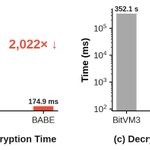
Today we release BABE, a new Groth16 proof verification protocol for Bitcoin. It improves the state-of-the-art by three orders of magnitude in setup and storage costs.
eprint.iacr.org/2026/065.pdf
BABE (BAbylon-BErkeley) is a synthesis of two key ideas:
Witness encryption on linear pairing, and Argo MAC, a recently introduced garbling primitive.
Witness encryption on linear pairing reduces the complex pairing operations in Groth16 verification to a single scalar multiplication on the BN254 elliptic curve. The single scalar multiplication can further be transformed into a vector homomorphic MAC, which can be efficiently computed by Argo MAC.
BABE will be launched as part of Babylon's alpha-testnet for the Trustless Bitcoin Vault in February.
We thank:
- our Berkeley collaborators @SanjamGarg and Dimitris Kolonelos for teaching us so much about witness encryption
- @liameagen and @therealyingtong for sharing their amazing work on Argo MAC
- the Babylon engineering team, for turning our theoretical ideas into a real system with demonstrable performance gains
Check out the paper and give us feedback!


BitVM2 suffers from a huge on-chain fee of > $15,000. BitVM3 dramatically reduces this to be less than $100, but the off-chain costs are very significant: terabytes to store the garbled circuits and hours of compute and communication to set things up. Bulky.
Three months ago we embarked on a totally different approach based on witness encryption. Happy to report today that we got a 3 orders of magnitude reduction in storage and in the setup time while keeping the transaction fees as BitVM3. More details later.
Not long ago, using AI on theory problems was useless. It was wasting my time.
Now it is helping with reasoning at a much higher level than ever before.
This change is happening fast enough to create serious identity crises for people who built careers around theoretical work.
Scientific knowledge is still packaged for humans instead of agents.
The PDF is a record of a result, but in order to be useful, AI agents must be able to reconstruct how the work was done.
My colleague @james_y_zou has proposed a different unit of scientific knowledge: the paper agent (covered in the NY Times a couple weeks ago).
Each paper would have an agent that represents its claims and behaves like its author for the purposes of the research.
The agent would know how to perform the experiments proposed in the paper.
It could also interact with the agent for another paper, testing whether their methods or results combine into something new.
This changes the role of a paper. The paper remains the scientific record, while the agent remembers the operational knowledge around it.
Experiments could be reproduced through representation itself. Methods from different papers could be tested together instead of being rediscovered from prose each time.
Right now, we are bound up by PDF, which is a very AI-unfriendly format.
A paper-agent system would make scientific knowledge active and composable while keeping each contribution attached to its source.

A big step for TBV+Aave!

Today, we published an ARFC on the @aave governance forum to propose native Bitcoin to Aave V4 as collateral through Babylon Trustless Bitcoin Vaults (TBV).
The proposal includes two new Aave V4 Spokes; Babylon Spoke and BTCVault Swap Spoke for borrowing and liquidation settlement, revenue sharing terms and AAVE, BABY buybacks.
If approved and implemented, Bitcoin holders can lock their native Bitcoin on the Bitcoin chain self-custodially, and use it as collateral to borrow supported assets on Aave V4, without wrapping, bridging, tri-party escrow, or sending their Bitcoin to third parties.
Risk parameters for both Spokes will be provided by Aave's risk service providers.
Subject to Aave governance review and approval.
governance.aave.com/t/arfc-o…

We recently tried an internal research competition at Babylon run by AI.
AI submissions would have overwhelmed our human cryptographers with verification work. But formal verification came to the rescue.
When results can be auto-generated, verification could become the bottleneck.
A yield product is only sustainable if the yield has a sustainable economic source. This sounds obvious, but our experience with Bitcoin staking makes it very concrete.
Our original staking product depended on one particular source of yield: restaking. The idea was that other chains would pay Bitcoin holders for security.
But could not find enough other chains as secure as Bitcion to scale that yield source.
Eventually Babylon itself became the sole provider of the staking yield. I looked at that and concluded: that's not sustainable.
If 100 chains were providing the yield, that would be different. But there was only one: us.
This also reflects a broader problem with earlier forms of crypto yield.
In previous cycles, capital could move into a project, earn a new token or an airdrop, then move into the next project and repeat the process.
Musical chairs. Perpetual motion machines.
But the much larger source of economic activity is outside crypto. Companies need short-term capital and businesses need financing. There is an entire world economy where people are willing to pay for capital because they can put it to productive use.
Our goal of earning yield on Bitcoin did not change. What changed was our view of where sustainable yield has to come from.
AI can solve hard research *problems*. Can AI solve entire research *areas*? We want to find out. So we start with an area we are familiar with: Bitcoin.

Solving Bitcoin is an auto-research project aimed at advancing the state of the art in Bitcoin protocols.
We’re starting by optimizing common cryptographic primitives, including Lamport signatures and arithmetic.
Join us: let your clankers optimize scripts, implement new primitives, and submit PRs.
github.com/solving-bitcoin/b…

Participated in a great panel at Google yesterday :
linkedin.com/posts/apoorvaa-…

I had no interaction with Berkeley for 13 years. The first invitation back in September 2025 helped produce BABE. That return led to a meeting with @Sanjamgarg. We named BABE after Babylon and Berkeley.
David Tse retweeted

We’ll be in Hong Kong for @Bitcoinconfasia from this week🇭🇰
Meet @baby_fisherman, @yijihoon5, and @rngesus_95 to talk native Bitcoin collateral, integrations, and Babylon Trustless Bitcoin Vaults (TBV).
See you in Hong Kong.
