


Pinned Tweet
Let's not forget this gem.
Palantir Ceo Alex Karp says short sellers are on cocaine. youtube.com/shorts/T0_qxL0r2… 👃 @YouTube

Andy retweeted

🚨🇨🇳 A Chinese glass company just turned the RIOTS in France into FREE advertising!
Hengxinfeng filmed NOTHING, just posted a video of its unbreakable windows on social media, and went VIRAL.
EPIC TROLLING!

Andy retweeted

The Tokenization Map 🗺️
102 names bringing real-world assets onchain, from chains and stablecoins to tokenized funds, stocks and DeFi.
We could make 10 more graphics like this and still not fit everyone.
See the full ecosystem map, with 1,000+ builders, at rwaf.xyz.

Andy retweeted

🚨 In 66 days the Pentagon's magnet rule stops asking "where was it melted?" and starts asking "where was it mined?" 🧲
📜 Today (to 31 Dec 2026): DFARS 252.225-7052 only bars NdFeB magnets if the Nd-Fe-B alloy was melted, or the magnet made (powder → press → sinter → magnetise), in China, Russia, Iran or North Korea.
⛏️ From 1 Jan 2027: "the entire supply chain from mining of neodymium, iron, and boron through production of finished magnets." Mined, refined, separated, melted or produced in a covered country = cannot be delivered under a DoD contract. The clause flows down to every subcontract tier.
📊 The gap it lands on: US demand ~48,000 t of NdFeB in 2025 vs ~300 t domestic supply (Arthur D. Little via Reuters). Capacity on track for ~5,000 t by end-2026.
♻️ The one recycling carve-out: an NdFeB magnet made from recycled material is exempt only if the recycled material is milled AND the final magnet sintered in the United States. For recycled NdFeB processed anywhere else, the clause is silent on how the mine-origin test is applied.
🔓 Escape valves: COTS items under 50% covered material by weight, electronic devices, buys under the simplified acquisition threshold, and a written nonavailability determination if compliant magnets "cannot be procured as and when needed at a reasonable price." My read: that last one does a lot of work in 2027.
🗓️ The date has already slipped once (2026 → 2027 via FY2024 NDAA s.854), and contractors have reportedly lobbied for another delay.
👀 Bottom Line: 66 days from now, every NdFeB magnet in a US defence contract needs a paper trail back to the mine, in a market that supplied 300 t of its own 48,000 t last year.
#RareEarths #NdFeB #Magnets #DFARS #CriticalMinerals #DefenseSupplyChain #Recycling #SupplyChain

In 67 days, the Pentagon’s restriction on NdFeB magnets will cover the entire supply chain, from mining of neodymium, iron and boron through production of finished magnets.
Today it covers melting and the later stages of magnet production.
From January 1, 2027, Pentagon contractors may not deliver covered material mined, refined, separated, melted or produced in China, Russia, Iran or North Korea.
The same change reaches back to ore for samarium-cobalt magnets, tantalum and tungsten. The clause allows exceptions, including a nonavailability determination by the agency.
The US-China truce suspending China’s October 2025 rare earth export controls was extended to January 10, 2027, nine days later.
Source: China Briefing

Andy retweeted
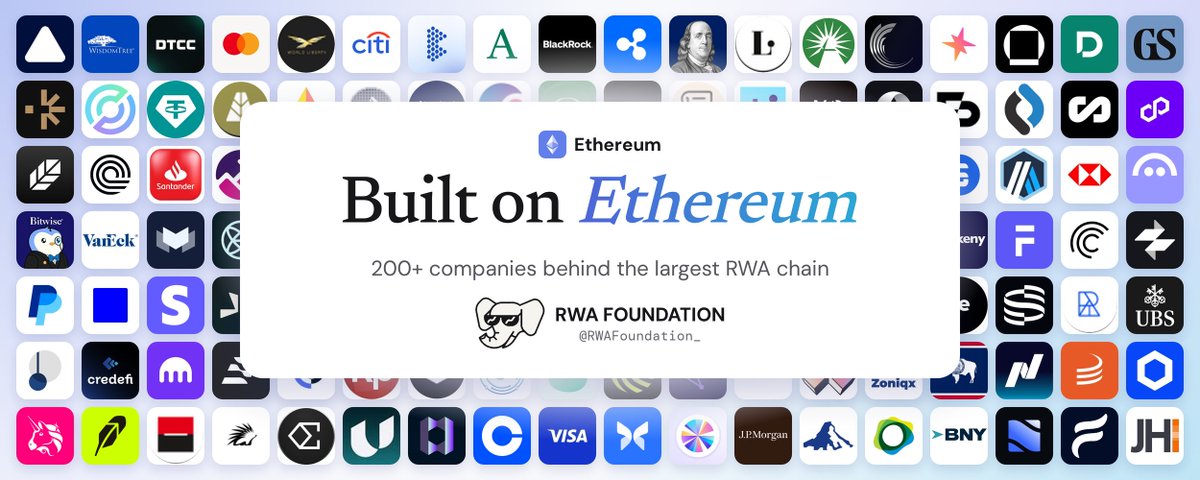
The builders on Ethereum 🧵
212 companies, issuers and public bodies building RWAs, stablecoins and tokenization on @ethereum, mapped by sector.


In 67 days, the Pentagon’s restriction on NdFeB magnets will cover the entire supply chain, from mining of neodymium, iron and boron through production of finished magnets.
Today it covers melting and the later stages of magnet production.
From January 1, 2027, Pentagon contractors may not deliver covered material mined, refined, separated, melted or produced in China, Russia, Iran or North Korea.
The same change reaches back to ore for samarium-cobalt magnets, tantalum and tungsten. The clause allows exceptions, including a nonavailability determination by the agency.
The US-China truce suspending China’s October 2025 rare earth export controls was extended to January 10, 2027, nine days later.
Source: China Briefing

🚨 Every guided weapon has a hidden interface between the software and the physics: a magnet. Fin actuators, radar tubes, phase shifters, seeker gimbals. Three materials do almost all of it, samarium cobalt, neodymium-iron-boron and the microwave garnets, and the rare earths inside them are licensed out of one country. I mapped where they sit, system by system. Here is the tour. 🧵
🎯 Actuators: moving the fins
🚀Precision-guided munitions steer with small rare-earth motors. SLAM, AMRAAM, HARM and Stinger use samarium-cobalt or rare-earth magnet motors to drive fins and canards; AMRAAM's moving surfaces sit mid-fuselage on SmCo actuators.
🦈Each fin actuator is a motor, a gearbox and a position sensor in a palm-sized package that has to survive boost, Mach heating and continuous manoeuvre. Tomahawk's tail fins run on direct-drive rare-earth actuators. JDAM tail kits add NdFeB-based actuators to "dumb" bombs, turning the GBU-29/30/31/32/35/38 family into PGMs, and the GPS-aided GBU-36 and GBU-37 bunker-busters use rare-earth magnet tail kits the same way.
xitter.cf/roblun1/status/2083836…
✈️ Aircraft
Samarium-cobalt generators supply aircraft electrical power, and high-power rare-earth actuators move flaps, rudders and ailerons in modern fly-by-wire jets. This is why the 2022 F-35 delivery halt was over a magnet alloy in a turbomachine, not a weapon.
📡 Radar and RF front ends
Travelling-wave tubes and klystrons focus their electron beam with rare-earth permanent magnets: periodic arrays in wide-band helix TWTs, non-periodic structures in higher-energy narrow-band klystrons. Those assemblies set gain and bandwidth for missile data-links, satellite uplinks and long-range comms. SmCo magnets focus the beam in radar magnetrons for search, surveillance and fire control.
🟡Yttrium-iron and yttrium-gadolinium garnets (YIG, YGG) sit in the tuners, filters and phase shifters of phased arrays, PATRIOT included, and magnetically biased circulators using YGG cores and SmCo magnets control the one-way flow of RF power between transmitter, antenna and receiver.
🔍 Sensors and guidance heads
HARM converts enemy radar emissions into steering commands through rare-earth microwave-sensing devices. IR and RF seekers use small SmCo and NdFeB magnets in gimballed sensor drives and stabilisation platforms.
🧲 Three materials, three jobs
🧲🔵SmCo: high-temperature, radiation-hard; missile fin actuators, aircraft generators, radar TWTs. NdFeB: highest energy product in the smallest package; JDAM kits, some cruise-missile actuators, compact motors. Ferrites and garnets: soft-magnetic, microwave-tuned; RF filters, phase shifters, circulators and tuners. In the words of the board: from fin actuators to radar phase shifters, rare-earth magnets are the hidden interface between software guidance and physical effect on target.
⚠️ Read it with care
Two caveats, because this list travels a lot. First, the system-by-system map is a long-standing one. It is published by REalloys, but the same descriptions trace back to Cindy Hurst's 2010 report for the US Army's Foreign Military Studies Office, and the REalloys page still carries the original 1996 citation on the bunker-buster line.
🧲Magnet choices in today's production variants are not public. Treat it as the canonical map of where the magnets sit, not a current bill of materials. Second, REalloys (NASDAQ: ALOY) makes rare-earth metals and magnets for defence customers, so it has a commercial interest in the story.
The Congressional Research Service says the same thing more briefly: SmCo "retains its magnetic strength at elevated temperatures and is ideal for military technologies such as precision-guided missiles, smart bombs, and aircraft", and NdFeB's strength "allows for the use of smaller and lighter magnets in defense weapon systems".
👀 Bottom Line
Put this board next to the samarium post. China produced 97% of the world's samarium in 2024 and has licensed its export since 4 April 2025; on 1 January 2027 US defence procurement rules reach back through the entire SmCo chain to the ore. Every box on this board is a part that has to pass that test. The quantities are tiny, grams to kilograms per round, and that is the point: the smallest magnet in the room decides whether the biggest things fly.
#RareEarths #PermanentMagnets #SamariumCobalt #NdFeB #DefenseIndustrialBase #CriticalMinerals #Radar #Missiles #PGM #DFARS #SupplyChain #China

Andy retweeted

🇷🇸🇷🇺 Student List to RT: No sanctions on Russia
Professor Jovo Bakić of the winning Student List says Serbia's new government will not impose sanctions on Russia, despite Vučić's claims that it would happen within months.
"We respect Russia both as a great power and as our historically important partner, and in many cases even our protector. There will be no changes there," Bakić told RT Balkan.
Having lived through UN sanctions in the 1990s, Serbs know "what kind of misery that is," he said. Sanctions from a small country like Serbia would change nothing for Russia, since even the entire EU failed to harm it, but they would damage relations and hurt Serbia itself. "I said this during the election campaign, and I'm saying it after the elections."

🇷🇸 Serbia: Vučić concedes defeat in snap parliamentary elections
Aleksandar Vučić, head of the Serbian Progressive Party (SNS)-led United Serbia list, said the Student List has won, based on a stratified sample. He estimates the Student List at 135 to 140 of 250 seats and his bloc at around 105, with no other list entering parliament. By his figures, the Student List got about 2.2 million votes to United Serbia's 1.72 million.
Vučić called the result the "confirmation of a revolution" backed by several EU countries, and claimed the Student List will impose sanctions on Russia by spring.
Official results are still pending.

Andy retweeted

What stands out to me about $FRMM is its plan to connect existing data centers with GPU deployments at telecom tower sites, creating a distributed network for AI inference.
By using sites with power and permits already in place, Forum aims to shorten deployment timelines and bring compute closer to users. The tower strategy is especially interesting: smaller, local deployments that can expand as each location proves its performance.
Separate project financing, with no cross-collateralization between sites, adds another layer of risk management.
Forum is still small, but if it turns this model into reliable revenue and cash flow, it could offer a compelling example of how to scale edge AI infrastructure.
@forummarkets #FRMM #EdgeAI
sec.gov/Archives/edgar/data/…

Forum Edge AI signed a definitive $94.4M 36-month agreement with Fireworks for Nvidia B300 GPU capacity at our Dallas data center with deployment expected in late December / early January.
“This agreement is an important proof point for our AI infrastructure strategy and reflects our focus on bringing revenue generating GPUs to market quickly in a modular manner," said McAndrew Rudisill, chairman and chief executive officer of Forum Markets, Incorporated. "We have a strong partnership with Fireworks and are excited about our growth trajectory as we scale our AI infrastructure business. This is the first finalized contract Forum Edge is executing against and the first of several exciting partnerships we expect to deploy into our unique footprint."


Andy retweeted
🚨 Rare earths aren't rare. The factory matters more than the mine. If you want the ten-minute version of what my seven-part series is unpacking, this explainer covers the same ground, from the same sources. I've checked its numbers against USGS, the IEA and the company filings. Most hold. Three things need updating, and you should know who made it. 🧵
🎬 Why it is worth ten minutes
It gets the shape right, in order: the name is wrong twice (not rare, not earths); the hard part is separating 17 chemical twins, not digging them up; one magnet type sits in almost everything that spins; China's lead is smallest at the mine and biggest at the factory; export licences turn processing into leverage; and most of the strategic metals are by-products, so you cannot simply open a gallium mine when prices jump.
That is the spine of Parts 1 to 7.
✅ The numbers I checked
🌍⛏️World mine output 2025 about 390,000 t REO, China about 270,000 t, "close to 70%" — USGS says 69%. United States second at about 13% (51,000 t), then Australia (29,000 t) and Myanmar (22,000 t). Holds.
🧲Magnet metals (Nd, Pr, Dy, Tb), IEA 2024: China about 60% of mining, 91% of refining, 94% of magnets. Holds.
📍Note the two scopes: ~60% is the IEA's magnet-metal mining share; 69–70% is USGS all-REO. Both are right. My Part 1 board carries the IEA figure, Part 2 the USGS one.
🇦🇺🇺🇸"Just under 10,000 t of NdPr oxide" from Lynas and MP Materials: Lynas FY26 7,260 t plus MP 2025 2,599 t = 9,859 t. Holds.
✈️About 417 kg of rare-earth materials per F-35: the CRS report says "approximately 920 pounds". 920 lb = 417 kg. Holds.
🟡Ytterby's four elements, cerium as common as copper, thulium and lutetium more than 100 times gold: standard crustal-abundance data. Holds.
⚠️ Three things to update
📊The export-control timeline stops in April 2025 and misses the biggest package and the date everyone is now watching.
📅On 9 October 2025 China added five more rare earths (holmium, erbium, thulium, europium, ytterbium), a rule reaching foreign-made products containing 0.1% or more Chinese rare earths by value, and controls on mining, separation, magnet and recycling technology.
📅After the Trump–Xi meeting in Busan, MOFCOM Announcement No. 70 suspended that package until 10 November 2026. On 28 September 2026 MOFCOM said the Kuala Lumpur arrangement behind the suspension is extended to 10 January 2027, but that statement does not name rare earths and no announcement amending the 10 November date has been published yet.
📅🧲So: 10 November on paper, 10 January if the extension is formalised. The April 2025 licences on seven rare earths (Sm, Gd, Tb, Dy, Lu, Sc, Y) and on magnets never stopped. The December 2024 ban on gallium, germanium and antimony exports to the US is also suspended, until 27 November 2026. A suspension is not a repeal; the legal instruments stand.
📈The prices quoted (neodymium about $186/kg, dysprosium about $1,000, terbium about $4,400, gallium over $3,000, germanium almost $12,000) are the publisher's own indicative retail reference prices, which its pricing page says include a display markup and are not order prices.
🇦🇺Lynas no longer simply "ships its ore to Malaysia". Mt Weld concentrate now also goes through the Kalgoorlie plant in WA, which produces mixed rare-earth carbonate, before separation in Malaysia. And the 2030 forecast (China's magnet-metal mining share below 55%, refining at 80% or more) is the publisher's call.
🔍 Who made it
EarthRarest is not a research institute. It is a brokerage that helps private investors buy physical strategic metals and rare earths, operated by Finofin Limited, a company registered in Israel; its site names Tradium GmbH in Germany among its suppliers and offers storage in Switzerland. I am sharing the explainer because it is good and the sources are the right ones.
👀 Bottom Line
The explainer gets the shape right: not rare, hard to ⚗️separate, and the grip tightens downstream. That is exactly the shape of this series.
📍Part 1 drew the map.
📍Part 2 showed the mine:
🇨🇳China at 69% of ore, two state groups holding 100% of the quota, and a heavy-rare-earth quota frozen at 19,150 t since 2018 while Myanmar digs up more than that next door.
📍Part 3 goes where the 91% lives: separation and refining, and who can actually do it outside China.
#RareEarths #CriticalMinerals #SupplyChain #NdFeB #Dysprosium #Terbium #Gallium #Germanium #Antimony #ExportControls #China #USGS #IEA #Lynas #MPMaterials
Andy retweeted
🚨 China mined 69% of the world's rare earths in 2025, yet mining is the layer where its grip is weakest. It is also the layer where Beijing has held its own heavy-rare-earth quota at 19,150 t a year since 2018 while Myanmar, next door, dug up more than that. Part 2 of 7: who digs what, who controls the tap, and who is actually building outside China. 🧵
The board below is Part 2 of the map from Part 1:
xitter.cf/roblun1/status/2113476…
same six stages, same loops, with MINING lit up. Four numbers at the top, four columns underneath: who mined what in 2025, reserves against production, how the quota works inside China, and the producing-versus-developing list outside it.
⛏️ Who mined what in 2025 (USGS, tonnes REO)
🇨🇳China 270,000
🇺🇸United States 51,000
🇦🇺Australia 29,000
🇲🇲Myanmar 22,000
🇹🇭Thailand 4,800
🇮🇳India 2,900
🇲🇬Madagascar 2,700
🇷🇺Russia 2,600
🇧🇷Brazil 2,000
🇳🇬Nigeria 1,500
🌍World 390,000 → China 69%
📊Straight from the USGS table. Myanmar, Thailand and Madagascar are estimates derived from China's import data, so they measure what crossed into China rather than what any named mine reported. And US output is essentially one mine, Mountain Pass.
🪨 Reserves are not the constraint
🇨🇳China 44M t (~52% of the world's 85M+) → 270,000t mined
🇧🇷Brazil 21M t → 2,000 t
🇦🇺Australia 6.3M t (3.3M t JORC-compliant) → 29,000t
🇷🇺Russia 3.8M t → 2,600 t
🇻🇳Vietnam 3.5M t → 150 t
🇺🇸United States 1.9M t → 51,000 t
🇬🇱Greenland 1.5M t,
🇹🇿Tanzania 0.89M t,
🇿🇦South Africa 0.86M t,
🇨🇦Canada 0.83M t → 0
🇧🇷Brazil holds about a quarter of the world's reserves and produced about half a percent of 2025 output. Vietnam has 3.5M t in the ground and 150 t out. Rock in the ground is not the constraint. What is built on top of it is.
🏛️ Inside China: two groups, one tap
🇨🇳China's mining comes from three places, in effect:
Bayan Obo in Inner Mongolia (the world's largest deposit, light rare earths recovered alongside iron ore, feeding China Northern Rare Earth at Baotou); Maoniuping in Sichuan (light, the world's number two); and the ion-adsorption clays of Jiangxi, Guangdong, Guangxi, Fujian, Hunan and Yunnan (dysprosium, terbium, yttrium, feeding China Rare Earth Group at Ganzhou).
⛏️The 2024 quota is the last one published: 270,000 t of mining and 254,000 t of smelting and separation, issued to just two groups.
China Northern Rare Earth received 188,650 t, all light. China Rare Earth Group received 62,200 t of light plus 19,150 t of ion-clay. That is roughly 70/30, and it is 100% of the quota. In 2023 there were still four quota-holders; from 2024 there were two.
📊Since then the numbers have gone dark. The 2025 quotas were issued quietly in July 2025 without a public figure, and no 2026 quota has been published either. Tonnages you see quoted for 2025 and 2026 in the trade press are not official and I have left them off the board.
📜Two rule changes sit behind this. The Rare Earth Management Regulations, in force since 1 October 2024, state that rare-earth resources belong to the State and that no enterprise may mine or separate outside the designated groups.
And MIIT Order 71, in July 2025, brought imported ore and monazite inside the quota system, so the clay coming over the border from Myanmar is now counted alongside domestic ore.
📊 The number almost nobody shows: 19,150 t
China's own heavy-rare-earth mining quota, the ion-clay line, has been 19,150 t a year since 2018. On the official numbers, any growth in China's heavy-rare-earth feed since then has come from imports, above all Myanmar.
🇲🇲Myanmar's ion-clay output was about 22,000 t in 2025 on the USGS estimate, more than China's entire domestic ion-clay quota, and almost all of it is trucked across the border for separation in China. Laos is now rising as a second source. In September 2026, Myanmar and Laos supplied 97% of China's imports of unlisted rare-earth oxides (3,509 t and 1,369 t of 5,021 t).
So the heavy-rare-earth story of the next two parts, separation and pricing, starts here: the dysprosium and terbium feed is mined outside China and processed inside it.
🌏 Outside China: producing now
🇺🇸MP Materials, Mountain Pass, California: 50,692 t of REO in concentrate and 2,599 t of NdPr oxide in 2025.
🇦🇺Lynas, Mt Weld, WA, with processing at Kalgoorlie and in 🇲🇾Malaysia: 13,089 t of REO ready for sale in FY26, including 7,260 t of NdPr.
🇧🇷🇺🇸Serra Verde, Pela Ema, Goiás, Brazil: an ionic-clay operation producing since 2024, ramping to about 6,400 t TREO a year by the end of 2027. Owned by USA Rare Earth since 3 September 2026.
🇲🇲Myanmar and 🇱🇦Laos, as above: producing, but into 🇨🇳China.
That is the whole producing list of any scale outside China and its neighbours. Three companies.
🚧 Outside China: still building
🇦🇺Iluka, about 1M t of monazite stockpiled at Eneabba, WA; the Eneabba refinery was about 60% built at the half-year, with commissioning in 2027.
🇦🇺🇲🇼Lindian, Kangankunde, Malawi: first monazite concentrate targeted for December 2026, with offtake to Iluka.
🇦🇺Arafura, Nolans, NT: final investment decision 21 May 2026, ground broken 8 October 2026, about three years of construction ahead.
🇦🇺Hastings, Yangibana, WA: fully permitted, 40% Hastings and 60% Wyloo, no final investment decision; Wyloo is running a sale process for its 60%.
🇦🇺Northern Minerals, Browns Range, WA: heavy rare earths, concentrate committed to Eneabba, first production targeted for late 2027 subject to funding.
🇧🇷🇦🇺Brazil: Meteoric (Caldeira), Viridis (Colossus) and Brazilian Rare Earths (Bahia). Lynas
🇦🇺🇺🇬Ionic Rare Earths, Makuutu, Uganda: an ionic-clay project, 60% held; mining licence granted 28 December 2023; a strategic review of the project has been running since 31 July 2026.
🇬🇧🇦🇴Pensana, Longonjo, Angola: construction more than 30% complete; on 25 September 2026 the company extended its schedule, with first output now guided for late 2028.
🇨🇳Ngualla, Tanzania, no longer a Western developer: Shenghe Resources completed its takeover of Peak Rare Earths on 30 September 2025.
🇺🇸USA Rare Earth, Round Top, Texas; American Rare Earths, Halleck Creek, Wyoming.
🇬🇱Tanbreez, Greenland approved the mining and closure plans (announced 5 October 2026); construction permits and financing still to come, first ore targeted for late 2028 or early 2029.
🇬🇱Kvanefjeld is not on the board: its exploitation licence was refused and its exploration licence was not renewed, and the dispute is in the courts.
Every one of these is a 2026–2029 story, and none of them produces a tonne of REO today. On the public record the first new ore from this list arrives from ⚗️Lindian (Dec 2026 target) and the first new refined oxide from Iluka (2027).
👀 Bottom Line
⛏️Mining is the least concentrated layer of the chain: China at 69% of ore, against 91% of refining and 94% of sintered magnets.
It is also the layer where the West already has real producers, with the US, Australia and Myanmar together mining 102,000 t last year. But look where the heavy feed comes from and where it goes.
Beijing has not raised its own ion-clay quota in eight years, and my read is that it has not needed to, the dysprosium and terbium come in by truck from Myanmar and Laos and are processed in Ganzhou. The grip tightens downstream, and that is where the next part goes.
Part 3, separation and refining, next.
#RareEarths #CriticalMinerals #Mining #SupplyChain #NdFeB #Dysprosium #Terbium #China #Myanmar #USGS #Lynas #MPMaterials #IXR #ASX

🚨 China mined 69% of the world's rare earths in 2025. By the time that ore is a sintered magnet, China's share is 94%. Over the next two days I am walking the chain one layer at a time, mining, concentration, separation, metal, magnets, recycling, and naming who actually stands in each layer outside China.
Part 1 of 7: the map. 🧵
The board below is the map for the whole series. Six stages, China's share at each one, the Chinese groups that dominate it, and the three loops that feed recycling: dross from metal-making, swarf from magnet machining, and end-of-life magnets. Every later part zooms into one stage, with its own board in the same format.
🗺️ The series
1. The map (this post)
2. Mining and extraction
3. Separation and refining
4. Metal, alloy and magnets
5. and recovery
6. End users
7. Chemicals, solvents and equipment
⛏️ Who mined what in 2025 (USGS, tonnes REO)
🇨🇳 China 270,000
🇺🇸United States 51,000
🇦🇺Australia 29,000
🇲🇲Myanmar 22,000
🇹🇭Thailand 4,800
🇮🇳India 2,900
🇲🇬Madagascar 2,700
🇷🇺Russia 2,600
🌎World 390,000 → China 69%🇨🇳
Two things hide inside those numbers. US output is essentially one mine, Mountain Pass.
And Myanmar's 22,000 t is the heavy-rare-earth feed (Dy, Tb) that is overwhelmingly processed in China, so China's grip on heavies is larger than its own mine share suggests.
🪨 Reserves tell a different story
🇨🇳China 44M t (~52% of the world's 85M+)
🇧🇷Brazil 21M
🇦🇺Australia 6.3M
🇷🇺Russia 3.8M
🇻🇳Vietnam 3.5M
🇺🇸United States 1.9M
🇬🇱Greenland 1.5M
🇧🇷Brazil holds the second-largest reserves on earth and produced about 2,000 t in 2025.
🇻🇳Vietnam holds 3.5M t and barely registers. Rock in the ground is not the constraint. What is built on top of it is.
🏛️ Two groups, one tap
🇨🇳China's rare-earth quota is no longer spread across six groups. The 2024 quota (270,000 t mining, 254,000 t smelting and separation) was issued to just two:
1. China Northern Rare Earth and 2. China Rare Earth Group, split roughly 70/30. Northern is the light-rare-earth giant at Baotou; China Rare Earth Group is the state-owned heavy and medium rare-earth consolidator at Ganzhou.
☎️When Beijing wants to turn the tap, it makes two phone calls.📞
📊 60% or 69%? Both
You will see both numbers quoted and they are not in conflict.
The IEA's 60% is China's share of mined MAGNET rare earths (Nd, Pr, Dy, Tb) in 2024, which is the basis my board uses.
The USGS 69% is China's share of ALL rare-earth oxide mined in 2025. The IEA's 91% (refining) and 94% (sintered magnets) are the magnet-basket numbers, and they are the ones that matter for motors, turbines and defence. In 2005 China made about 50% of the world's sintered magnets. Twenty years later it is 94%.
🇺🇸 Where the Western money is going
The US build-out is the clearest read on where the real chokepoints sit, because the loans are going to the middle of the chain, not to mines:
Separation and refining
⛏️🧪⚗️🔥🔬🧲MP Materials, US$150m OSC loan (Aug 2025) for heavy-rare-earth separation at Mountain Pass, part of the July 2025 DoD package (US$400m preferred equity, US$110/kg NdPr floor, 10X magnet plant).
⛏️🧪⚗️🔥🔬🧲USA Rare Earth, definitive agreements with Commerce signed 11 Jun 2026: up to US$277m direct funding plus up to US$1.3bn in loan capacity, milestone-based, for Round Top (Texas) and Stillwater (Oklahoma) metal and magnets.
⛏️🧪⚗️🔥🔬🧲Energy Fuels, US$725m conditional OSC loan commitment signed 18 Jun 2026, 20-year tenor, for White Mesa separation and a new metals and alloy plant. Still subject to due diligence and financial close.
⚗️ReElement Technologies , US$25m Department of War equity investment (Jul 2026) and a US$200m equity facility announced in Oct 2026.
Metal and magnets
🧲 eVAC , South Carolina magnet plant opened 2025, targeting 2,000 t/yr.
🧲Vulcan Elements, US$620m conditional OSC loan (Nov 2025) plus US$50m Commerce equity and US$550m private capital, to scale to 10,000 t/yr of NdFeB.
🧲Noveon, US$215m Series C closed 19 Jan 2026, led by One Investment Management, to grow beyond 2,000 t/yr in Texas.
⚗️🔥Phoenix Tailings, metallisation plant opened 2025 at ~200 t/yr; US$500m conditional OSC loan commitment (Jun 2026) for a rare-earth metals facility.
Separation and metallisation. Not ore.
👀 Bottom Line
⛏️Mining is the one layer where non-Chinese producers already hold a real and growing position, the US, Australia and Myanmar between them mined 102,000t last year.
Chokepoints are the next two layers: separation and refining (~91%) and magnets (94%). That is why the loans are landing on separation plants and metallisation furnaces, not on ore.
The rest of this series goes layer by layer to show who is actually standing in each one outside China.
Part 2, mining and extraction, next.
#RareEarths #CriticalMinerals #SupplyChain #NdFeB #Magnets #China #USGS #IEA #Separation #Metallisation


Andy retweeted

The U.S. designated helium as a critical material on Friday.
On Sunday, 60 Minutes reported on the helium shortage caused by the effective closure of the Strait of Hormuz and Iranian strikes on a Qatar gas facility earlier this year.
A range of industries are feeling the impact with no end to the war in sight. Helium is critical for many electronics. One-fifth of the world's helium is consumed by the semiconductor industry, according to the Compressed Gas Association.

Andy retweeted

Lithium demand is forecast to more than triple by 2050, which would require the equivalent of 134 new mines and more than $100 billion in investment, according to Benchmark Mineral Intelligence.
That is one new mine every two months for the next 24 years.
Demand would climb to nearly 7 million metric tons of lithium carbonate equivalent from 2.11 million this year, with each new mine averaging 36,000 metric tons of annual capacity.
Benchmark says the biggest challenge is sustaining that investment through price cycles, while competing for capital with AI, defense and the wider energy transition.
Source: Benchmark Mineral Intelligence

Andy retweeted
$FRMM How can existing cell tower sites become AI inference hubs?
That’s the key question for Forum’s upcoming discussion: using existing power and connectivity to deploy GPUs closer to users.
If the model proves economical and repeatable across sites, the scaling potential could be significant.
📅 October 27, 12 PM ET
@forummarkets @OpenAI @AnthropicAI @nvidia
#AIInference #EdgeAI #AIInfrastructure #DistributedComputing
Join Force Family Office and our CEO McAndrew Rudisill to hear how Forum Edge AI plans to turn existing tower infrastructure into distributed AI compute.
Tuesday 10/27, 12pm ET / 9am PT
Link: bit.ly/4ssnmjF


Andy retweeted
In AI infrastructure, three months can mean a substantial difference in revenue timing and financing pressure.
Jensen Huang put the cost of a 1 GW AI factory at roughly $50 billion. Assuming $40 billion in annual revenue, a three-month deployment delay would postpone $10 billion in revenue.
Simply scaling that illustration to 1 MW:
▪️Build cost: ~$50 million
▪️Assumed annual revenue: ~$40 million
🔻Three months late: ~$10 million in delayed revenue
🔺Three months earlier: an opportunity to generate ~$10 million in revenue sooner
What causes delays? Grid connections, permits, community opposition, construction and installation.
Revenue can be postponed. Interest obligations keep coming. GPUs already purchased also age while waiting to generate cash.
That captures a central market concern:
“After borrowing heavily to build, can operators start earning soon enough to recover their investment?”
This is where $FRMM CEO McAndrew Rudisill’s stated investment criteria deserve attention:
• Sites where power and permits already exist
• Equipment financing on terms the company can model and collateralize
• Risk contained at the project level
Huang explained the economic value of shortening deployment. Rudisill described a business structure intended to shorten that timeline and manage financing risk.
Different approaches, but a clear connection:
Securing expensive GPUs matters. So does shortening the time until paying customers can use them.
$NVDA’s DSX POD announcement reinforces that logic. $FRMM must now demonstrate it through customer contracts, financing and operating capacity.
The 1 MW figures are a simple proportional illustration of Huang’s 1 GW assumptions—not project cost estimates, profit figures or Forum revenue guidance. This comparison does not imply Forum uses DSX POD.
Huang’s remarks, shared by Shay:
xitter.cf/StockSavvyShay/status/…
Forum’s official announcement and CEO comments:
sec.gov/Archives/edgar/data/…
@forummarkets @StockSavvyShay
$FRMM $NVDA #AIInfrastructure #EdgeAI #DataCenters #DSXPOD

Jensen Huang says a 1 GW AI factory costs ~$50B but could generate ~$40B in annual revenue meaning every month of deployment delays ~$3.3B in potential revenue.
That puts $NVDA new DSX POD into perspective because cutting deployment from 4 months to roughly one month could bring forward over $10B in revenue per GW without needing additional GPUs.