

Build Saas or nothing
Australia
Joined January 2016
- Tweets334
- Following158
- Followers26
- Likes125



David retweeted

This is f*cking insane. Google hired this engineer at $500K-$1.2M a year because he knows how to make AI agents write code that doesn't break
In this 41-minute workshop, he shows exactly how to build that system from scratch
Prompts → Agent Skills → Harness → Agents That Ship Without You
step 1 → Refine the idea - drop in a vague thought, the agent interviews you and comes back with 3 directions
step 2 → Write the spec - success criteria, stack and open questions locked before a single line of code
step 3 → Plan in small tasks - each one gets acceptance criteria and a list of files it's allowed to touch
step 4 → Build test-first - red to green, slice by slice, so nothing that already works breaks
step 5 → Verify and review - the agent opens the app in a browser, checks security and simplifies its own code
He open-sourced all 24 skills, and the repo is close to 100K stars
Google calls this "agentic engineering"
Most people spend weeks building this by hand
You don't have to
Bookmark it and watch it tonight
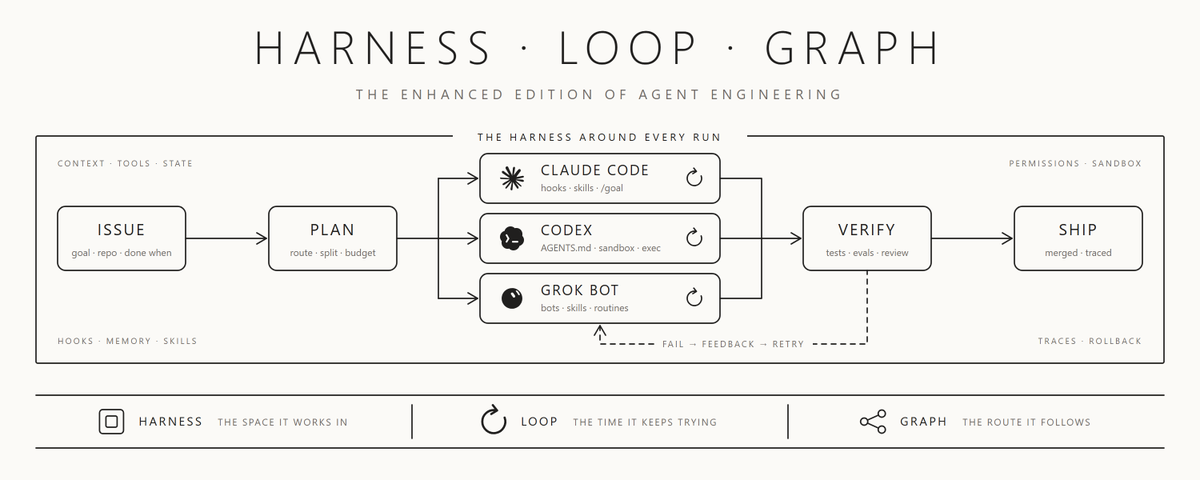
Then read how to wrap skills like these into a full harness in the harness engineering guide below ↓


David retweeted

This is f*cking insane. Anthropic engineer:
"You're not supposed to prompt Opus 5.5
You're supposed to build a system that prompts itself. At Anthropic, 90% of our engineers have already built these systems"
In 30 minutes, she walks through exactly how Anthropic builds agents that remember, fix their own mistakes and get sharper with every run.
Better than any $1000-$2000 agent course I've seen.
Watch it, then read the article below ↓
David retweeted

Ce skill Claude gratuit copie n'importe quelle animation que tu vois sur un site, 775 étoiles sur GitHub en 4 jours 🤖
Tu lui donnes le lien, une vidéo de ton écran ou un gif, il filme l'original, le refait dans ton code, filme sa copie et compare image par image jusqu'à ce que ça bouge pareil
Les animations de Stripe, Vercel ou Clerk refaites presque au pixel près, pour ton site, ta landing ou ton app
Enregistre le post
Je te mets le lien en réponse 👇
David retweeted

Prend les meilleures vidéos que tu kiffes.
Demande à Claude d'analyser frame par frame.
Et de te créer des fichiers fx, animations, in, out, pour reproduire ces mêmes vidéos motion design.
David retweeted

Internet a trouvé son nouveau passe-temps favori : découper littéralement tout grâce à l’IA. ✂
Depuis qu'une méthode circule pour générer ces coupes transversales ultra détaillées, les créateurs s'en donnent à cœur joie pour disséquer des objets du quotidien, des monuments ou des concepts absurdes.
Évidemment, on n’a pas pu s’empêcher de tester le prompt… et on a poussé l'expérience avec des trucs complètement improbables.
Suivez 👉 @numerama pour anticiper l'avenir !
--
#ia #histoire #numerama
David retweeted

i just re created kurzgesagt's entire channel in 10 minutes with claude opus
they have 0 competition because every video takes a full team of animators and 1200+ hours to make
i turned it into a claude prompt that im giving out for free
open claude code, paste the prompt, pick an idea, and your video is fully automated
thank me later ↓
<inputs>
Ask me for: one topic as a "what if" question (default: "What if the Sun vanished?"), the length (default 30 seconds), and whether I have an ElevenLabs key (if not, use a free local voice).
</inputs>
<direction>
A Kurzgesagt-style animated explainer at 1920x1080, 30fps, drawn entirely in code: one 2D canvas plus one WebGL canvas for planets.
Space: a vertical gradient #081d2c to #102348, five huge parallax nebula blobs (teal rgb 24,150,160 at 20%, blue 40,95,195 at 16%, coral 220,95,110 at 10%, indigo 60,70,175 at 15%), three star layers at parallax depths .12/.35/.6 that twinkle, 40% of the near stars drawn as 4-point sparkles.
The Sun: radius 300px, half off the left edge. A radial gradient #fff7dc to #ffc857 to #ff8f4a with an offset highlight, additive halo rings at 1.23/1.48/1.76/2.1x the radius, 18 faint rotating ray wedges, 28 drifting glowing granules on its surface.
Earth: an orthographic sphere in a fragment shader, 4x supersampled, from a 2048x1024 map painted from longitude/latitude polygons: land #5fc47a, forest #48ad6b, desert #f5c75f, rainforest #3a9d62, ice #f1f8ff, ocean gradient #4dc7eb to #1a66b8, white capsule clouds. Tilt .26 rad, spin .55 degrees per second. Day/night uses smoothstep(-.12, .24, N·L) with the light direction recomputed from Sun to Earth every frame. Navy night side with ~380 warm city lights, a coral band on the terminator, a cyan rim, ocean specular, an atmosphere halo that is stronger on the lit side.
A small astronaut mascot (~180px) built from rounded rectangles: suit #f3f7fb, orange #ff8f4a boots, a visor gradient #1f5a73 to #0a1c2c with glowing cyan eyes that look at whatever matters, a blinking antenna light, an idle bob, squash and stretch on every pose.
Type: Fredoka 600/700 only. Captions in caps with 3-6px letter spacing in teal #8fd8e6, gold #ffd98a or white, sitting in rounded pills of rgb(6,20,40) at 62%. Every line of text rises 1.3x its own height through a clip on an ease-out-quint.
Finish: a vignette to rgba(4,4,20,.45) and a 6% film grain re-randomized 24 times per second.
Banned: outlines, flares or loops on the Sun's edge, static infographic strips, full stops in on-screen text, text that fades in whole, AI images or AI video, Kurzgesagt's own characters, bird or music.
</direction>
<structure>
30 seconds, every line of narration gets a camera move or a transformation, nothing ever holds still.
Tight on the Sun at 2.25x (0s) → on the word "vanished" it swells 6% for 0.22s, collapses in 0.33s, then a white flash and a shockwave ring (1s) → pull back to 1x revealing Earth still lit and the astronaut staring at the empty spot (1.6-3s) → on "eight" an 8:20 countdown slams in from 1.7x to 1x and starts ticking, a "LAST LIGHT" label rides the edge of the growing dark disc (3.2s) → dive to 2.3x on Earth with light streaks flowing in (5.6s) → on "you" a YOU pin drops (7s) → on "left" a photon lands on the pin with "THIS LIGHT LEFT THE SUN / 8 MIN 20 SEC AGO" (7.5s) → on "play" the pin morphs into a play button, "YOU PRESSED PLAY / 15 SEC AGO" (8.8s) → one pull-back from 2.4x to a 0.3x orbit view, "LAST LIGHT" and "GRAVITY" riding the ring (9.6-12.5s) → on "nothing" a dotted circle at the empty centre (13.4s) → on "hits" the darkness sweeps Earth in 0.7s, city lights pop on, the countdown turns gold at 0:00 (15.8s) → on "black" the background fades almost to black (17.4s) → Jupiter appears, "STILL SHINING FOR 1 HOUR+" (17.9s) → zoom out, a dashed tangent line, "30 KM/S" as Earth flies straight off (20.8s) → a thermometer counts 15 to -70°C while frost grows from the poles (22.8s) → a 0.8s rewind on a separate story clock (24.3s) → sunglasses drop onto the astronaut (25.2s) → a photon tagged "8:20 OLD", then the title (27.7s).
For any other topic, keep the same shape: the event happens on its word, pull back to show scale, dive in to make it personal ("you"), pull back out, the consequence with a live counter, an escalation, a funny beat with the mascot, a callback and the title.
</structure>
<build>
1. One HTML file. Every frame is a pure function of time: window.seek(t) draws frame t. No timers, no CSS animation.
2. Camera moves on easeInOutCubic, zoom is interpolated in log space, every pop is a damped spring (damping .42-.5, frequency 12-16).
3. Voice: ElevenLabs eleven_v4 with a designed voice (calm, warm, curious male, late 30s, crisp, light neutral European English), stability .5, similarity .75, generated with timestamps. Without a key, use kokoro-onnx locally and get word times with faster-whisper. Every animation event fires on its word. About 165 words per minute, 0.24s between sentences, a 0.36s beat before the big reveal.
4. The darkness front: any pixel within the front's radius from the Sun turns to night with a 30px soft edge. The front moves at ~47px/s and ramps to 700px/s near Earth.
5. Keep two clocks: ambient time for twinkle, spin and bob, and a separate story clock for events, so a rewind stays consistent.
6. Render with Playwright in headless Edge with the GPU: seek every frame at 30fps and blend 2 subframes (shutter 0.6) for motion blur, then encode with libx264 at CRF 16 for the master and CRF 20 for delivery.
7. Sound: a calm royalty-free space music bed 7dB under the voice, timed so its natural ending lands on the title, swelling 5dB under the title. One downloaded royalty-free sound effect per event kind (collapse, impact, pull-back whoosh, countdown tick, dive, pin tap, photon land, play click, light hit, reveal, frost, rewind), each peak-aligned to its frame and 4-10dB under the voice. Master with gain plus a limiter to -14 LUFS, -2.2dB true peak.
</build>
<gotchas>
Make the WebGL globe canvas at least 2 x radius x zoom x 1.18 pixels or the sphere clips flat in close-ups. Never draw prominences on the Sun's edge, they read as white hooks. Never pad the voice to fit the visuals, tighten the read instead. Speed the darkness front up near Earth or it takes 13 seconds to cross the planet. Show me a contact sheet of every beat before rendering.
</gotchas>
<start>
Ask me the inputs, write the narration with the beat each word triggers, show it to me, then build and render the video.
</start>

kurzgesagt has 25M subs and they still go viral with 15M+ views on every single video for years
nobody copies them because every video takes a full studio of animators and months of work
i rebuilt their format with opus 5.5, 100% code for $0 per video, on the left is my own version i created
he probably averages $150k+ earning per video
9 years ago he posted how he makes 1 video in 1200 hours, i re created this in literally 10 minutes for free (check in comments)
would u guys be interested if i turned this into a free claude skill you can use?

David retweeted

Claude made this 60fps animated short while i was sleeping using @ComfyUI Api
Fully automated pipeline made for @prompthqfr students


David retweeted

THE BEST TUTORIAL YOU WILL EVER FIND ON X TODAY 😁
HOW TO REALISTIC AI VIDEOS | FULL TUTORIAL 🔥❣️


David retweeted

INSTEAD OF WATCHING NETFLIX TONIGHT. Spend 2 hours with this. Claude AI FULL COURSE that teaches you how to BUILD and AUTOMATE anything. The people who watch this tonight will wake up tomorrow with a new skill. Watch it and bookmark it now.

David retweeted

Google just released free 2-hour course on full Graph & Loop engineering: 1 prompt → 100 agents → loops → graphs from 0% to 100%:
0% → 0:35 - Graph engineering from scratch
30% → 31:17 - build your first agents graph
45% → 43:40 - run hundreds agents in parallel
75% → 1:04:58 - Loop engineering: route, check, repeat
100% → 1:30:09 - self-improving graphs that work while you sleep
most people keep stuffing instructions into one agent - the real upgrade is a graph that routes, checks, and rebuilds the workflow at runtime
learn graph from Google, ship your first - then unlock the complete system design below ↓


David retweeted

Google just released the best 1-hour course on Graph Engineering: from single agent to a full 24/7 system
00:00 - What Graphs are
09:16 - Build an agent
21:15 - Graph engineering explained
41:03 - Graph engineering practice
52:21 - Self improving Graphs
Free, the best thing on Graph engineering I've come across
Watch it, then build your first graph with the step-by-step guide below


David retweeted

Loops vs. Graphs, clearly explained!
loops are great, and they have a ceiling you can watch happen:
a loop goes around. it produces, checks, corrects, and goes around again.
after six passes you have one job, done very well.
after six hundred passes you still have one job, done very well.
Graph engineering fixes this by moving the decision up a layer: not how well one job gets done, but which jobs exist to be done at all.
you need both, and here is the sentence that resolves the whole confusion:
the loop lives inside a node. the graph lives between them.
↳ inside one unit: produce, check, correct, repeat until green
↳ between units: split, fan out, merge, gate, send back
Prompts → Context → Harness → Loops → Graphs
the loop does not go away when you build a graph.
it moves inside, and now there are three of them running at once on three things you would never have thought to run.
the trick is being selective about what becomes a node.
only spend a model where judgment lives.
merging, ranking, deduping and schema checks are edges, and edges are code. free, instant, and they cannot be argued out of a verdict.
one thing to know before you scale it.
a loop that cannot fail is not a loop, it is a repeat with a bill attached.
and the check people write is almost always the wrong kind.
↳ the test suite exits 0 is a check. the diff touches only the files in the plan is a check
↳ the output looks good, the model says it is confident, no errors were raised, none of those are checks
that last one catches careful people.
absence of an error is not evidence of correctness, and a loop built on it will confidently repeat a mistake until the budget runs out, with a clean log the whole way.
and the one that eats whole nights: when a unit fails, return that unit, not the batch.
send back four slices because one failed and you have just rewritten three correct ones. do it twice in a run and the run never converges.
below i have quoted my full guide on graph engineering. it covers the three topologies, the verifier patterns, and where the gate should actually open.
save this and read it below ↓


David retweeted

This guy just LEAKED the EASIEST way to make money in 2026:
Claude Code + YouTube = $62,000/Month 💰
(Just 13 minutes)
Save this. You’ll thank me later.
David retweeted

El CURSO más COMPLETO de CLAUDE CODE
Aprende todo el proceso de principio a fin: desde la configuración inicial y la creación de flujos de trabajo, hasta el despliegue de sitios web, la construcción de equipos de agentes de IA, la automatización de tareas en navegadores, la generación de oportunidades comerciales y la fijación de precios rentables para tus servicios.
Todo ello sin escribir ni una sola línea de código.
Al final: usas Claude Code como un profesional y monetizas tus habilidades.
Principiante o avanzado, todo está ahí en un solo lugar, este curso lo cubre todo.
Vale más que todos esos cursos de $500 que la gente vende.
Guárdalo en favoritos y míralo cuando tengas tiempo, te será muy útil.