Founder @RevvedDigital. $80M+ in tracked ROI for home service companies. Free report 👉 https://nitter.gq/t.co/unOQukSYB3
Los Angeles
Joined November 2019
- Tweets1.5K
- Following1.2K
- Followers484
- Likes723
Pinned Tweet
We audited a plumbing company’s Google Ads account.
$8,839 spent. 2 conversions recorded.
That’s $4,419.50 per recorded conversion, before we even know whether either became a job.
That’s why I built the free Revved Blueprint.
revved.digital/blueprint/
2
73
your duplicate google listing might still route calls
before you touch it, check which number rings and which profile your local services ads actually use
revved.digital/merge-duplica…
2
28
if both listings are for the same business, request a duplicate merge. don’t mark an open business closed to get rid of a pin
afterward, try the public call button again and confirm where it lands
1
5
i put the before-and-after checks in one place so you can hand them to whoever owns the listings
revved.digital/merge-duplica…
6
cool you’re #1 in your own parking lot. where are you when the customer searches
Average Google Maps rank can hide the neighborhood a contractor actually wants. I wrote how I’d read a local rank grid before moving budget: revved.digital/local-rank-gr…
18
Stop making people apply for financing before you’ve even told them what the job costs.
Go open your HVAC replacement page on your phone. Start at the top like you’re a homeowner whose AC just died.
If the biggest button sends you to a lender before you can even ask for an estimate, you built that page backwards.
I get why it happens. The dealer gives you a financing badge, somebody drops it onto the site, and now there’s a nice blue button under the words “affordable monthly payments.” Looks great in the mockup. Then you click it and a company you’ve never heard of wants your personal info.
All you wanted was a price.
Here’s what I’d change:
- Put Get a replacement estimate first. If clicking it means someone calls to set up a visit, say that. If there’s a fee to come out, say that too. Let the office answer questions about the job instead of explaining what your website meant.
- Keep financing right there for people who actually want it. Name the lender. If the next screen is an application, label the button Apply with [lender name]. Don’t call it “See options” and surprise people with a form.
- Stop counting clicks to the lender as leads. Put them in their own column. An estimate request gives your office someone to call. A click to another site doesn’t, and it sure as hell doesn’t tell you whether anybody booked a replacement.
Do the test with whoever answers your phones. Give them the page, ask them to tap both buttons, and have them tell you what they’d expect to happen next. If their answer and the website don’t match, you’ve found the copy to fix.
You don’t need a new website to do this. You need 2 honest buttons and a way to tell which 1 led to an actual job.
3
3
115
In this sample, $270 is 30% of visible Performance Max search spend, not 30% of the campaign. If those numbers are getting mixed up in your report, fix the baseline before you test a brand exclusion.

ALT Can You Trust Your PMax Baseline? An illustrative $1,500 campaign shows $900 in visible search terms: $270 own-brand, $450 other classified, $180 unclassified. The $600 gap does not identify a channel. Separately, of 12 distinct inquiries, 7 have verified outcomes and sources, 3 have known outcomes but unverified sources, and 2 remain unresolved. Before testing a brand exclusion, check bidding goals, save the dated export, reconcile leads with dispatch, and agree on an account-level outcome and rollback trigger.
1
1
56
You get a report with screenshots, the fixes I’d make first, and a 90-day plan.
Then we get on a free 1:1 and walk through what’s costing you calls, what to fix first, and what can wait. You can hand the report to your current team. No obligation to hire us.
1
11
The application takes 4 steps. If you’re a fit, we’ll send you an access checklist and audit the channels you use. We won’t change anything in your accounts.
Apply for the free Revved Blueprint: revved.digital/blueprint/
8
Before I’d use an HVAC estimate report to judge pricing, I’d split the open estimates into 2 groups: the ones with a next step and the ones nobody owns.
Start with estimates that have been out long enough for customers to make a decision. I’d pull them by the week they went out, rather than mix yesterday’s quotes with last month’s. Keep the service types separate. A homeowner deciding on a panel upgrade and somebody who needed a drain cleared that afternoon are on different clocks.
Use the date the estimate went to the customer. An estimate someone started in the office and never sent is a different problem.
Here’s a made-up example. An HVAC shop sent 40 replacement estimates in a 2-week period. When the owner checks back, 18 are accepted, 8 are declined and 14 are still open.
The first thing I’d do is open those 14 records.
Say 5 have a next step on the calendar. One customer is waiting for a financing answer. Another asked for a call after getting back from a trip. Leave those with the people already handling them.
The other 9 have no next step. Before firing off another reminder, check the last conversation. Did the homeowner ask a question nobody answered? Did the tech mention a second option that never made it into the written estimate? Did the office get a reply and forget to update the record?
I’d give each estimate that’s still open and worth pursuing an owner, a next action and a date. If the customer asked not to be contacted again, close it out and respect that. If the estimate has expired, confirm the pricing and scope before anyone sends it back.
Put the open count next to the acceptance rate in your report. In this example, 18 out of 40 were accepted as of the review date. That’s 45% so far, with 14 still open. It doesn’t tell you what the final close rate will be, and it doesn’t tell you that all 14 are recoverable.
If homeowners are declining because the price is outside their budget, that’s worth looking at. If they’re waiting for an answer you haven’t sent, changing the price won’t solve that. I’d put the 9 unassigned estimates on the office’s list and leave the pricing discussion for when we know why people said no.
6
1
50
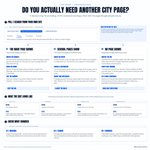
Before you pay for another city page, check which URL Google already shows when someone searches for the job you want more of.
Open Search Console → Performance → Search results. Filter to a service + city query, then click Pages. I’d use the last 90 days to start, and check a few close variations before making a call. “Drain cleaning in [city]” and “clogged drain [city]” can both tell you something useful.
What you do next depends on what you find.
1. The right page is already showing up.
Say your drain cleaning page is getting impressions for that city. Open the page on your phone and see what a customer sees. Can they tell you actually do their job in their town? Is there a real nearby job photo? Does the call button take them to the right line?
That’s where I’d spend the first hour. You have a page Google already knows about. Give the person who lands there enough information to call.
2. A few URLs show up for the same searches.
This happens when you have a homepage, a service page, and a city page, and all 3 try to answer the same question. But seeing 3 URLs in the report doesn’t prove they’re fighting. Open them. If the city page explains coverage and the drain page helps someone with a backed-up line, both have a job. Link them accordingly. If 2 pages really do the same thing, pick the stronger one and redirect the redundant URL to it.
3. You’re not seeing impressions.
Check URL Inspection on the page you expected to show. Then look at related searches and ask dispatch which jobs you actually get in that area. A blank query row alone doesn’t tell you there’s no demand. I’d build a new page only if there’s a distinct customer need, you can actually serve the area, and you have something useful and specific to put on it.
Once you make the change, write down the date and the URL. Check the same query group over comparable periods. If you can tie calls back to the landing page, ask dispatch how many were jobs you wanted. That last part is how you decide whether the next city page is worth paying for.
61
If your plumbing shop closes for Thanksgiving but a tech is still on call, tell customers which calls you can actually take.
Set Special hours in Google, then check the website and voicemail. “Call for emergencies” only helps if someone can take the call.
1
27
If a contractor's ad leads drop right after an edit, I'd look in Google Ads → Change history before touching the budget.
Find the exact change and which campaign it hit. If untouched campaigns dropped too, the edit might not explain the whole dip.
21
A contractor's Google clicks are up. What if more people are simply searching for the company by name?
In an SEO report, I'd separate those clicks from people looking for a service. Here's how I'd check both in Search Console.
4
1
38
Now look at the non-branded searches and the pages that earned those clicks. More clicks for “water heater repair” going to your service page tell you something different from more clicks to your homepage for your name.
1
5