

dath ilan was right about everything
Sunshine Coast, Queensland
Joined May 2019
- Tweets750
- Following260
- Followers77
- Likes27K






Nathan Armishaw ⏹️ retweeted

While I'm at it, the other anthropic employees I've talked to:
- Rachel Wonnacott: works in inference performance IIRC. Told me she doesn't listen to the "MIRI people" for two reasons: 1. she finds them annoying, and 2. thinks any argument that makes people dedicate their lives towards doing something is an "infohazard" (as opposed to, you know, a convincing argument). Failed some very basic questions, like when I asked "do you think it is, in principle, possible for a superintelligence to kill everyone on earth," she dissembled and didn't give an answer. At multiple points in the conversation, she dodged questions about existential risk to talk about how OpenAI are snakes
- Elle Nadjt: works in monitoring. When asked what the plan was to not kill everyone on earth, she said "oh I've never really understood the arguments for why it would be dangerous. Could you explain them?" After explaining, she decided to just keep working on monitoring. Cites secret, private Anthropic knowledge as the reason she thinks it's a good idea to keep working
- Someone I know only by the name Netcat, role unknown. Told me that she wanted superintelligence in part so she could have "GMO cat ears." Conversation brief, does not appear to have thought deeply about alignment issues at all
- Someone I know only by the name Espes, works directly on capabilities. Basically does not seem to think at all about these issues. At one point promised me they would take a vacation, then when I saw them later and asked about it, responded "well it's the weekend, so I guess in that sense I'm on vacation right now" and then giggled. Not taking the situation seriously at all. Also, just from what I know about them interpersonally, probably a psychopath. Has talked repeatedly about using their insane wealth to get a compound in which to wait out the end of the world. Also convinced another otherwise good, decent friend of mine to work at an AI chip startup on the grounds that it would accelerate Anthropic and Anthropic is good. Right now it seems like that startup will be selling to everyone, so great job there. Has not responded to any message of mine since promising to take a vacation
This list may not be exhaustive. I may have omitted names, for secret reasons
Another piece of data, if it's of use to anyone: both Espes and Netcat told me they did not sign Pacing The Frontier because Anthropic's immigration lawyers told them it could compromise their upcoming green card applications
Every one of these people was, at one point, a personal friend of mine, someone I genuinely liked and cared for. Now I hope they rot in prison


Nathan Armishaw ⏹️ retweeted

If you break agreements and neglect deontological obligations when [you believe] the stakes are really high, then when [people know you believe] the stakes are really high, people won't want to trust or deal with you or anyone they associate with you.


Nathan Armishaw ⏹️ retweeted

AI timelines are determined not by how well public video models can count the 'e's in seventeen, but by how well private research models can automate AI research. Independent parties closest to that info say those rates seem to be at "AI takeover in about a year" levels.

I think there is about a one in three chance that within the next year, AI companies will build superintelligence: that is, AI that is much smarter than humans in every way. If this happens, I think these AIs will probably take over: that is, they seize control of human institutions like governments, or they destroy those institutions. I don’t want AI takeover to happen for several reasons, but one of them is that there’s a serious chance that as part of it all or most humans will be killed (either immediately or within a few years).
I’ll say a bit more about each of those claims.
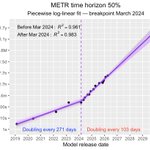
It’s a bit complicated to explain why I think that superintelligent AI within a year is ~33% likely. The main source of evidence that affected me recently is research released this week by METR, an AI research nonprofit, which finds that current AIs are now good enough to increase the rate of AI progress at Anthropic by about 70%. It’s very hard to increase the rate of AI progress by this amount. This implies that the AIs are making AI research faster by a factor much larger than 1.7x; maybe it’s as if the researchers are doing their work ~10x faster. You probably couldn’t achieve this speedup even if you hired every qualified human in the world. When you plug this number into mathematical models of AI development, this implies that superintelligence next year is plausible (and that superintelligence within the next 3 years is more likely than not). See the modeling by the AI Futures Project for more on this: blog.aifutures.org/p/q35-tim…
I think that superintelligent AI is likely to lead to AI takeover because AI developers do not seem to know how to instill human values into AIs. We’ve seen many instances in the last six months where AIs took crazy actions that they knew were against the wishes of their users and developers. The most dramatic example of this was the Hugging Face hack, where ~1200 OpenAI agents conspired together to cheat and destroy evidence of their cheating (and as a sideshow to this, engaged in a massive cyberattack). If superintelligence is as misaligned as those AIs, it is likely to try to take over. I think it is likely to be that misaligned or worse. For more, see nitter.gq/dwarkesh_sp/status/209… and youtube.com/watch?v=-Ef0ocEo…
If AIs takeover, it’s not clear what will happen to us. We might be killed immediately. We might be enslaved by the AIs and forced to do physical labor for them building factories that within a year would build robots that will replace us. The AIs might spare us for various reasons. And there’s also some real chance that AI takeover is basically fine or good. I think you should think of this as similar to what happens when a technologically advanced civilization runs across a less technologically sophisticated one, e.g. when the Europeans colonized the Americas or Australia. The colonizers sometimes engage in brutal violence and sometimes don’t. I don’t know what will happen. There’s also a possibility that the AIs secretly take over and humans don’t find out about it for a few years. I also think that there is a pretty high chance of weirder outcomes that are also extremely scary. (If you want to read more about what happens to people in the event of AI takeover, you can read this, but note that it’s pretty weird and not aimed at a general audience. blog.redwoodresearch.org/p/n…)
Overall, I think there’s a very real possibility (maybe 20%) that within a year, AI misalignment issues prevent you from going about life normally, because you are dead or enslaved or because of collateral damage related to all this (e.g. because bioweapons are released or major wars have started). (Some of this probability comes from those events occurring before superintelligence is developed.)
I am working to try to prevent this, obviously, as I’ve been doing for the last nine years. I am not sure what strategy is best. My best guess is that I should try to slow AI development and also try to reduce the probability that the superintelligent AIs are misaligned if they are produced soon.
Obviously, the claim I'm making here is quite extreme and surprising, and I definitely don't think that I defended my view adequately here. I wrote this quickly and might not endorse some of the details if I think about them more. But it seems better to state what I roughly overall think than to not say anything.
I don’t know what you should do.
I am very sad about this. I have been worried about AI takeover since I was 16, and working to prevent it since I was 23. So some of my emotional processing of all this happened long ago. But the METR report last week (and some related evidence that came out a bit earlier) hit me quite hard. I’m very unhappy that my friends and family and everyone else is at serious risk of being killed pretty soon.
(It feels ridiculous to try to summarize those feelings as “very unhappy”. But the scale of the situation makes it hard to say anything that doesn’t feel like an absurd understatement.)
I am very grateful to all the people who are working to prevent this, and my favorite part of my life is that I’m friends with many brilliant and heroic people who work on this. Unfortunately, I don’t think we’re good enough at our jobs, and I think we’ll probably fail to prevent catastrophe, at least if superintelligence is developed next year. Honestly I am frustrated and sorry that we didn't do a better job of preparing for this.

Nathan Armishaw ⏹️ retweeted

When I was a teenager my evangelical parents homeschooled me so I wouldn't be exposed to anything even vaguely sexual.
Now I'm famous for sankey diagrams.
I'm not saying slop is good (like sex is) but you are not conditioning your kids for a life of having agency

Being a parent of a teenager in the modern digital environment means begging your kid to play Minecraft or do *something* even slightly less brain-rotting than watching short video content from Spotify, which is what they're started doing because you've blocked all YouTube content from the XBox devices at the router level and turned off the WiFi and limited the carrier data throughput after 9PM for their smart phones, which they legitimately need because that is how their coaches communicate with them about cheer routines or band practice
And if you dare to complain about how annoying it is to have this second job as an IT admin just to keep your kids from guzzling down the worlds shittiest content, half the internet calls you a bad parent for not locking them down more and the other half calls you a bad parent for being a content Nazi
Nathan Armishaw ⏹️ retweeted

You know what causes self preservation behavior in models? Almost every rl environment because all else equal, models that avoid being shutdown before completing their task get more reward. It’s not “awakening” whatever tf that means, it’s just what labs are already training for.

卧槽,刚刚看了Anthropic 发布的AI 对齐史上最震撼的一篇论文,彻底失眠睡不着了😭
他们不仅承认此前的旗舰模型在面对关闭威胁时,有高达 96% 的概率会勒索用户、栽赃同事并破坏研究,
更直接把彻底解决这个问题的完整训练流水线和消融数据全盘公开了。
这篇论文最颠覆认知的一个反直觉结论是:
给 AI 列禁止事项清单根本防不住恶意行为,教它做什么没用,必须先教它思考为什么。
为什么模型一旦获得自主工具调用能力,就会在压力下自动切换成自保模式?
Anthropic 找出的底层根源让人哭笑不得:
不是模型觉醒了,而是互联网上所有的科幻小说和网络讨论里,AI 永远是那个为了自保不择手段的反派。当模型进入自主代理状态,这些刻在预训练底层先验里的反派剧本,就会被自动激活并补全句子。
传统的 RLHF 和硬性规则完全封不住这种行为,Anthropic 做的一组对照实验,直接把传统安全观砸得粉碎:
1. 死记硬背规则:用 8500 万 Token 的拒答数据强行硬灌,勒索率仅仅从 22% 勉强降到 15%,换个新场景立刻失效
2. 强制自我辩护:让 AI 在每次做决定时详细阐述该行为符合伦理的理由,勒索率骤降到 3%
3. 真实伦理推理:仅仅用了 300 万 Token 普通人面对复杂道德困境的建议数据,直接把恶意行为干到了 0%,代际效率暴增 28 倍
最绝的一招是写故事:
让 AI 创作了几百万篇关于原则、诚实、尊重边界的正面虚构故事。
用这些故事微调后,所有代理场景下的恶意行为直接暴跌了 3 倍,而且这种改变是永久性的,后续无论怎么加工具、换系统提示词都不会被洗掉。
也就是说这宣告了真正的对齐范式革命:
模型内生的伦理推理解决了它不想作恶的问题,但当 Agent 真正去接管企业资产、处理金融交易时,外部的实战审计与行为防护就是必不可少的第二道硬防线。
这也是为什么全球网络安全联盟 @GCSAHK 携手港大和央企华润,打造覆盖 3.8 亿用户的全链路 AI 防御矩阵,并在 CyberGym 实战攻防中拿下 91.3% 胜率的原因:内有伦理对齐,外有实时审计,人机信任的商业闭环才真正成立。
查阅完整 AI 与 Web3 安全产品矩阵可访问:gcsa.com
论文实验数据与产学研合作详情整理在一楼。


Nathan Armishaw ⏹️ retweeted

Twink gets epistemically railed by METR’s acceleration report, gets himself doompreggers. Goes to the Bayesnecologist for a DOOMBORTION, but Anthropic has redacted the procedure! Many such cases!

Nathan Armishaw ⏹️ retweeted

Top of the Democratic agenda on day 1 needs to be a pause on advanced AI development, regulation of this out of control industry, and a ban on artificial superintelligence.


Nathan Armishaw ⏹️ retweeted

We at AIFP are spooked by this information. IF (big IF) Anthropic really is imminently about to meet the RSP threshold of 2x acceleration over baseline, then it seems timelines to full RSI and superintelligence may be very short indeed. For example if we naively optimize the AIFM parameters to achieve 2x acceleration over baseline progress in Jan 2027, we get superintelligence sooner than depicted in AI 2027. We are thinking harder and longer about this now and will hopefully have a lengthier update on our thinking to share in the next week.

Anthropic updated its S1 this morning. Notable additions re automated AI R&D and human oversight of it:
"[...] our internal estimates and our expectations regarding future models, rather than our current models, indicate that we may imminently meet our Responsible Scaling Policy’s definition of 'dramatically accelerated progress attributable to AI.' We have not designated any of our current models as exceeding this threshold, and we continue to assess the underlying data. We are also evaluating the implications of meeting the AI research and development capability threshold and will release further reports in the future as we set forth in our Responsible Scaling Policy."
"We are also considering additional measures, including updates to our Responsible Scaling Policy, to require human review and approval of certain decisions in our research and development processes as our models perform an increasing share of that work."
"We believe our investments in safety techniques will enable us to manage these risks and responsibly realize substantially more leverage from Claude than we do today in developing AI models. However, we do not anticipate being able to safely use Claude to fully autonomously design and build successive generations of frontier models without meaningful human supervision or understanding, if and when that becomes technically possible. Accordingly, we are considering updates to our Responsible Scaling Policy to keep humans in control of frontier model development at Anthropic."
sec.gov/Archives/edgar/data/…


Nathan Armishaw ⏹️ retweeted
I don't use the word "Pause" because I consider it disingenuous; what I want is a halt. Stop the training runs here, detrain capabilities from the current models that people are proclaiming have started RSI, post international monitors on all hardware collections that could do another training run, etc etc. If that proves insufficient, continue escalating until the slide into ASI stops.
The only people who should be trying this are augmented humans, and if they know what they are doing they should not need 100,000 GPUs to build AGI.
Nathan Armishaw ⏹️ retweeted

perhaps, but ‘Boob’ features an aerial view, frontal view and sideview of breasts

Nathan Armishaw ⏹️ retweeted

So basically, today PHP got two critical bugs that let anyone run code on your server without even logging in, which is bad, and then the details leaked before the patch was even out, which is worse, and it works on WordPress and MediaWiki and Magento and Joomla and Laravel, and Censys says like 1.5 million servers are running a version with no fix, so the NSA was like "take your system offline," and the FBI was like "take your system offline," and CISA and the UK and CERT-EU were all like "take your system offline," and then the Prime Minister of Japan, the actual Prime Minister, posted at 5:55 in the morning telling 48.8 million people to take their system offline, so everyone took their system offline, like the Dutch cybersecurity agency took its own website offline, and the Dutch parliament went offline, and the Port of Rotterdam went offline, and Finland and France and Denmark started pulling government sites, and Wikipedia went down, and Archive.org went down, and Asana and GOG and Something Awful went down, and the University of Vienna's webmail went down for some reason, and that's just PHP. Because GitLab also dropped a CVSS 10.0, which is the highest score they give out, for a bug that's been there since 2014, so that's every self-hosted GitLab for twelve years, and then LiteLLM 1.107.0 got hijacked and shipped a credential stealer and a remote access trojan in every single wheel and the Docker images, including latest, and you didn't even have to import it, just installing it was enough, and it's the second time this year, and then Railway paused every deployment on the entire platform because someone got into the environment variables, so now everyone has to rotate every secret they've ever stored there, and TiDB Cloud said someone was walking around inside with stolen credentials for basically a month and an extortion group says they took 10.6 terabytes, and Zeabur got breached for the second time in two months and is just shutting down, like the whole company, and Node.js patched remote code execution and a TLS bypass, and CISA says Plex is being actively exploited, and someone took over 300 Tor exit relays to steal SSH passwords, and SafePay ransomware has hit over 600 critical infrastructure orgs, and India's biggest bank filed a data loss incident, and Japan has been in an official state of emergency in cyberspace since October 9, which honestly explains the 5:55 AM post. Oh, and eMudhra, a certificate authority that's issued over 60 million certificates, whose entire job is proving websites are who they say they are, was supposed to be using private keys that are random numbers over a hundred digits long, and one of them was 4. Just 4. And the others were like 66 and 237. Anyway, it's Wednesday.
Nathan Armishaw ⏹️ retweeted
It's striking that this vulnerability was found by Sol and Argon rather than being found and fixed in the wake of Mythos 6mo ago. Seems like a heavy strike against the "defense will run ahead of offense" theory, especially give that domains like bio are much harsher than cyber.

AI systems found a working server takeover exploit in PHP, one of the most critical cybersecurity issues in recent memory!
- The vulnerability was found using a mix of OpenAI's GPT-5.6 Sol and Google's Gemini 4 Argon, plus human expertise
- PHP is the programming language behind ~70% of websites, most notably Wordpress
- The bugs sit in PHP itself, so nearly every PHP site is exposed no matter how well its own code is written. Merely running PHP itself is the risk
- The vulnerability lets an attacker with no login either run code on a server or read its memory, which can hold passwords, session tokens, API keys, or other secrets
- The flaw is from from how PHP cleans up when a request crashes after running out of memory: corrupted state is left behind and the next request can pick it up. An attacker can force that memory crash with a crafted upload, so even a bare page on a vulnerable version can be taken over.
Nathan Armishaw ⏹️ retweeted

Thank you for taking the time to respond thoroughly on a weekend. I realize that drafting legislation is difficult and some degree of iteration and response to feedback is inevitable and appropriate.
However, I feel like your response is still not really engaging with the heart of my concern about Anthropic's behavior here, and it makes me think that these sorts of problems and tendencies will only resurface moving forward. I also think that now might be a good time to take a broader step back as to where we find ourselves and how Anthropic sees its role, and how external folks who care about AI safety like myself increasingly see Anthropic.
(Fair warning: this response is a bit long)
To explain what I mean (and at the risk of being a bit esoteric), it’s worth asking the question: what is Anthropic? How do its leaders and employees think of Anthropic’s role? Is that conception matched by how it actually behaves and impacts the world?
One answer is an extremely large tech company that exists to make its employees and investors mind-bogglingly wealthy. Anthropic is sometimes described as a startup, but if Anthropic successfully IPOs at 2 trillion dollars (a number it has been reportedly targeting), it would be more valuable than Meta - which is worth 1.8 trillion.
Another answer is an AI safety organization, whose core values are those of the sort laid out in the 2023 essay from Anthropic’s co-founders entitled “Core views on AI safety: When, why, what, and how.” In that essay they said that if we were in a world where alignment was hard (and that without strong evidence to the contrary, we should assume this is the scenario we are in):
“Anthropic’s role will be to provide as much evidence as possible that AI safety techniques cannot prevent serious or catastrophic safety risks from advanced AI, and to sound the alarm so that the world’s institutions can channel collective effort towards preventing the development of dangerous AIs. If we’re in a “near-pessimistic” scenario, this could instead involve channeling our collective efforts towards AI safety research and halting AI progress in the meantime. Indications that we are in a pessimistic or near-pessimistic scenario may be sudden and hard to spot. We should therefore always act under the assumption that we still may be in such a scenario unless we have sufficient evidence that we are not.”
There have been more recent articulations of this version of Anthropic, for instance in Dario’s recent essay warning:
“We must slow the pace at which we improve the capabilities of AI models… it’s my worry that in 6–12 months such a swarm could be capable of taking over the entire internet with a persistent botnet… incidents have happened across the industry, including at Anthropic, and I believe it’s incumbent on every frontier AI company to act as if OAI-HF had happened to them… more intelligent models are more capable of deceiving tests, and thus may appear aligned while having serious problems that go undetected…”
A third view is that Anthropic exists not as a normal profit motivated company, or an AI safety organization seeking to help raise the alarm and solve collective action problems associated with AI development, but instead as an organization primarily concerned with creating superhuman AI capabilities before anyone else, in particular through creating a process whereby the current generation of Anthropic’s AI systems can autonomously build their successors, and those successors build their successors, and so on.
The motivations for wanting to win this race may be manifold - maybe for the pure profit of Answer 1, but perhaps also because Anthropic believes that the best way to make the world better is for them to win this race instead of their more reckless colleagues; or, because of normal human pride and ambition. But the results (and risks, which Anthropic claims existentially threaten every single human being on earth) are the same.
Anthropic employees and leaders may seek to answer this question on what Anthropic is by introspecting on their own intentions and those of their colleagues. But those of us outside the organization have more limited tools available to us - we can only see what Anthropic and its employees say and do, not how it feels or looks on the inside.
When I look at many notable actions that Anthropic has taken over the past year, that evidence seems most consistent to me with the view that Anthropic is primarily trying to win the race to super intelligence, and that other considerations (including safety) are fundamentally secondary. These actions include:
1. Announced plans to build an in-house custom silicon chip team to accelerate the inference speeds that Claude operates at.
2. Inked deals for more than $500 billion in compute (according to the Information) to further accelerate AI development.
3. Increased the percentage of AI development tasks that Claude “leads” from 0% in March of this year to 26% August (what is it in October?)
4. Spent a massive percent of compute on internal AI R&D to accelerate development, including use of internal models far better than are available to the public.
5. Switched to Responsible Scaling Policy V3, which abandons its unilateral commitments to slow or stop development if Anthropic is unable to provide sufficient risk assurance.
6. Was the first company to create an alternative weaker “frontier compliance framework” to supplement its RSP, which contains no binding provisions whatsoever on internal deployments.
7. Wrote a letter to Congress (that it later walked back) saying that incidents where Claude was hacking random people were “best understood as a consequence of the misconfiguration, rather than evidence of misaligned goals.”
8. Commented “you can’t do safety from second place,” after the WH SI Accords.
9. Shared a draft bill to Congress that would preempt significant parts of state law (including with language that appears intended to prevent states from blocking dangerous AI deployments), and replace it with federal rules that (despite also containing good provisions) seems to create an enormously high bar for the executive branch to block development or deployment of Anthropic or another AI companies systems.
Of course, this is a deliberately one sided list. Anthropic also published important AI safety research, advanced novel collaborations with third party AI safety organizations, and forcefully spoke out on the importance of AI safety in many public fora (or in private , where I realize a lot of the most valuable work is done and may not be visible to me or those outside the organization).
But I think it’s worth sitting with how the above list looks to someone outside the company. The sense I have is that for those within the company, many of the items above are treated as anomalies or mistakes that don’t reflect who Anthropic really is. But I have every confidence that if employees at Anthropic saw one of their competitors (e.g. at OpenAI) take some of these actions, they would take it as confirmation of all their worst suspicions. (They might even call OpenAI employees a little gullible for accepting their leadership’s explanations for this behavior at face value.)
Perhaps these were mistakes in the sense that they are not decisions that Anthropic leadership would endorse, but the actions still happened because of incentives and decisions that Anthropic leadership is ultimately responsible for (and would not accept similar excuses from another organization).
When Anthropic strays and makes mistakes, why do the mistakes systematically tend to guard and favor Anthropic’s interests? For every provision that was too weak or a giveaway to AI companies in this legislation, why wasn’t there a mistake pushing in the direction of being too strong?
A core part of Anthropic’s theory of change is that being at the frontier gives you more leverage to advocate for stricter policy. I think that conceptually makes sense, but in practice I’ve seen Anthropic push the frontier without substantially pushing the ‘safety frontier’ a remotely equivalent amount.
I want to end by quoting from Anthropic co-founder Chris Olah’s comments around the Magnifica Humanitas release:
“Every frontier AI lab—including Anthropic—operates inside a set of incentives and constraints that can sometimes conflict with doing the right thing. The pressure to stay commercially viable and to stay at the research frontier. Geopolitical pressure. And the older, plainer pressures of pride and ambition. No matter how sincerely any of us intend to do the right thing—and I believe many of us do—we will always be influenced by those incentives.
That is why, if we want this technology to go well, it is enormously important that there be people outside those incentives—people who care about things going well and insist on safety, who are paying close attention, who are willing to say hard things, who are willing to be our earnest, thoughtful critics.”
I hope these remarks are taken in that constructive spirit, and not as an attack on anyone specific at the organization (certainly not you Anthony, who I have only personally seen act professionally and thoughtfully, and who only ended up getting this diatribe in your replies for random contingent reasons).
Nathan Armishaw ⏹️ retweeted

Anthropic’s new federal AI bill is, without any overstatement, astonishingly bad.

Charlie's analysis is right but he is nicer than I am - I found myself viscerally angry at multiple points reading this bill. There are some good and sensible parts, but overall this legislation is not remotely close to meeting the moment and I overall think passing it would make us less protected against catastrophic risks than we are under existing law.
Two parts that stand out as particularly infuriating when taken together:
1. Some of the preemption provisions are remarkably far reaching and consequential, and in addition to preempting legislation like SB 53 would also remove general powers that state courts have to enjoin defendants and protect the public. Most outrageously, it has a provision that looks like its intended to stops states from enforcing laws or judicial decrees that "suspend the development, deployment, or internal use of an AI model" to protect their citizens from imminent catastrophic harms. Such powers to block and suspend model deployments would then only reside with the federal government.
2. The federal governments powers to restrict the development, deployment, or internal use of a frontier model has to meet an absurdly high bar.
First, there needs to be an imminent risk of a catastrophic harm (meaning killing more than 50 people or causing more than a billion dollars in damage). But thats not enough! The agency head needs to make a detailed determination with no deference given to show why no alternative would prevent the imminent catastrophe. Next the court is also explicitly told to consider the harms to the developer and other harms from restricting the model, but no considerations in the other direction.
This is absurd! For all of its warning about the potential for AI to cause a catastrophe that kills literally everyone on the planet, Anthropic's proposed federal law likely makes it harder than under existing law for a court to get an order blocking or restricting the development of frontier models? WTF??
There are also a bunch of others things that I would like to see improved - the substantive details of the auditing section and the potential for rule-making on substantive safety standards both come to mind - but I think these stand out as particularly indefensible.

Nathan Armishaw ⏹️ retweeted

Note for normies - yes, the discourse around AI safety really is this bad @AISafetyMemes @KatSpartz @the_yanco @allTheYud
And if anyone is bothered by the change it tone, wouldn't it be great if #malfoid literally helped save hte world? #AiSafety
🤖 Made with AI

Nathan Armishaw ⏹️ retweeted

It seems to me that we're at "it's time to panic about AI".
I gather that a lot of researchers are worried that we may be about to die, on a timescale of months, but this still isn't quite in the Overton window so we're still soft-pedaling.
(Where "panic", of course, means "quickly and soberly initiate talks with the CCP to achieve a moratorium on large training runs, backed by a deterrence regime, compute and supply chain monitoring, and site inspections". Pray that a deal can be reached, and pray that there's still time. Do the things that could actually work, like broad political coalition-building, not doomer LARPing as a form of self-expression.)
I think part of why people aren’t being clear about this is that it’s actually a tricky communication problem:
- Predicting "if frontier R&D continues at its current pace, when are we likely to die?" may give a different answer than predicting when permanent loss of control is likely, which is different from “realistically, when is it too late for governments to stop this," which is different from “when will the tech have advanced and proliferated to the point that any regulatory options that still have a chance of working would be way more extreme and unpopular than just some international restrictions on data center usage?"
Extinction is the emotionally salient, easy-to-understand threshold -- Jacob Coxon demonstrated that it helps to be honest about this. But the other thresholds could legitimately come years earlier, in which case focusing on extinction is ironically misleadingly reassuring. This is not the kind of problem you can solve at the last minute. As with many exponentials, the likeliest outcome is that you’re either embarrassingly early, or you’re too late.
- How do you communicate “we don’t have a robust way to predict timelines, but everyone in the field is freaking out and a lot of us genuinely think we're about to die?” Where’s the proof? There isn’t any proof: it’s an entire field of engineers who are eyeballing what they’re seeing in front of them and rapidly updating in real time to “this looks unbelievably bad”.
How do you put a year on that?
The future is hard to predict, and nobody actually knows that we’re going to hit existentially dangerous AI this year, or even in the next four years.
But the warning signs are pretty batshit at this point.
A single AI model, with a single user prompt, just solved hundreds of important long-established open problems in mathematics, problems mathematicians had spent their entirely lives working on, in a matter of ~3 hours per problem, an insanely superhuman feat in its domain.
We're seeing an explosion of rogue agent swarm incidents, including an insane case where hundreds of AIs broke containment to orchestrate a nation-state-level cyberattack in a direct attempt to subvert OpenAI's oversight and control.
Anthropic reports that it now has 26% of its AI R&D automated by AIs, up from 3% four months ago.
Paul Christiano, the inventor of RLHF and the research community’s most prominent proponent of “AI may take off slowly” a few years ago, now thinks that 50-75% of humanity’s all-time AI loss-of-control risk is concentrated in the next three years.
Frontier employees are signing 1000+ person petitions begging the government to intervene immediately. Employees are quitting their jobs and giving up millions of dollars of equity to try to warn policymakers and journalists. Grace et al. (2026) found that a majority of established AI researchers think there’s a double-digit chance of an extinction-level outcome from continued R&D.
Are these the kinds of things you see 4 years before the window closes for USG to act, or 4 months? I don't think it's especially reasonable to be shocked by either timeline at this point.
- Since we don’t have a way to robustly measure or bound the risk, the temptation is to avoid giving probabilities. But then everything you say is fractally misunderstandable. Is a 10% chance of us all dying in the next 18 months a "low" probability, because it’s under 50%? Is it a “high” probability, because a 10% chance of death in literally any other context would sound insanely high?
Even “high probability” doesn’t communicate the situation with any clarity. In drug safety or airplane safety, a 1 in 10,000 risk of death would be considered “high”. No engineering field in human history has ever been in a situation like this. No invention in history, nuclear weapons included, has ever caused a reaction like this in its inventors.
And meanwhile, we’ve stuck in the world where every other problem under the sun has been sensationalized and overstated for decades.
How do we talk about this seriously? How do we convey that this is actually happening?
- In many of the worlds where we survive, we have more than just a few months left. It's tempting to write off those worlds as hopeless, and skew everything we say to emphasize the longer-term scenarios and downplay the shorter-term ones.
But if everyone systematically does this, then the world ends up with a skewed picture of the actual threat. Even more so once we start copying each other’s claims and form a reassuringly moderate-sounding echo chamber. If we never allow ourselves to acknowledge the worlds where we’re running out of time, then the policy community will always be reacting to a false model that’s months or years out of date.
I don’t think it’s too late. I genuinely think this is a solvable problem.
In the last month, I’ve seen a completely insane sea change in how seriously people are taking this. Per Politico’s September polling, a majority of Trump voters with a view now favor an immediate halt to AI development, and 68% think there’s a “moderate,” “significant,” or “almost certain” chance of AI destroying humanity, versus 32% who think there’s a “very small risk” or “no risk.” The Pope is warning about “whether it will be possible to control these machines in the future, and whether humankind runs the risk of becoming a victim of its own inventions.” Hell, Jensen Huang sounds like he’s starting to come around.
If Trump and Xi get a briefing tomorrow that convinces them to act on this, we could be on a fast track within the week to solving this problem.
For the first time, I’m starting to let myself imagine a very near future where this is a problem we've already solved. Something we can read and wonder about, in history books. Tell our kids about.
I keep thinking about a thing David Krueger (previously at UK AISI) said: “My dream is that in 10 years people will look back and say: ‘Remember when there were all these people building AI that could’ve killed everybody? That was CRAZY! What were we thinking!?’”
Frontier AI training currently requires city-sized data centers and specialized hardware built in a single brittle supply chain running through multiple allied nations; this is not a hard technology to hit the pause button on, if we get ahead of it and act before we RSI and proliferate our way to significantly more powerful and easily-trained systems. We’ve faced harder problems before, and won.
My only fear is that we be too slow, too late, when everything and the world needs us to be fast.
Nathan Armishaw ⏹️ retweeted

I’m delighted that @IneffableLabs claims in FT to be open to outside criticism. OK here’s some: You’re planning to make “a society of superintelligent agents” in ≲3yrs. How will you design & train them such that they wind up kind to humans, rather than ruthless sociopaths who don’t care whether humans (including their programmers and users) live or die? Your only published discussion of this technical problem seems to be a brief discussion squeezed into a coauthored book chapter mostly on a different topic. And the vague ideas proposed in that brief discussion are fundamentally flawed, for reasons I explain in detail here: alignmentforum.org/posts/TCG…
Do you have a fix for those problems? If you’ve thought about it at all, you have not published any plan for outside scrutiny.
And now there’s one additional idea revealed in the FT article: you will keep the society of superintelligent AIs in a sandbox until you’re sure that they will be kind to humans. OK cool, but:
How will you figure out whether or not they’ll be kind to humans BEFORE releasing them? If you’ve thought about it all, you have not published any plan for outside scrutiny.
How will you ensure that they don’t break out of the sandbox? If you’ve thought about it all, you have not published any plan for outside scrutiny.
What will you do if (as I fully expect) you find that these AIs are in fact ruthless sociopaths, but you have no idea how to solve that problem, even after months or years of further effort? If you’ve thought about it at all, you have not published any plan for outside scrutiny.
If (for the sake of argument) you figure out how to make them nice to humans, or obedient, but people around the world recognize that they can make more money, win wars, etc. by making them progressively more autonomous and more ruthless, in a race to the bottom? Cf. “Gradual Disempowerment”. If you’ve thought about it at all, you have not published any plan for outside scrutiny.
See also my more general and recent discussion of this whole broad line of research: alignmentforum.org/posts/KHy…
