

Marine plankton ecology and global change
Buenos Aires
Joined November 2012
- Tweets770
- Following599
- Followers286
- Likes6.4K



BioGeoSCAPES has been launched! You're invited to read the Science Plan [doi.org/10.5281/zenodo.23465…] and join a webinar on Nov-10 for more info on how to participate! 🌎🌍🌏🖥️🧪🦠
biogeoscapes.org/
Understanding ocean metabolisms on a changing planet. Connecting microbial life, biogeochemical cycles, and models to understand the ocean today and predict its future.
Federico M. Ibarbalz retweeted

New in Ecology and Earth Systems from Rebecca Chmiel & @MakASaito: The potential of anthropogenic cobalt to perturb the natural biogeochemical cycle doi.org/10.1525/elementa.202…
Federico M. Ibarbalz retweeted

We just published the 2026 State of the Climate Report. Of 16 planetary vital signs spanning greenhouse gas concentrations, temperatures, the oceans, ice, energy balance, and wildfire, 7 (44%) are currently at record extremes. Read report here: doi.org/10.1093/biosci/biag1…


Federico M. Ibarbalz retweeted

El Niño just arrived in June 2026, but one of its effects on ocean ecosystems is already visible: lower chlorophyll.
This green pigment is found in phytoplankton, which form the base of the marine food web.

ALT Map showing chlorophyll concentrations in the Pacific Ocean during an El Niño in June 2026. Green areas indicate more chlorophyll and blue areas indicate less. There is a band of green along the equator, except off the eastern coast of Australia. An arrow points to this area of low chlorophyll. Other than the equator and along coastlines, the ocean is mostly shown in blue.


Humans are slowly mapping the microbial genetic seascape of the upper ocean, allowing exploration of e.g. ocean as a single meta-organism, “ocean metabolism,” “conveyor-belt” dynamics, etc. Congrats to the authors and the ACE project team. 🌊🧬nature.com/articles/s41467-0…

"Cells - The Illustrated Story of Life" with a preface by Eric Karsenti, now published by "The Experiment" : theexperimentpublishing.com/…

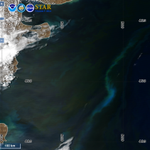
True color from Nov-10th: it was still too early in spring for such bright waters (coccolithophores) to appear over the Patagonian shelf (SW South Atlantic). October already had shown the highest PIC on record for that month.

Did you know this new open access journal? link.springer.com/journal/44…
Great team of editors, and currently waiving publication costs.
In one of its initial Perspectives, "The southern gap in ocean microbiome science", Sarmento et al warn about parachute science in the field

Live transmission from a submarine canyon of the Patagonian shelf/slope system in Argentina youtube.com/watch?v=unK8z38G…
Federico M. Ibarbalz retweeted

⏳ Less than 2 weeks left! Applications for the SOLAS Summer School 2026 close on 31 August 2025!
📍 Tamandaré, Brazil
📅 9-27 March 2026
Apply now: solas-int.org/events/solas-e…

Federico M. Ibarbalz retweeted

The recent Schmidt Ocean Institute #TaludContinental_IV expedition in the #MarDelPlataCanyon may have concluded, but the excitement and engagement linger on. Check out our latest story: youtu.be/eTLt6m2f3rk?feature…
I accidentally discovered that by pressing the keys 'd', 'w', 'm' or 'y' you switch day-week-month-year view in Google Calendar... You're welcome!
1/2 --- In 2024, we organized several activities around the visit of Dr. Lisa Levin xitter.cf/ecofedei/status/182876…

Dr Lisa Levin's visit...
Step1: open course on deep ocean and climate change
Step2: scientific workshop with local experts
Step3: what should it be? ...
#DeepOcean #ClimateChange #Conservation #ResourceManagement #Argentina


2/2 --- Those meetings triggered the writing of a Policy Brief that you can read here
The Argentine deep sea: a new strategic frontier for sustainable development
dx.doi.org/10.47193/mafis.38…
Ocean Microbiology | The journal’s first articles have now been published and are live on the website omjournal.biomedcentral.com/