

we turn complex technical analysis into reports you can actually trade with. for day traders, prop firm traders, and algo traders.
Miami, FL
Joined June 2023
- Tweets26.8K
- Following269
- Followers23.2K
- Likes38.3K




if $ES breaks yesterday's high on a Friday, here's how it usually closes:
over the last 6 months, on Fridays:
→ broke yesterday's high, closed green: 88%
→ broke yesterday's low, closed red: 83%
15 of the last 17 Fridays that broke yesterday's high on $ES closed green.
takeaway:
breaks yesterday's high on a Friday = favor continuation higher into the close
breaks yesterday's low on a Friday = favor continuation lower into the close


edgeful retweeted
if you trade fair value gaps on $NQ, this stat is hard to ignore…
over the last 6 months, 15min FVGs bigger than 0.25%:
→ bullish FVGs left unmitigated: 88.24%
→ bearish FVGs left unmitigated: 82.35%
15 of the last 17 big bullish 15min FVGs on $NQ held without a close through.
takeaway:
big 15min FVG = look for continuation off the gap, not a close back through it

when the $NQ 15min ORB high formed first, the low broke first 64%, and when the low formed first, the high broke first 72%:

Some useful NQ M15 ORB Data to look at:
On Thursdays, if the high forms first, the low breaks first 64% of the time. If the low forms first, the high breaks first 72% of the time.
Pair this with your setup for a higher probability trade.
1 year’s worth of data via @edgeful

+$374.50 scalping $NQ in London on Thursday, with the edgeful stat that 70% of Thursdays break both sides of the first hour:


edgeful retweeted
we asked edgeful AI what $NQ does after it breaks yesterday's high or low on a Thursday, here's what it said:
over the last 6 months in the NY session, on Thursdays:
→ broke yesterday's high, closed green: 87% of the time
→ broke yesterday's low, closed red: 92% of the time
takeaway:
breaks yesterday's high on a Thursday = look for continuation longs into the close, not a reversal
breaks yesterday's low on a Thursday = look for continuation shorts into the close, not a reversal
11 of the last 12 Thursdays that broke yesterday's low on $NQ closed red.

if you're taking profits right at the 15min ORB high on $NQ, look at this first…
over the last 6 months, on days that only broke the ORB high:
→ reached the 0.5 extension: 87.88%
→ reached the 0.8 extension: 75.76%
25 of the last 33 ORB-high-only days on $NQ reached the 0.8 extension.
takeaway:
ORB high breaks and the low holds = favor continuation to the 0.8 extension

when the 8:12–9:12 range on $NQ was under 100 points, 74% of days took both the high and the low:


your trading plan isn't supposed to make you comfortable. it's supposed to make you consistent. those two things feel very different in the moment and look very similar in the results.
$30,470 profit in 6 months with this fully automated $NQ IB algo… check it out:
it's the IB breakeven stop strategy inside the algo templates, over the last 6 months:
→ $30,470 net profit
→ 63.8% win rate
→ 2.46 profit factor
→ 58 trades
→ -$3,640 max drawdown
then on untouched holdout data:
→ 55.6% win rate
→ 2.43 profit factor
→ $4,350 out-of-sample profit
→ $483 average per trade
takeaway:
the holdout sample is only 9 trades, so don't read too much into any one number…
the win rate dipped (63.8% to 55.6%), but the profit factor held almost flat on data the optimizer never saw (2.46 to 2.43), and that's the part worth paying attention to.

want to try this $NQ IB algo yourself?
it's inside the edgeful algo templates:
edgeful.com/features/algos

edgeful retweeted
$38,540 profit in 6 months with this fully automated $GC IB algo… check it out:
it's the IB breakeven stop strategy inside the algo templates, over the last 6 months:
→ $38,540 net profit
→ 62.7% win rate
→ 2.39 profit factor
→ 75 trades
→ -$4,100 max drawdown
then on untouched holdout data:
→ 60.0% win rate
→ 2.21 profit factor
→ $7,460 out-of-sample profit
→ $497 average per trade
takeaway:
the holdout sample is only 15 trades, so don't read too much into any one number…
the win rate and profit factor dipped slightly (62.7% to 60.0%, 2.39 to 2.21), but the average trade held up on data the optimizer never saw ($514 to $497), and that's the part worth paying attention to.

ES & NQ Live Key Levels, IB and Orb Setups | October 23 With Mr Zinc and Andre xitter.cf/i/broadcasts/1RKZzBdQj…

the 3:00–3:15am London range on $NQ broke both sides on 81.33% of sessions over the last 5 years:

The first London breakout on $NQ is often a trap.
Testing the 3:00–3:15am ET range, I found that $NQ broke both sides on 81.33% of sessions over the past 5 years.
Here’s simple model to utilise the data:
- Mark the first 15-minute high and low
- Wait for one side to break
- Look for confirmation of a reversal toward the other side
Pair this data with the market structure, and you've got a much better chance of being on the right side of the move
Data: @edgeful


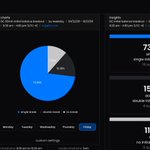
how often does $GC break both sides of the IB on a Friday? here's the data:
over the last 6 months:
→ only one side of the IB broke: 73.08%
→ both sides broke: 15.38%
19 of the last 26 Fridays on $GC broke only one side of the 60min IB.
takeaway:
IB high breaks first = favor continuation higher
IB low breaks first = favor continuation lower

edgeful retweeted
if $GC breaks the overnight high or low on a Thursday, you need to know this stat:
over the last 6 months in the NY session, the overnight range breakout by weekday report shows this for Thursdays:
→ only one side of the overnight range broke: 84.62% of the time
→ both the overnight high and low broke: 0% of the time
takeaway:
overnight high breaks first on a Thursday = look for continuation longs, not a reversal to the overnight low
overnight low breaks first on a Thursday = look for continuation shorts, not a reversal to the overnight high
not one of the last 26 Thursdays had $GC break both sides of the overnight range.

edgeful retweeted
78% BEARISH DAY on NQ when THIS happens | opening candle continuation
@JamesBruce131
taking longs on NQ using @edgeful: entries, exits and full trade breakdowns
@JamesBruce131