
EECS @ UC Berkeley | Robotics + ML @ BAIR
Joined July 2026
- Tweets7
- Following89
- Followers125
- Likes21


It’s been great leading this work with Brian Zhu, Momen Khalil and Emanuele Poggi from Siemens Research and Predevelopment in the US and Germany, along with those at UC Berkeley, ETHZ, and Microsoft to make this project happen.
Full paper: arxiv.org/abs/2608.23831
(6/n)

Thanks also to all the collaborators: Philipp Schmitt, Bernd Kast, Philine Meister, @pranav_atreya, @qiyang_li, Finn Ferchau, Cesar Colmenero, Yash Shahapurkar, Gokul Narayanan, Melih Erdogan, Kai Wurm, @GeorgWichert, @oier_mees, Eugen Solowjow, @ajwagenmaker, @svlevine
(n/n
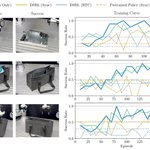
We evaluate ARLI across simulated and real-world manipulation tasks and find that it enables effective RL fine-tuning in settings where standard RL can fail entirely—while even matching or exceeding standard RL in idealized no-latency settings.
(4/n)

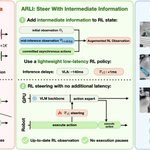
Asynchronous VLA inference reduces inference delay, but breaks the Markovian assumption necessary for RL fine-tuning.
How can we enable RL fine-tuning of VLAs with async inference? We introduce ARLI: Asynchronous RL with Intermediate Information!
async-rl-intermediate-inform…
(1/n)


