

Economic historian @LSEEcHist studying health, demography, living standards and economic growth; working on global historical child stunting; Colorado hiker.
London, England
Joined October 2014
- Tweets1.5K
- Following702
- Followers1.8K
- Likes2.5K







Pinned Tweet
1/
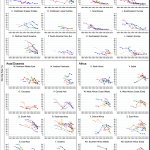
Why do many WASH interventions have limited effects on child stunting?
Our historical data suggest something surprising:
Sanitation infrastructure alone often wasn’t enough, even in the past.
New BMJ Global Health paper 👇
doi.org/10.1136/bmjgh-2024-0…

1/ Workshop CFP
Resilient Societies: Shocks, Adaptation and the Persistence of Inequality in Historical Perspective.
How have societies responded to historical shocks, and why have some individuals or societies proved more resilient than others?
LSE, 20–21 May 2027

ALT LSE Historical Economic Demography Group Logo
8/ Full details and submission link here:
lse.ac.uk/economic-history/h…

Eric B Schneider retweeted

Join us for this year's Epstein Lecture, where we host some of the most exciting economic history research! This year's edition features @gobbi_paula, who discusses how inheritance patterns change economies and societies 💰👨👩👧👦
#lseevents #echist
lse.ac.uk/events/development…

Our global stunting data up on our world in data! We hope it helps people contextualise child stunting in a much longer historical lens.
Thanks to Hannah and Tuna for visualising and explaining the data so well!
The link to the original paper is here:
doi.org/10.1136/bmjgh-2024-0…

✍️ New article: “Childhood stunting fell dramatically over the 20th century”
One in four children in the world today suffers from “stunting”. That’s 150 *million* children under five.
A stunted child is too short for their age due to poor nutrition and frequent infections. Stunting suggests that their physical and cognitive development have been hindered, and the effects can last a lifetime.
In many countries, stunting was once prevalent but has now been nearly eliminated. Japan is one such success story that has particularly high-quality data.
But there are still many countries, especially in Asia and Africa, where stunting affects more than a third of all children. You can see this in the chart.
How have some countries made so much progress against stunting? And what can other countries where rates are still high learn from this?
In a new article, @_HannahRitchie and Tuna Acisu answer these questions by zooming in on Japan. Their analysis is made possible by a crucial new dataset published by Eric Schneider and colleagues.
Before World War II, Japan focused on tackling infectious disease, particularly through the expansion of clean, piped water. Stunting declined at a moderate pace.
After the war, they tackled both disease *and* diet, with diversified foods, school lunch programs, and more. This multifaceted approach made progress nearly three times faster.

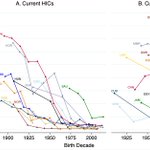
ALT Line chart of childhood stunting rates in Japan by birth cohort from 1892 to 2011 where the rate falls from about 70% in the early 1900s to below 5% by the 2000s, illustrating Japan’s dramatic decline over the 20th century. Dashed horizontal lines show 2015 reference rates for other countries spanning 10 to 60% (examples: 60% in Burundi and East Timor; 50% in Guatemala and Niger; 10% in Thailand and Costa Rica), and a data gap is noted for the World War II cohort. Data source: Eric Schneider et al. (2026) via OurWorldInData.org.
Eric B Schneider retweeted

This weekend the @EcHistSoc Economic History Society begins its centenary celebrations. Founded in 1926 at the @LSEEcHist the Society has spent 100 years supporting and disseminating research in economic and social history.
Eric B Schneider retweeted
🗺️ @msaleh1982 and @RoyHistory1 are featured in this month's LSE Research for the World, about a project they undertook with Leigh Gardner to develop tools for teaching about colonialism in UK schools 🏫
Read the article here 👇
lse.ac.uk/research/research-…

Eric B Schneider retweeted

✍ New post on Global Health at LSE!
'Child stunting was once common in rich countries. Lessons from global history on its decline.'
@ericbschneider on his team's recent systematic review in @GlobalHealthBMJ: bit.ly/4uE2KFH
#childhealth #childnutrition #globalhealth

Btw the data from the paper is available here: dx.doi.org/10.5281/zenodo.18…
The paper is open access online.
Thanks to all my coauthors for their contributions! @evanrobertsnz @kris_inwood among many others.

1/
Why do many WASH interventions have limited effects on child stunting?
Our historical data suggest something surprising:
Sanitation infrastructure alone often wasn’t enough, even in the past.
New BMJ Global Health paper 👇
doi.org/10.1136/bmjgh-2024-0…
12/
Child stunting is not as salient as mortality as a health indicator because it is difficult for individuals to understand.
Stunted children look normal relative to their peers in LMICs.
They are only short compared to healthy children, which people cannot observe.