

Official Twitter feed of the Emilia-Romagna Region Tourism Board, Italy
Joined May 2009
- Tweets35.4K
- Following2K
- Followers18K
- Likes16.2K


The @DavisCup is returning to Bologna from 24 to 29 November 2026: find out how to experience the thrill of the Final 8, both on and off the court 😍
👉 visiter.it/daviscup26
#SportValleyEmiliaRomagna #inEmiliaRomagna @BolognaWelcome

1
99
Autumn in Emilia-Romagna is an experience for all the senses, with art, music, and delightful aromas and flavours 🍂 Here are our Top5 events not to be missed this week
👉 visiter.it/events | #inEmiliaRomagna

Discover #Bologna without spending a euro ❤️
From UNESCO-listed porticoes and historic squares to beautiful parks and free museums, there's plenty to explore on a budget 🏛️🌿
👉visiter.it/zzew | #inEmiliaRomagna

Golden hour in San Pellegrino in Alpe 🌅
As the sun sets over the Apennines, the mountains turn into silhouettes and the meadows glow in warm golden light.
A moment of pure peace, surrounded by nature 🍂⛰️
Ph. damiano_quellostrano_official | #inEmiliaRomagna

Following the footsteps of the Italian Resistance 🌿
Through mountain villages and places of remembrance, this itinerary along the Gothic Line reveals stories of courage and the struggle for freedom during World War II 🏔️🕊️
👉visiter.it/2mwg | #inEmiliaRomagna

1
83
A journey through centuries of art and history 🏛️
In the heart of the Po Delta, #Pomposa Abbey welcomes visitors with its impressive Romanesque bell tower, ancient frescoes and beautiful mosaic floors
Ph. eleonora_a_spasso_nei_castelli | #inEmiliaRomagna


Discover Parma's Food Museums, where every flavour tells a story 🧀
From Parmigiano Reggiano to Prosciutto di Parma, explore the traditions, craftsmanship and iconic products that make this corner of Emilia-Romagna the Food Valley 🍝
👉visiter.it/w584 | #inEmiliaRomagna

Explore the historic centre of #Cento on foot and get to know Guercino’s hometown and its rich artistic and cultural heritage: ferrarainfo.com/en/immerse-y… | #inEmiliaRomagna #IlikeItaly – at Cento, Emilia Romagna

#Comacchio (Emilia-Romagna, Italy) through the looking glass: visitcomacchio.it/en/
📸: ricky.finetti | #inEmiliaRomagna #VisitRomagna #IlikeItaly – at Comacchio, Emilia Romagna

inEmiliaRomagna retweeted

Hey, we've got a date. 🩷🇮🇹 21 stages. A whole country to cross. And 110 editions of Giro d’Italia history behind us. The route is set. See you in 2027! 🔥
Hey, abbiamo un appuntamento. 🩷🇮🇹 21 tappe. Un Paese intero da attraversare. E 110 edizioni di storia del Giro d’Italia alle spalle. Il percorso è tracciato. Ci vediamo nel 2027! 🔥
#GirodItalia #TheRoute
inEmiliaRomagna retweeted

From a Roman sanctuary to a medieval Christian complex — nearly 2,000 years of architectural transformation.
In Bologna, Italy, the Basilica of Santo Stefano tells an extraordinary story of how architecture evolves over time.
The site is traditionally associated with a Roman temple dedicated to Isis, possibly dating to the 1st century AD. However, archaeologists still debate the precise relationship between the ancient sanctuary and the later church complex.
During the 5th century, Bishop Petronius played an important role in its Christian development. The complex was designed around the idea of recreating important holy places in Jerusalem, particularly the Church of the Holy Sepulchre.
Over the following centuries, Lombard influences, Benedictine monastic expansion and Romanesque rebuilding gradually transformed the site. Cloisters, chapels, churches and courtyards became interconnected parts of a remarkable architectural ensemble.
Here is something particularly interesting: the complex is popularly called Sette Chiese (Seven Churches), although it now comprises four churches, two courtyards and a museum.
Its present appearance was also shaped by major restorations in the late 19th and early 20th centuries.

inEmiliaRomagna retweeted

A historical architectural model of medieval Bologna, Italy, often called "Manhattan of the Middle Ages"....
Italy's little city that was medieval answer to NYC before its giant towers collapsed - as it nicknamed "Manhattan of the Middle Ages", an Italian city may have had 200 towers over 900 years ago, but today only a few remain standing.
Between 12th-13th Centuries AD, just over 900 years ago, Bologna in northern Italy was a city full of towers, earning it the nickname of the “Manhattan of the Middle Ages”. Almost all were tall, defensive stone towers, highest being 97m. The reasons for the construction of so many towers are not clear. One hypothesis is that the richest families used them for offensive or defensive purposes during the period of the Investiture Controversy - a conflict between church and state over the ability to choose and install clergy of monasteries and the pope himself.
In 13th Century AD, many of the towers were taken down or demolished and others simply collapsed. Two most prominent ones remaining, known as the Two Towers (Asinelli Tower, 97m, and Garisenda Tower, 48m) are a landmark of the city.
Building a typical tower with a height of 60m in the Middle Ages was no easy task: it would have required between three and 10 years of work. Each tower had a square cross-section with foundations between five and ten metres deep, reinforced by poles hammered into the ground and covered with pebbles and lime. Tower's base was made of big blocks of selenite stone. The remaining walls became successively thinner and lighter the higher the structure was raised, and were realised in so-called "a sacco" masonry: with a thick inner wall and a thinner outer wall, with the gap being filled with stones and mortar. Besides the towers, there are still some fortified gateways (torresotti) that correspond to the gates of the 12th Century city wall, which itself has almost been completely destroyed.
Many towers have subsequently been utilised in one way or another: as prison, city tower, shop or residential building. Nevertheless, towers remained a famous sight of Bologna throughout the centuries. Even Dante, the renowned Italian poet, writer and philosopher, mentioned some of the towers in his narrative poem Inferno, the first part of The Divine Comedy. The last demolitions took place during 20th Century, according to an ambitious, but retrospectively unfortunate, restructuring plan for the city. The Artenisi Tower and the Riccadonna Tower at the Mercato di mezzo were demolished in 1917. Among the towers still standing are Azzoguidi Tower, also called Altabella (with a height of 61m), Prendiparte Tower, called Coronata (60m) and Scappi Tower (39m).
The first historian to study towers of Bologna in a systematic way was Count Giovanni Gozzadini, a senator of the Italian kingdom in 19th Century, who looked at the city's history intensively. His research suggested that there were as many as 180 towers, an enormous amount considering the size of resources of medieval Bologna. However, more recent estimates reduced the number to between 80-100, and not all towers existed at the same time. Nevertheless, this is still an impressive figure for the time. For context, New York City is now home to over 7,000 high-rise buildings that are at least 35m tall. The city’s first skyscraper was the Tower Building, which was built in 1889. Empire State Building was completed in 1931.
Today, Bologna’s metropolitan area is home to more than one million people. It is the capital and largest city of the Emilia-Romagna region, centre for automobile production including Ferrari and Maserati. It is also famous for being the home to the oldest university in continuous operation, University of Bologna, established in 1088 AD. In 2021, UNESCO recognised the lengthy porticoes - a porch leading to the entrance of a building - of the city as a World Heritage Site. They represent a symbol of the city together with the towers.
#archaeohistories


inEmiliaRomagna retweeted

Consecrated in 547 CE under Emperor Justinian, the Basilica of San Vitale in Ravenna is a Byzantine jewel.
Its octagonal plan, soaring dome, and ring of arched galleries create an interior that feels weightless. The dome uses lightweight hollow clay tubes instead of heavy stone, a clever Roman-era trick. Then come the glittering mosaics: Justinian and Empress Theodora appear in processions, glowing in gold tesserae.
Built when Ravenna was the Western Empire’s capital, it fuses Roman engineering with Eastern splendor.

inEmiliaRomagna retweeted

The starry sky of Ravenna: a journey inside the Mausoleum of Galla Placidia.
Just a few steps from the majestic Basilica of San Vitale in Ravenna stands a building—small in size, yet possessing extraordinary visual power: the Mausoleum of Galla Placidia.
Constructed around the middle of the 5th century, this monument encapsulates the crucial transition from Late Roman to Byzantine art, housing one of the world’s most significant artistic treasures.
Crossing the threshold of the mausoleum is a sensory journey. While the exterior, with its exposed brickwork, appears sober and austere, the interior welcomes visitors into a warm, golden twilight, illuminated by soft light filtering through unique alabaster windows.
The gaze is immediately drawn to the vaulted dome, dominated by an intense, deep blue against which hundreds of eight-pointed golden stars shimmer.
At the center stands a large golden cross—also surrounded by stars—while the symbols of the four Evangelists appear in the pendentives.
The walls and lunettes tell stories of faith and immortality through iconic imagery.
Notable examples include stags drinking from a spring—a symbol of souls thirsting for God—and the figure of Saint Lawrence, shown moving toward the gridiron of his martyrdom.

Bright green like rich lasagna pasta, hefty as tortelloni, and packing a killer filling of mortadella, ricotta, and Parmigiano Reggiano: visiter.it/yd0l | #inEmiliaRomagna #FoodValley – at Bologna, Emilia Romagna

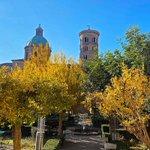
Who said that autumn colours can only be admired in the woods? As you stroll through the streets of Ravenna, you'll come across golden foliage and colourful gardens that invite you to experience the city in autumn: visiter.it/ra6a
Ph. Comune di Ravenna | #InEmiliaRomagna

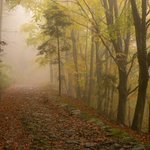
A guide to the must-see spots in the Bolognese Apennines, recommended by those who experience them every day. Perfect for mountain lovers and anyone looking for ideas for a high-altitude hike 🍁visiter.it/djfn
Ph. Giovanni Zati | #EmiliaRomagnaSlow #VisitEmiliaRomagna

4
188
November's here, and it brings with it lots of events dedicated to good food. But that's not all!
Click here for the full list: visiter.it/events
#InEmiliaRomagna #VisitEmiliaRomagna
