
Associate Professor in health and social care statistics at Kingston University. PhD in econometrics.
London, England
Joined May 2014
- Tweets8.6K
- Following409
- Followers1.5K
- Likes29.2K






Pinned Tweet
If you think LLM is the way to achieve general intelligence (AGI?), think again. Using chess/Go as an example, LLMs are still far behind top human players, let alone top chess/Go AIs such as AlphaGo (which is not an LLM). xitter.cf/i/grok/share/e41421a71…
Chao Wang retweeted

Spread looks much worse without a log scale
It visually undersells the headline finding


The Economist's estimate of Britain's age- and sex-standardised conviction rates for sexual offences by the offender's nationality
economist.com/britain/2026/1…


Chao Wang retweeted

It's the same pretty much everywhere with rent controls. A story from Berlin:


True in Spain too. Every landlord in Madrid and Barcelona screens the renters now. This is an obvious consequence of rent control. The most vulnerable, ostensible protected by the legislation, are in fact excluded from the rental market: if you cannot be evicted for non payment, then you are too risky a renter.


Chao Wang retweeted

PSA
It is VERY ILLEGAL to alter this mans picture in the UK
Whatever you do, please DO NOT alter or satirize this picture in any way.
The UK police would REALLY not like that.

Chao Wang retweeted

Be a small town politician.
A child puts bunny ears on your photo and comments on how you dress.
So mad you report it to the police.
Cops show up at the child's house.
Causes international outrage.
Now the bunny pic is in the New York Post.
And your Google results are just rabbit ears forever.


Chao Wang retweeted

Arguably my favourite of this


Just Eat apologises for AI food mistakes after social media ridicule bbc.in/4jAIj9J

Chao Wang retweeted

This is what rent control does. When it’s illegal to ration by price, you start rationing by any other means you can.

Chao Wang retweeted

I thought it was suspicious that Ofcom's report didn't include any charts or numbers, so I've dug into Ofcom's underlying data, and it's even worse than it first appears.
Exposure to porn went from 11.0% to 12.9% among 11–17s, suicide or self-harm from 12.5% to 13.7%, and any “primary priority” content from 29.6% to 32.2%.
None of these changes is statistically significant, but they all point the wrong way.


Study design does not dictate the level of evidence, as often depicted in "evidence pyramid". Context is important. See the example below (youtu.be/3pxudE0GNAo?si=MZpY…). Many people thought Study 2, a cross-sectional study, is the weakest. However Study 2 is arguably the strongest.


"We show that AI-generated article reviews are now better, by every measure we could construct, than reviews written by well-compensated human experts and judged to be of unusually high quality by journal editors and authors." gking.harvard.edu/peerless/

“It is now more difficult to run a five-year-old Python script than a 40-year-old Fortran program, and even if it runs, it may not produce the same results as it did in the past.” 🤔
blog.khinsen.net/posts/2026/…

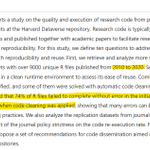
The situation is pretty damning for R too. There’s roughly a 50% chance that code you write in R today won’t run successfully in ten years. This is even before considering whether it would produce the same results! nature.com/articles/s41597-0…

Chao Wang retweeted

Trump: "I alone could secure a prisoner release from Russia without giving anything in return"
Trump literally ten minutes later: "Now you idiots know why I had to waive sanctions on Russia, no shot I got that prisoner release otherwise"


Chao Wang retweeted

We have nationwide rent controls now.
This tribunal didn’t just stop a rent rise within a tenancy, it cut the rent to below what had been agreed between the landlord and the tenant at the start of the tenancy based on a judgement of what the property is worth.


Chao Wang retweeted

10 years ago today, the third and final Clinton v Trump debate, with the famous “puppet” exchange about Putin:


Chao Wang retweeted

FOOL BRITANNIA by @EdConwaySky
While many countries face higher energy costs due to the events in the Middle East and Russia, few have seen quite as big a spike as Britain has. Industrial power costs are comfortably higher than in most developed nations, with domestic costs not far behind. To some extent, this is a function of bad luck and geopolitics. Britain is particularly dependent on natural gas to provide the critical baseload power for its electricity, not to mention much of its domestic heating.
But higher energy costs are also the product of policy. Britain pushed faster and further towards net zero (the goal of diminishing carbon emissions to close to nothing in net terms) than most of its peers. The ambition, held by Labour and Conservative governments, was that the UK should be the global leader in decarbonisation – the flag-bearer for net zero. In one respect, the enterprise was a stunning success – Britain is one of the fastest-decarbonising major economies in the world.
The main catch in – and the cardinal sin of – the make-things-cheap economy is how it affects energy bills. For all that Boris Johnson and Ed Miliband insisted (and as far as I can tell, sincerely believed) that renewables would mean lower costs, the opposite has happened. Unlike solar power, the cost of which fell precipitously as the Chinese mastered the mass production of arrays, wind power has remained comparatively expensive. And so Britain’s ambitious offshore wind programme happened largely thanks to a complex web of subsidies and price guarantees. Those interventions will lock in higher power costs in this country for years.
There is a point – most likely a decade and a half in the future – at which the savings from net zero (less spent on gas and fuels) should outweigh the costs of building all the necessary infrastructure. But for the time being, the policy is expensive – nearly £30bn a year for the next five years, which is the equivalent of an extra 5p on the basic rate of income tax. One of the main reasons net zero is becoming so controversial (and will likely get more controversial) is that the majority of those costs end up on consumer bills.
The other problem is that much of this decarbonisation was achieved through deindustrialisation. In the face of higher energy costs and rising environmental taxes, many manufacturers relocated overseas. Indeed, more than half of Britain’s carbon footprint is now accounted for by imported goods. Paradoxically, the more steel mills and chemicals plants shut down, the better the UK’s environmental credentials, since net zero plans ignore the embedded carbon in our imports and focus solely on what is puffed out of domestic flues and chimneys.
Cover art by Doug Chayka

So AI cannot do these?

Anthropic is offering a 145k salary for a personal assistant in London.
Responsibilities include:
"Scheduling and managing calendars for leader(s) and their organization"
"Building and maintaining organizational systems for tracking and managing inbound requests"
"Managing the leader's inbox and communications with precise attention to detail"
"Handling travel logistics"
Somebody should really build some sort of tech tool that can handle this stuff autonomously.
